
 Русский

Rotary Tables & Indexers: The Complete Selection Guide
Rotary tables and indexers are foundational components in precision motion-control systems — enabling controlled, repeatable angular positioning across industries like semiconductor assembly, packaging, medical device manufacturing, CNC machining, and automated test equipment. Yet despite their widespread use, selecting the optimal solution remains a nuanced engineering decision. This guide cuts through the noise to clarify core functionality, key performance differentiators, and how to align your application requirements with the right technology — including Rotary Platforms / Rotary Tables from HDB Motor.
What Do Rotary Tables and Indexers Actually Do?
At their core, both devices rotate a load to precise angular positions — but they differ fundamentally in motion profile, control architecture, and mechanical design:
- Rotary Tables provide continuous or indexed rotation with programmable positioning, often integrated with servo or stepper motors and high-resolution feedback (e.g., encoders). They support complex motion trajectories, variable speeds, and dynamic load handling — ideal for multi-axis gantries, robotic wrists, or inspection stations requiring fine angular resolution.
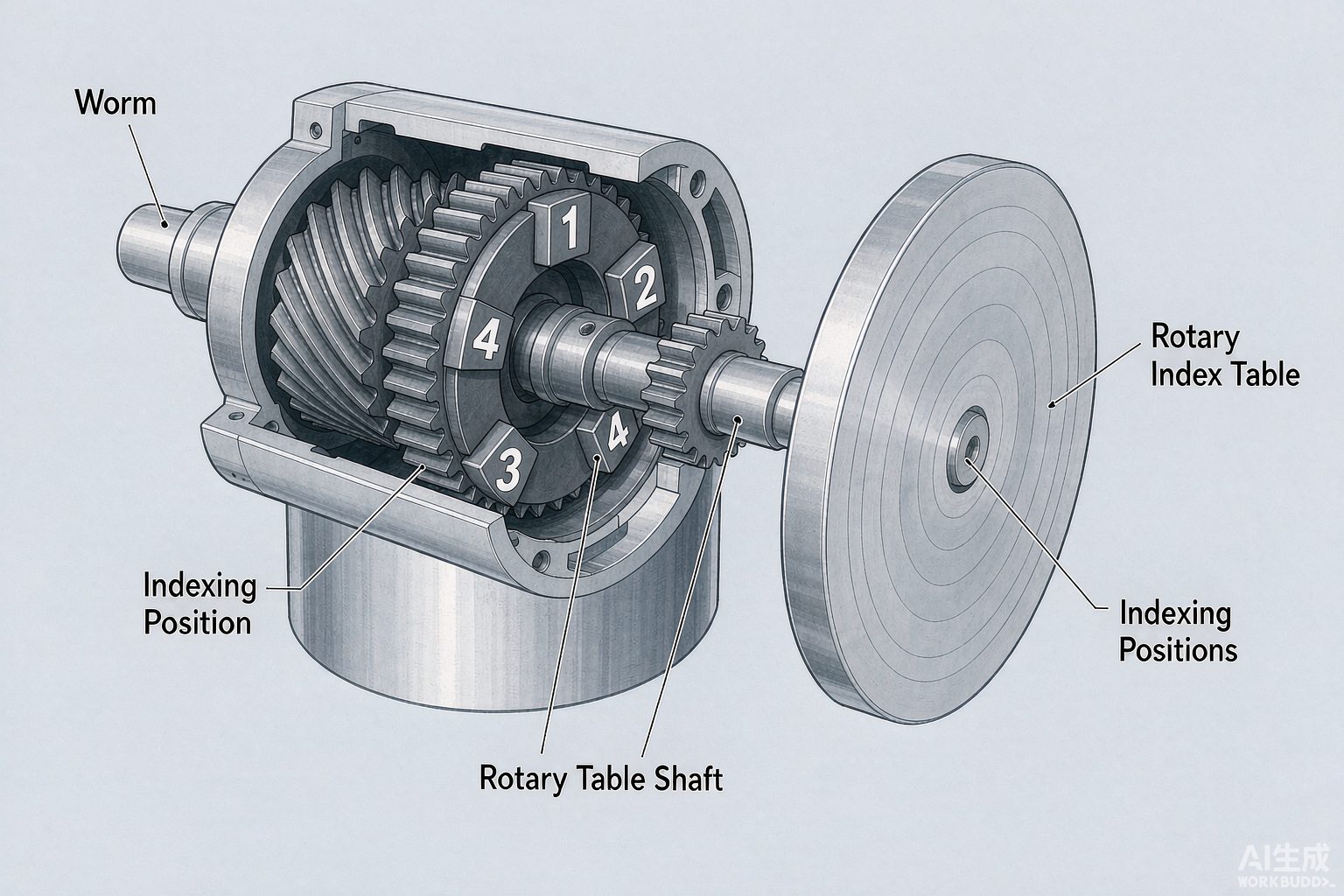
- Indexers (especially cam indexers) deliver discrete, highly repeatable indexing motions — typically at fixed intervals (e.g., 4, 6, 8, or 12 stops per revolution). Their motion is mechanically governed by a cam-follower system, offering exceptional rigidity and zero backlash during dwell — making them preferred for high-cycle, high-stability applications like rotary transfer machines or bottle capping lines.
While the terms are sometimes used interchangeably, confusing them can lead to suboptimal system performance, premature wear, or costly redesigns. Understanding this distinction is your first step toward an informed selection.
Hollow Rotary Table vs Cam Indexer: Matching Design to Function
The choice between a hollow rotary table and a cam indexer hinges on your application’s need for flexibility versus rigidity:
- Hollow Rotary Tables feature a central through-hole — allowing cables, pneumatic lines, or shafts to pass through the center of rotation. This eliminates cable twisting, simplifies integration with end-effectors or tooling, and supports modular automation architectures. They’re commonly driven by servo or stepper motors and offer full programmability, acceleration control, and bi-directional motion.
- Cam Indexers rely on precision-machined cam profiles and roller followers to convert continuous input rotation into intermittent output motion. They require no electronic feedback or motion controller — just a consistent input speed — and deliver near-zero positional drift over millions of cycles. However, they lack programmability: changing the number or timing of indexes usually requires physical cam replacement.
For applications demanding reconfigurability, variable cycle times, or tight synchronization with other axes, a hollow rotary table is often superior. For ultra-high-reliability, high-dwell-force, fixed-sequence operations, cam indexers remain unmatched. To explore this trade-off in depth, see our dedicated comparison: Hollow Rotary Table vs Cam Indexer: Which for Your Production Line?
Accuracy vs Repeatability: Why the Difference Matters
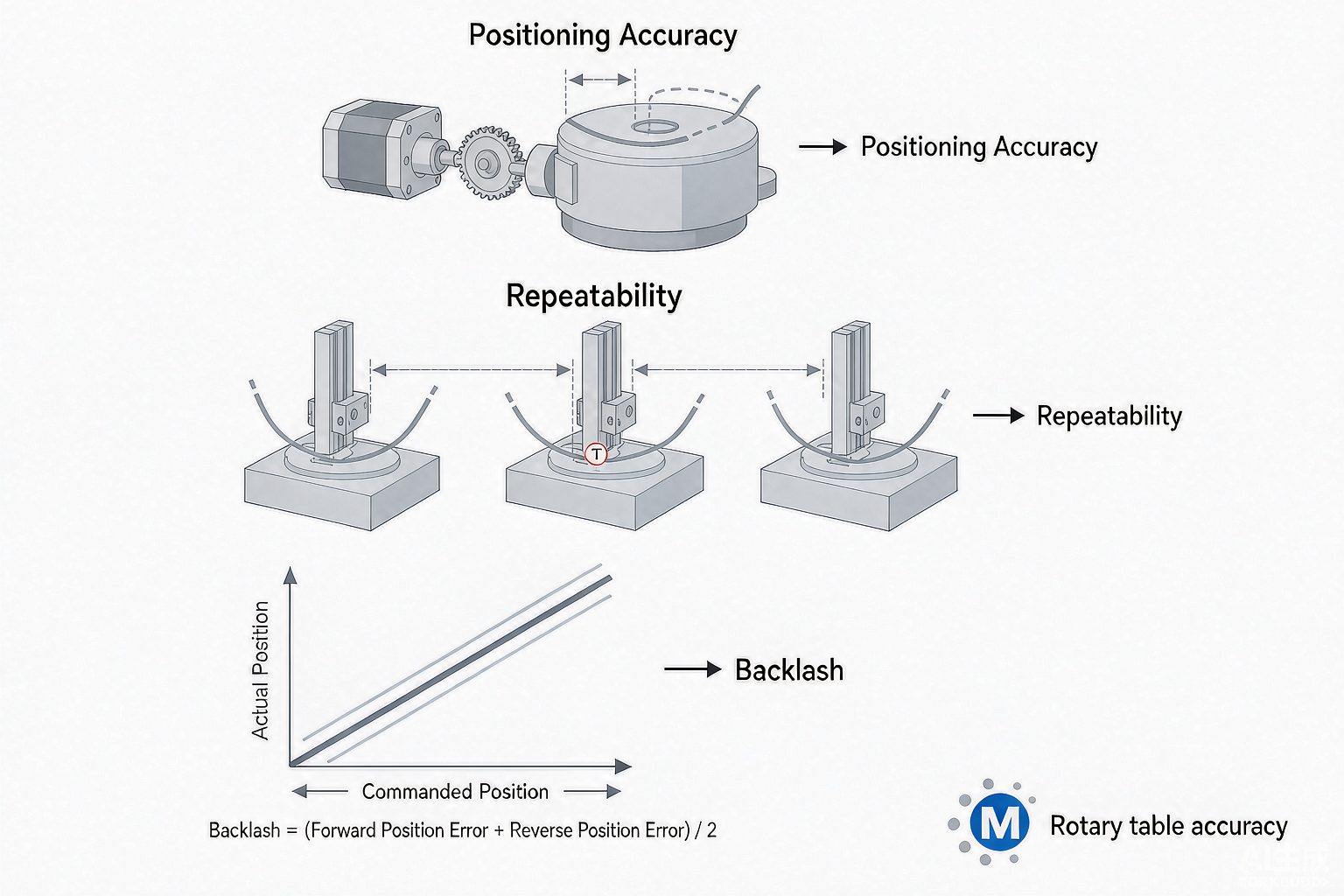
In rotary motion systems, accuracy and repeatability are distinct — and frequently misunderstood — metrics:
- Accuracy refers to how closely the actual position matches the commanded position — influenced by gear backlash, encoder resolution, thermal drift, and mechanical alignment.
- Repeatability measures how consistently the device returns to the same position under identical conditions — reflecting mechanical consistency, bearing quality, and drive stability.
A system can be highly repeatable (±1 arc-second) but inaccurate (±15 arc-seconds off nominal), or vice versa. In most industrial automation, repeatability is more critical than absolute accuracy — especially when downstream vision systems or tool calibration compensate for minor offsets. That said, high-precision tasks (e.g., wafer alignment or laser micromachining) demand both.
HDB Motor’s rotary platforms achieve sub-arc-minute repeatability through preloaded crossed-roller bearings, low-backlash planetary or harmonic drives, and optimized motor-mounting stiffness. Learn how these factors interact in our technical deep dive: Accuracy vs Repeatability in Rotary Indexing Tables.
Servo vs Stepper Driven Rotary Tables: A Practical Comparison
Your choice of drive technology shapes torque delivery, control complexity, cost, and suitability for dynamic loads:
- Servo-Driven Tables use closed-loop feedback (typically incremental or absolute encoders) to continuously monitor position and correct errors in real time. They excel in high-inertia, high-acceleration, or variable-load scenarios — delivering consistent torque across speed ranges and resisting stalling.
- Stepper-Driven Tables operate open-loop (though many modern versions include optional stall detection or encoder verification). They offer excellent low-speed torque, inherent holding torque at rest, and simpler control architecture — making them ideal for cost-sensitive, medium-precision applications with predictable loads.
Both approaches are well-supported across HDB Motor’s lineup — from compact NEMA 23–34 stepper-integrated rotary platforms to high-torque servo-compatible tables with IP65-rated housings and dual encoder options. For side-by-side evaluation of torque curves, tuning effort, and failure modes, refer to our applied analysis: Servo vs Stepper Driven Rotary Tables: A Practical Comparison.
HDB Motor’s Rotary Platform Offerings
HDB Motor designs and manufactures rotary platforms engineered for integration, reliability, and long-term performance — not just spec-sheet metrics. Our Rotary Platforms / Rotary Tables span multiple form factors and performance tiers:
- Compact Hollow Rotary Tables — NEMA 23 to NEMA 42 frame sizes, integrated stepper or servo motors, standard hollow bores (20–60 mm), and optional brake or absolute encoder packages.
- High-Torque Precision Tables — Featuring harmonic drive or planetary gear reduction, rated for radial and axial loads up to 500 N, and compatible with third-party servo amplifiers and motion controllers.
- Modular Rotary Stages — Designed for stackable multi-axis configurations (e.g., XYθ or XYZθ), with standardized mounting interfaces and low-profile footprints.
All platforms undergo rigorous factory testing for torque ripple, positional stability, and thermal drift — ensuring specifications reflect real-world behavior. Explore the full range alongside our stepper motors, drivers, gearboxes, and brushless DC solutions in all HDB motor products.
Selecting the Right Solution: A Decision Checklist
Before finalizing your rotary motion component, ask these questions:
- What is the required angular resolution and maximum allowable positioning error? (This informs encoder choice and gear ratio.)
- Does the application demand continuous rotation, intermittent indexing, or both?
- What are the peak and average radial/axial loads — and do they shift dynamically during operation?
- Is cable management or through-bore utility required? (If yes, prioritize hollow designs.)
- How critical is motion reprogrammability versus mechanical simplicity and uptime?
- What environmental conditions apply? (e.g., washdown, dust, temperature extremes — guiding IP rating and lubrication choices)
If your answers point toward programmability, modularity, and integration ease, HDB’s rotary platforms offer a robust starting point. If you’re evaluating broader motion-control ecosystems — including matched stepper drivers, gear reducers, or custom-engineered solutions — consult our Rotary Tables & Indexers guide for cross-product recommendations and system-level best practices.
Frequently Asked Questions
Can a rotary table replace a cam indexer?
Yes — but only if your process doesn’t rely on the cam indexer’s inherent mechanical dwell rigidity or extreme cycle-life durability. Servo-driven rotary tables can emulate indexing motion, yet may require additional tuning and safety logic to match the passive, zero-backlash dwell of a cam system.
Do HDB rotary tables support third-party controllers?
Absolutely. Our servo-compatible platforms accept industry-standard analog ±10 V or pulse-and-direction inputs. Stepper-integrated models work seamlessly with common step/direction controllers — and many support RS-485 or CANopen for networked operation.
How do I get application-specific sizing support?
HDB Motor’s application engineers provide free load calculations, inertia matching, and motion profiling — directly supporting your mechanical and controls team. contact HDB Motor with your torque, speed, and load data for a tailored recommendation.
Conclusion
Selecting the right rotary table or indexer isn’t about chasing the highest resolution or largest torque rating — it’s about matching mechanical architecture, drive technology, and precision characteristics to your application’s functional, environmental, and lifecycle requirements. Whether you need the programmable agility of a hollow rotary table or the unwavering stability of a cam indexer, understanding the trade-offs empowers smarter decisions. HDB Motor’s portfolio — built on decades of motion-control expertise — delivers precision-engineered platforms that balance performance, integration readiness, and long-term reliability. Start with the fundamentals, validate assumptions with real-world data, and partner early with motion specialists to avoid costly iteration down the line.