
 Русский

Servo vs Stepper Driven Rotary Tables: A Practical Comparison
Choosing between servo- and stepper-driven rotary tables is one of the most consequential decisions in motion-control system design. Whether you're building a high-speed packaging line, a precision laser cutting station, or a compact assembly cell, the actuator behind your rotary platform shapes performance, reliability, and total cost of ownership. At HDB Motor, we engineer both stepper- and servo-compatible Rotary Platforms / Rotary Tables — and we know the choice isn’t about ‘which is better,’ but ‘which fits your application’s real-world constraints.’ This article cuts through marketing hype to compare servo and stepper solutions head-to-head on four critical axes: speed, torque, cost, and feedback architecture.
1. Speed: Not Just Top RPM — It’s Acceleration & Settling Time
Maximum rotational speed matters—but so does how quickly a table reaches that speed, holds position under load, and settles with minimal overshoot or vibration.
- Servo-driven tables excel in dynamic response. With closed-loop current/torque control and high-bandwidth feedback (typically from resolvers or multi-turn encoders), they achieve rapid acceleration, precise velocity profiling, and sub-millisecond settling times—even at high speeds. They’re ideal for applications requiring variable speed ramps, synchronized multi-axis motion, or frequent direction reversals (e.g., robotic palletizing or CNC indexing).
- Stepper-driven tables, by contrast, rely on open-loop pulse-and-direction commands. While modern microstepping drivers dramatically improve smoothness, their top speed is limited by motor inductance and driver voltage. Above ~1,000–1,500 RPM (depending on motor size and gearbox ratio), torque drops sharply — and resonance zones can cause missed steps or audible vibration. That said, for fixed-indexing tasks (e.g., 4- or 6-station assembly), steppers often deliver more than enough speed — with predictable, jitter-free dwell stability.
Importantly, speed isn’t just about the motor — it’s co-determined by the gearbox/reducer, bearing preload, and mechanical inertia. Our HDB Rotary Platform Series: Compact Indexing for Tight Spaces offers both stepper- and servo-compatible models with integrated planetary gearboxes optimized for low backlash (<1 arcmin) and high torsional stiffness — helping either drive type perform closer to its theoretical limit.
2. Torque: Availability, Consistency, and Thermal Behavior
Torque defines what your rotary table can move—and how reliably it maintains position during operation.
- Servo systems provide continuous, controllable torque across their entire speed range — including zero speed (holding torque). Their torque output is linearly proportional to command current, and thermal management is built into the design (e.g., forced-air cooling, thermal sensors, adaptive current limiting). This makes them well-suited for high-inertia loads, variable payloads, or long-duration holding (e.g., inspection turntables under camera lighting).
- Stepper systems deliver peak torque only at low speeds. As speed increases, back-EMF rises and available current — and thus torque — falls. More critically, steppers hold position *only* when energized; de-energizing causes loss of position unless mechanical brakes are added. While our Stepper Drivers (companion) include advanced features like automatic current reduction at standstill (to minimize heat and power draw), they cannot recover from lost steps without external homing — a key limitation in unattended operation.
For applications demanding consistent torque at speed — especially with varying loads or extended duty cycles — servo-driven rotary tables offer inherent robustness. For deterministic, repeatable indexing with light-to-moderate loads and infrequent motion, stepper-driven solutions deliver excellent value and simplicity.
3. Cost: Upfront Investment vs. Lifetime Value
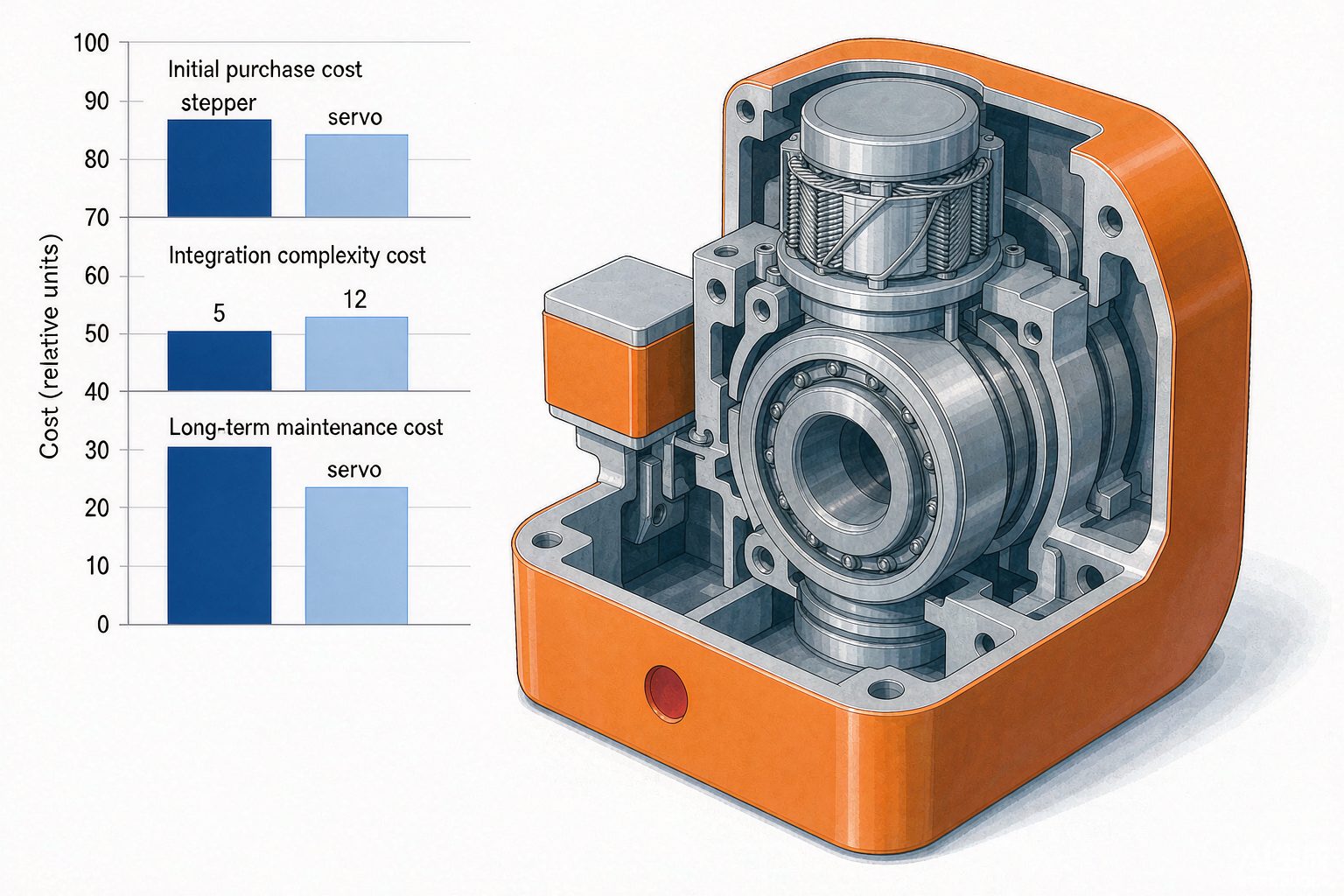
Cost comparisons must go beyond list price. Consider controller complexity, commissioning time, integration effort, and long-term maintenance.
- Servo systems carry higher upfront hardware costs: servo amplifier, encoder interface, tuning software, and often a dedicated motion controller. Commissioning requires parameter tuning (PID gains, feedforward, notch filters), which demands expertise and test time. However, this investment pays off in reduced downtime, longer component life (due to intelligent thermal/current management), and scalability across complex machines.
- Stepper systems are inherently simpler and lower-cost. A basic stepper driver + PLC pulse output is often sufficient. No tuning is required — just set microstep resolution and current limit. Our stepper-compatible Rotary Platforms / Rotary Tables integrate seamlessly with standard industrial controllers and support plug-and-play setup. For cost-sensitive OEMs building mid-volume automation cells, this simplicity translates directly into faster time-to-market and lower engineering overhead.
That said, don’t overlook hidden costs: servo systems may reduce need for external sensors (e.g., home switches or position verifiers), while stepper-based lines may require periodic re-homing or manual intervention after power loss. For a detailed breakdown of acquisition and operational cost trade-offs, see our related industry article.
4. Feedback: Open-Loop Simplicity vs. Closed-Loop Assurance
This is where philosophy meets physics — and where many design compromises originate.
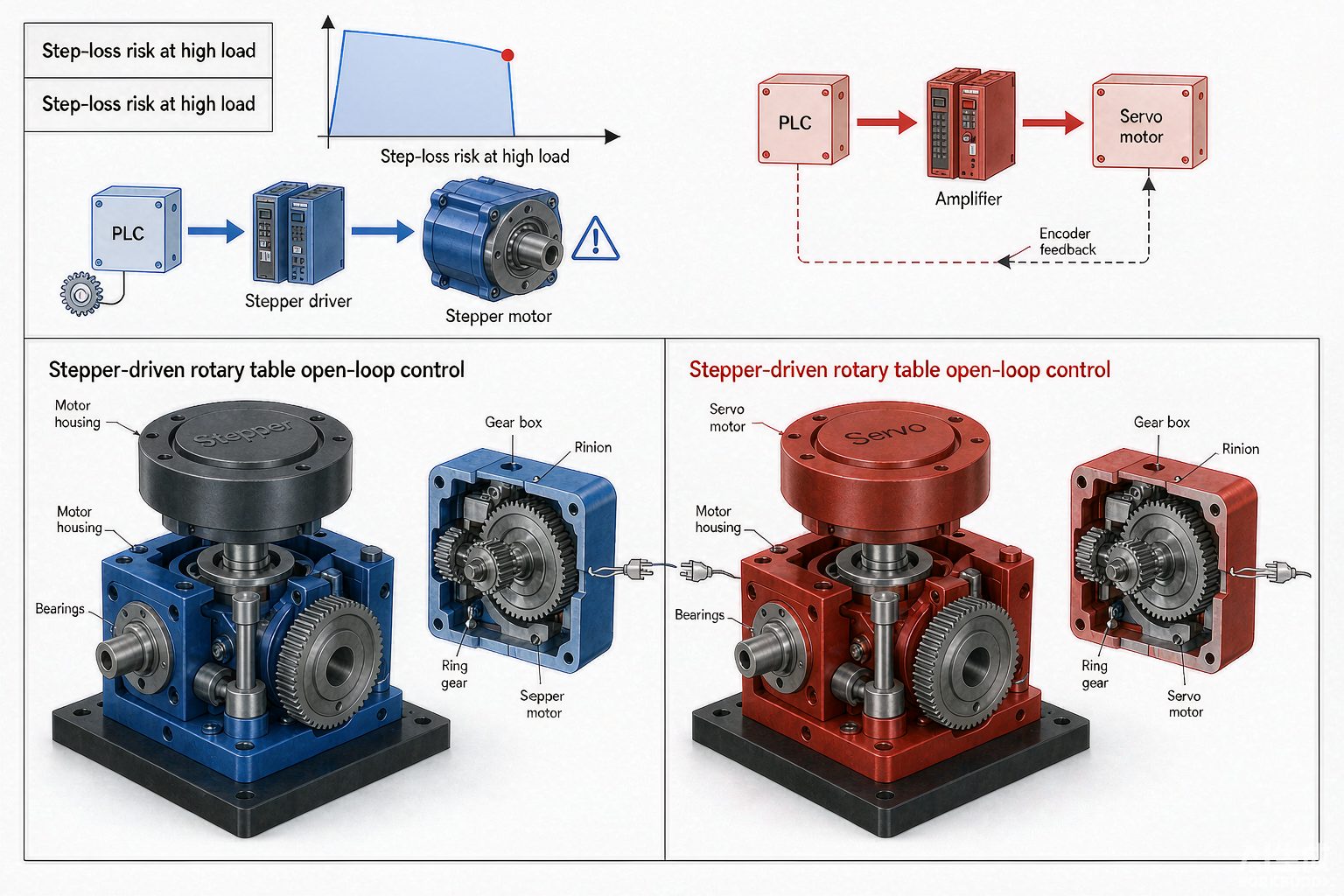
- Stepper-driven tables operate open-loop. They assume every commanded step is executed. That assumption holds well in clean, stable environments with conservative load margins — but fails silently if overload, resonance, or power fluctuation causes a missed step. Without feedback, there’s no way to detect or correct positional error in real time. That’s why applications requiring traceability (e.g., medical device assembly) or safety-critical positioning often mandate servo or hybrid solutions.
- Servo-driven tables are closed-loop by design. Position, velocity, and current are continuously monitored and corrected. If load spikes or mechanical wear introduces error, the system compensates within milliseconds. This enables guaranteed repeatability (±5 arcsec or better on high-end models) and supports advanced features like electronic gearing, camming, and torque limiting — all vital for synchronized production lines.
It’s worth noting that hybrid stepper-servo solutions exist — such as closed-loop steppers with integrated encoders. While these bridge some gaps, they still lack the full torque linearity, bandwidth, and diagnostic depth of true servo systems. For deep technical insight into how feedback affects long-term reliability, explore our Accuracy vs Repeatability in Rotary Indexing Tables guide.
When to Choose Which — A Decision Framework
Ask these three questions before specifying:
- Is position verification or error recovery required? → Choose servo.
- Does your cycle time demand high acceleration/deceleration or variable speed profiles? → Choose servo.
- Is your budget constrained, your motion pattern simple (e.g., fixed-angle indexing), and your environment stable? → Stepper is likely optimal — especially when paired with our rugged, pre-aligned HDB Rotary Platform Series.
Still unsure? Compare your use case against our comprehensive our Rotary Tables & Indexers guide, or explore how rotary tables stack up against alternatives like cam indexers in Hollow Rotary Table vs Cam Indexer: Which for Your Production Line?
Frequently Asked Questions
Can I upgrade a stepper-driven rotary table to servo later?
Yes — if the mechanical platform supports it. Many HDB rotary tables (e.g., hollow-shaft and flange-mount models) accept both stepper and servo motors via standardized mounting interfaces and compatible gearbox input shafts. However, you’ll need to replace the motor, driver, and controller — and verify inertia matching and feedback compatibility.
Do stepper-driven rotary tables require homing?
Yes — unless powered continuously. Since they’re open-loop, power loss or emergency stop resets position memory. Homing (via limit switch or encoder index pulse) is required at startup or after fault recovery to re-establish absolute reference.
Are there applications where stepper and servo tables perform identically?
In low-speed, low-acceleration, fixed-indexing applications with consistent, light loads — yes. For example, a 4-station pick-and-place table rotating 90° at 30 RPM with 0.5 kg·cm inertia may show identical positioning accuracy and cycle time on either platform. The difference emerges under stress — not steady state.
Conclusion
Servo and stepper-driven rotary tables aren’t competitors — they’re complementary tools. Servo excels where dynamics, diagnostics, and determinism are non-negotiable. Stepper shines where simplicity, predictability, and cost efficiency define success. At HDB Motor, we design both with the same commitment to precision, durability, and ease of integration — whether you're selecting from our full range of all HDB motor products or optimizing a single axis for a custom machine. Contact HDB Motor today for application-specific guidance and performance validation support.