
 Русский

Accuracy vs Repeatability in Rotary Indexing Tables: What Every Automation Engineer Needs to Know
When specifying a rotary indexing table for high-speed assembly, packaging, or precision machining, two terms appear repeatedly—and often interchangeably—in datasheets and sales conversations: accuracy and repeatability. Yet confusing them can lead to costly over-engineering, unexpected scrap rates, or missed cycle-time targets. In precision motion control, these are distinct, rigorously defined performance metrics—each serving a unique role in system behavior and application success.
What Is Accuracy in a Rotary Indexing Table?
Accuracy refers to how closely the table’s actual stopping position matches its commanded (theoretical) position—measured across a full 360° rotation. It answers the question: “Did the table land where it was told to land?”
Accuracy is typically specified in arc-seconds (″) or milliradians (mrad), and includes contributions from multiple error sources:
- Positional error due to encoder resolution and interpolation
- Mechanical backlash in gear trains or cam followers
- Bearing runout and shaft eccentricity
- Thermal drift and mounting surface flatness
- Control loop latency in closed-loop systems
For example, an indexing table with ±15 arc-second accuracy means that, at any given index point, the actual angular position falls within ±15″ of the ideal commanded angle—regardless of direction of approach or prior motion history.
What Is Repeatability in a Rotary Indexing Table?
Repeatability, by contrast, measures consistency—not absolute correctness. It defines how tightly the table lands on the same physical position when repeatedly commanded to the same index point, under identical conditions (same direction, speed, load, temperature).
Repeatability is almost always tighter than accuracy—and is usually the more critical spec for high-cycle-rate applications like pick-and-place or multi-station assembly. It reflects the stability of mechanical components and control fidelity, excluding systematic offsets (e.g., fixed gear backlash or encoder offset).
A typical high-performance rotary table may offer ±3 arc-second repeatability—even while its overall accuracy remains ±12 arc-seconds. That’s because repeatability excludes predictable, repeatable errors that can be compensated via calibration or electronic correction.
How Are They Measured and Specified?
Both metrics follow international standards—most commonly ISO 230-2 (Test Code for Positioning Accuracy of Numerical Control Machines). Here's how testing works:
- Accuracy test: The table indexes to 10–20 equally spaced positions across one full revolution. At each point, a high-resolution laser interferometer or autocollimator records the deviation from nominal. The maximum deviation (positive or negative) becomes the stated accuracy.
- Repeatability test: The table moves to a single index position (e.g., 90°) at least 30 times—always approaching from the same direction and under identical load/temperature conditions. Standard deviation (σ) or peak-to-peak spread (3σ × 2) is reported. Many manufacturers cite ±2σ or ±3σ repeatability; always verify which convention is used.
Crucially, accuracy and repeatability are not additive. A system with ±10″ accuracy and ±2″ repeatability does not guarantee ±12″ total error—it means the mean landing position may be offset up to 10″, but every landing will fall within ±2″ of that mean.
Which Metric Matters More—And When?
The answer depends entirely on your application’s functional requirements:
Choose High Accuracy When:
- You require absolute angular alignment with external tooling (e.g., mating a rotary table to a CNC spindle or optical encoder ring)
- Your process involves synchronized motion with linear axes (e.g., coordinated contouring or helical drilling)
- Calibration is impractical or impossible (e.g., sealed medical devices or vacuum-integrated stages)
- You’re integrating into legacy machinery where positional offsets cannot be software-compensated
In such cases, look for features like high-resolution absolute encoders, preloaded precision bearings, and thermally stable aluminum or granite bases. Our Rotary Platforms / Rotary Tables line offers models with factory-trimmed accuracy down to ±5 arc-seconds—ideal for metrology-grade positioning.
Choose High Repeatability When:
- You perform high-volume indexing (e.g., 10,000+ cycles/day in packaging or semiconductor handling)
- Parts are fixtured relative to the table itself (e.g., palletized workholding)—so only relative station-to-station consistency matters
- You use closed-loop feedback with dynamic compensation (e.g., servo-driven systems with real-time error mapping)
- Process tolerance bands are narrow but centered around a known, stable offset
Here, mechanical rigidity, low-hysteresis drivetrains (e.g., direct-drive or preloaded planetary gears), and robust motor control become paramount. As explored in our Servo vs Stepper Driven Rotary Tables: A Practical Comparison, servo-based indexing delivers superior repeatability under variable loads thanks to continuous torque monitoring and adaptive tuning.
Real-World Tradeoffs: Accuracy, Repeatability, and Cost
Improving either metric usually increases cost—but not always linearly. For instance:
- Upgrading from a standard planetary gearbox to a zero-backlash harmonic drive improves repeatability dramatically—but adds 20–35% to base cost.
- Adding an absolute high-resolution encoder boosts accuracy but requires compatible controller firmware and calibration time.
- Hollow rotary tables—while offering cable-free through-bore access—often sacrifice some accuracy due to larger moment arms and bearing span; however, their repeatability remains excellent when properly preloaded. See our detailed comparison in Hollow Rotary Table vs Cam Indexer: Which for Your Production Line?
That’s why many engineers start with repeatability as the primary selection criterion—then validate accuracy post-installation using in-situ calibration. This pragmatic approach reduces upfront risk and aligns with lean integration practices.
Selecting the Right Table: Beyond the Datasheet
Don’t just compare headline numbers. Ask these questions before finalizing your choice:
- Is the spec quoted as bidirectional (averaged from both clockwise and counterclockwise approaches) or unidirectional? Unidirectional repeatability is typically 2–3× tighter—and more relevant for unidirectional indexing lines.
- Was the test performed under load? Repeatability degrades significantly if the table is rated at 10 N·m but tested at 0.5 N·m. Always request loaded test data.
- Does the spec include thermal stabilization time? A table may achieve ±2″ repeatability after 30 minutes at 23°C—but drift ±8″ during warm-up. Industrial environments demand thermal modeling.
Our our Rotary Tables & Indexers guide walks through these decision filters step-by-step—including application-specific checklists for packaging, lab automation, and aerospace testing.
HDB’s Approach: Precision Engineered for Purpose
At HDB Motor, we design rotary indexing solutions around functional intent—not just specs. Our HDB Rotary Platform Series: Compact Indexing for Tight Spaces delivers ±8″ accuracy and ±2.5″ repeatability in a 120 mm footprint—perfect for collaborative robot end-of-arm tooling. Meanwhile, our heavy-duty servo-driven rotary tables support dynamic loads up to 50 kg·cm while maintaining ±3″ bidirectional repeatability—validated per ISO 230-2 and traceable to NIST standards.
All models integrate seamlessly with industry-standard motion controllers and support optional field calibration kits. And because no two production lines are identical, we offer application engineering support to help you match performance to process need—not to marketing bullet points.
Frequently Asked Questions
Can repeatability be improved after installation?
Yes—via encoder interpolation upgrades, mechanical preload adjustment, or software-based error mapping (especially with absolute encoders). However, fundamental accuracy limits—such as bearing geometry or gear tooth profile—are fixed at manufacture.
Is resolution the same as accuracy or repeatability?
No. Resolution is the smallest incremental movement the system can command (e.g., 0.001°). A high-resolution system can still be inaccurate or non-repeatable due to mechanical slop or thermal expansion.
Do stepper-driven rotary tables offer comparable repeatability to servo-driven ones?
Under light, consistent loads and open-loop operation, yes—they can achieve ±5″ to ±10″ repeatability. But under varying torque or acceleration, steppers risk missed steps. Closed-loop stepper systems bridge this gap. Learn more in our Servo vs Stepper Driven Rotary Tables: A Practical Comparison.
Conclusion
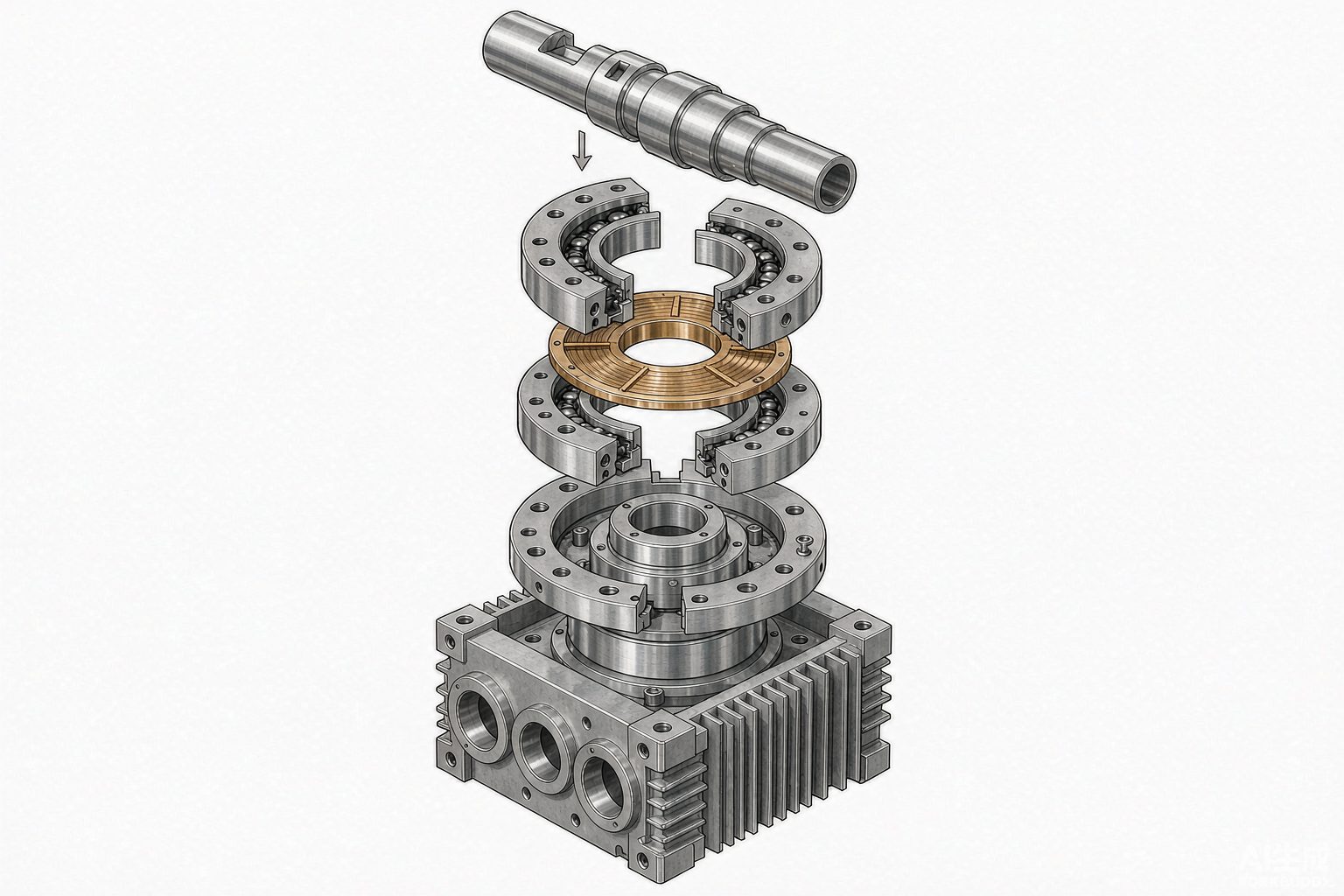
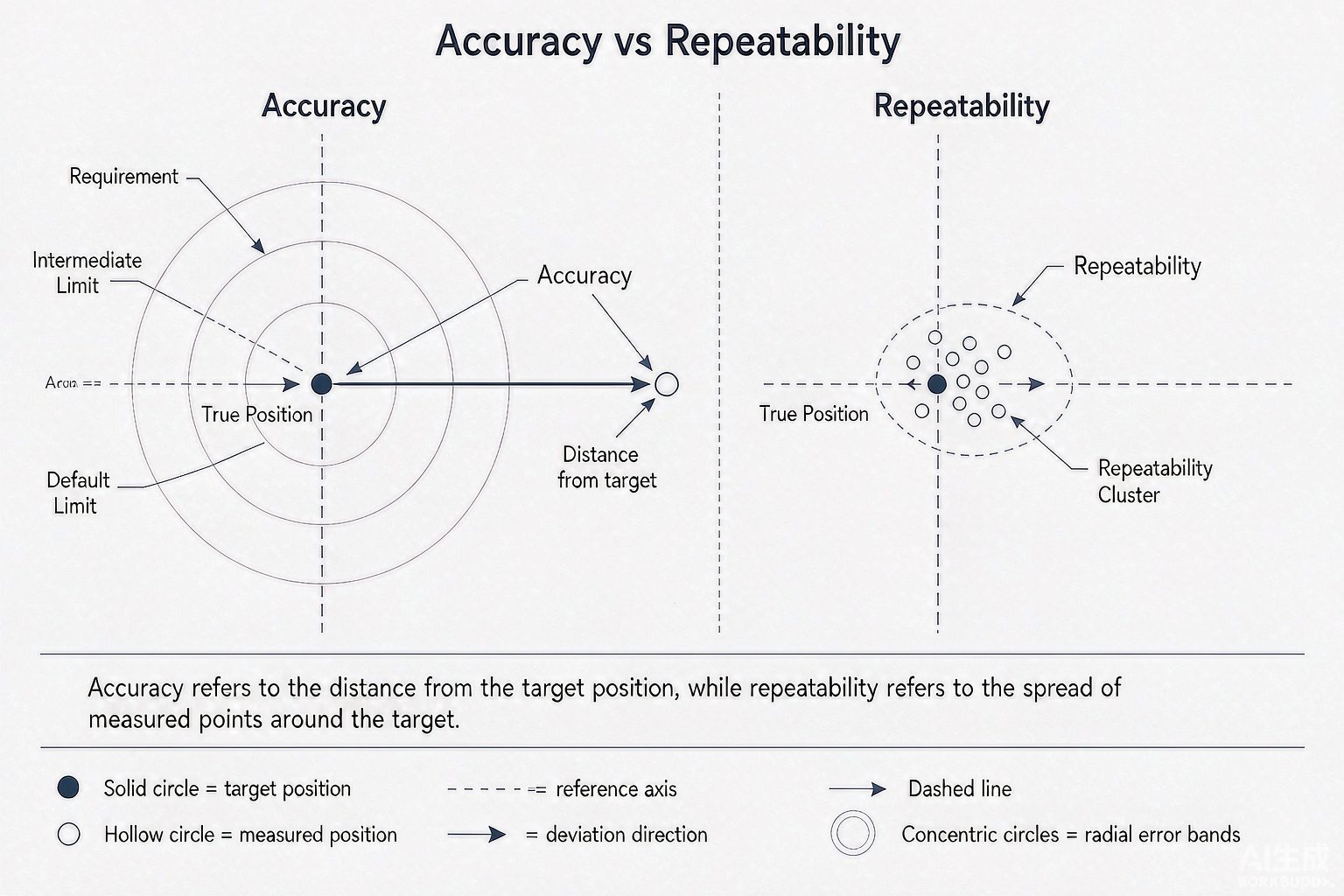
Accuracy tells you where the rotary table stops. Repeatability tells you how reliably it stops there. Neither is universally “better”—they’re complementary lenses for evaluating motion performance. By clarifying your application’s true requirement—absolute alignment or consistent cycling—you avoid overspending on unnecessary precision or under-specifying for mission-critical stability. Whether you’re exploring compact platforms for robotic integration or heavy-duty servo indexers for automotive assembly, HDB Motor provides engineered solutions backed by test data—not assumptions. Explore all HDB motor products, or contact HDB Motor today for a free motion analysis tailored to your line.