
 Русский

Hollow Rotary Table vs Cam Indexer: Choosing the Right Indexing Solution
When designing or upgrading a high-precision production line—whether for assembly, packaging, testing, or laser processing—you’ll likely face a critical motion-control decision: hollow rotary table or cam indexer? Both deliver precise angular positioning, but they serve fundamentally different operational philosophies. Understanding their trade-offs in flexibility versus cycle speed, mechanical complexity, control integration, and long-term adaptability is essential to avoid costly over-engineering—or underperformance.
Core Functional Differences: Motion Philosophy Matters
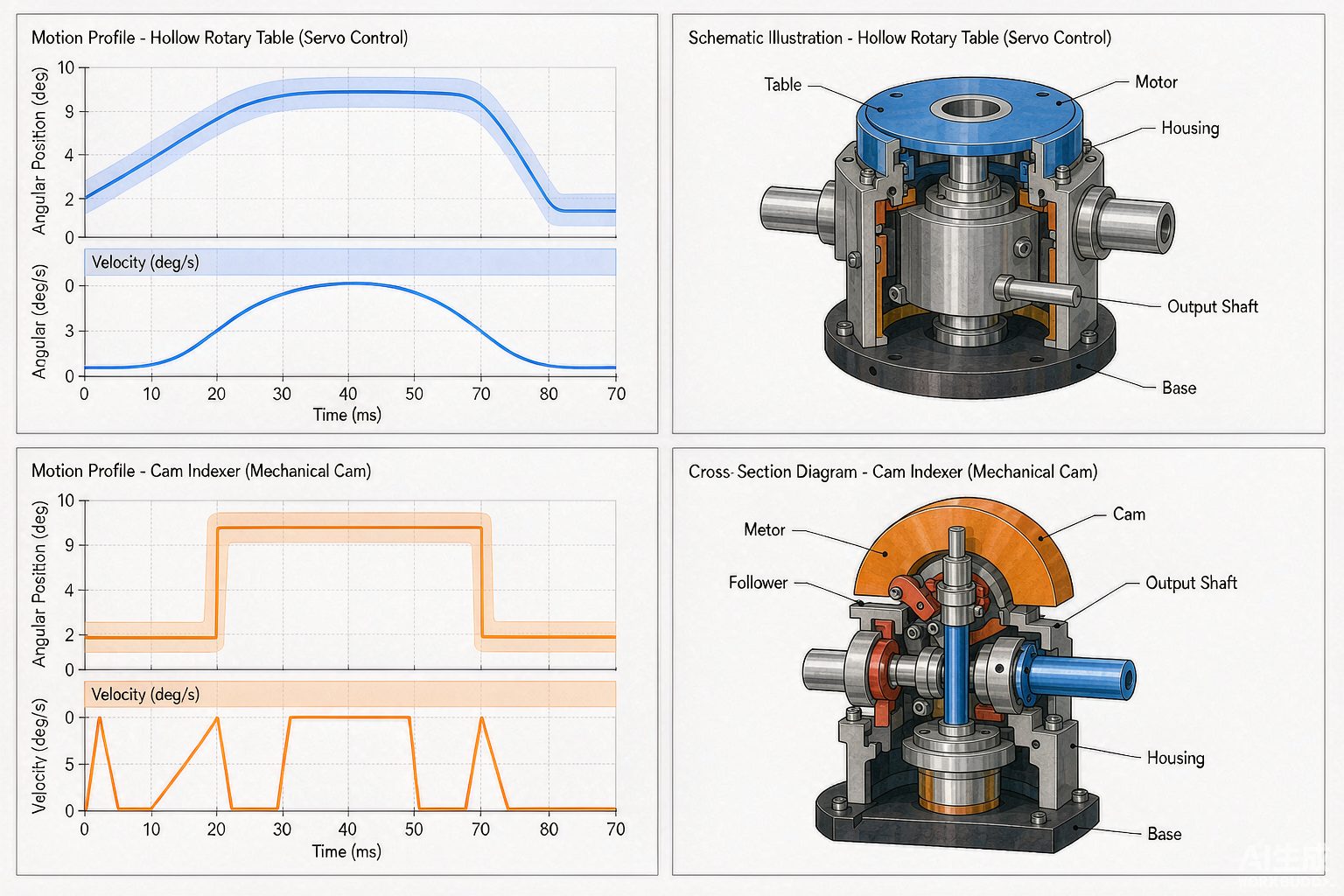
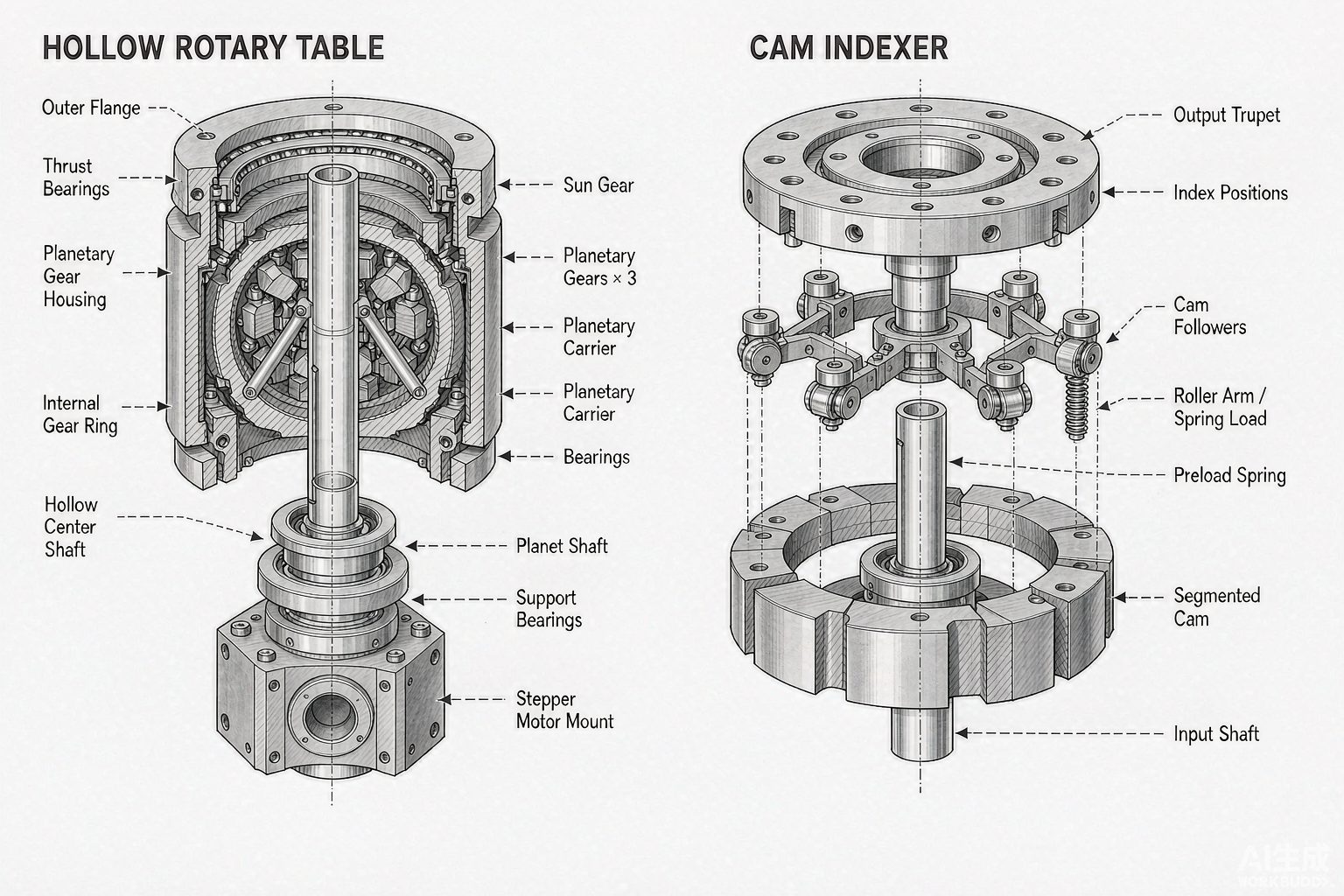
A cam indexer (also called a Geneva mechanism or intermittent motion indexer) is a purely mechanical device. It uses a rotating cam and follower system to convert continuous rotary input into discrete, fixed-angle stops—typically at 2, 4, 6, 8, 12, or 24 positions. Its motion profile is rigid: dwell → rapid rise → dwell → repeat. There’s no electronic control—it’s driven directly by a motor (often via timing belt or direct coupling), and its indexing angle and dwell time are physically determined by the cam geometry.
In contrast, a hollow rotary table is an electromechanical indexing platform—typically built around a high-torque servo or stepper motor, integrated gearbox, and precision bearing system—with a central through-hole for routing cables, pneumatics, or tooling. Its motion is fully programmable: position, speed, acceleration, dwell time, and even multi-segment motion profiles can be adjusted on-the-fly via controller commands.
Flexibility: Where Hollow Rotary Tables Excel
Flexibility isn’t just about convenience—it’s about future-proofing your line. Hollow rotary tables support:
- Variable indexing angles: Need to shift from 45° to 30° indexing for a new product variant? Adjust in software—not with a cam replacement.
- Dynamic sequencing: Run different numbers of stations per cycle (e.g., 6 stations one shift, 8 the next), or skip positions based on sensor feedback.
- Multi-axis coordination: Synchronize seamlessly with linear stages, grippers, or vision systems using pulse train or EtherCAT/Modbus commands.
- Reversible indexing: Move forward or backward without mechanical reversal—ideal for error recovery or bidirectional process flows.
- Ease of reconfiguration: Add encoders, brakes, or custom mounting plates without redesigning core mechanics.
This adaptability makes hollow rotary tables ideal for high-mix, low-to-medium-volume production; pilot lines; R&D cells; and applications requiring frequent changeovers. For compact, space-constrained setups, our HDB Rotary Platform Series: Compact Indexing for Tight Spaces delivers this flexibility in minimal footprints—without sacrificing torque density or positional integrity.
Cycle Speed & Throughput: The Cam Indexer’s Advantage
Where cam indexers shine is raw, deterministic speed. Because motion is mechanically timed and optimized for a single profile, they achieve extremely short indexing times—often under 20 ms—with near-zero settling vibration. There’s no servo tuning, no encoder lag, and no controller latency. Once engineered and tuned, performance is repeatable, decade after decade.
This makes cam indexers the go-to choice for ultra-high-speed, high-volume applications such as:
- Bottle capping or labeling machines (200+ cycles/min)
- Pharmaceutical blister-packing lines
- High-speed wafer handling in semiconductor test handlers
- Continuous-motion packaging where dwell time must be minimized
However, that speed comes at the cost of rigidity: changing the indexing angle, dwell duration, or number of stations requires physical cam replacement—a downtime-intensive process involving recalibration, alignment, and often machine revalidation.
Accuracy, Repeatability, and Long-Term Stability
Both technologies can achieve sub-arcminute accuracy—but how they get there differs significantly.
Cam indexers rely on precision-ground cams and hardened followers. Their repeatability is excellent (<±5 arc-seconds typical), but accuracy depends heavily on installation alignment, bearing preload, and wear over time. Thermal drift and mechanical backlash accumulate gradually, requiring periodic maintenance.
Hollow rotary tables—especially those using high-resolution encoders and closed-loop servo control—offer superior absolute accuracy and dynamic repeatability. They compensate for load-induced deflection, thermal expansion, and minor mechanical variations in real time. For applications demanding traceable, certified positioning (e.g., metrology fixtures or aerospace assembly), this distinction is decisive.
To dive deeper into these nuances, read our technical deep-dive: Accuracy vs Repeatability in Rotary Indexing Tables.
Integration & Control Complexity
Cam indexers integrate simply: connect a motor, set the speed, and run. No PLC programming, no motion controller, no tuning. That simplicity reduces upfront engineering effort and eliminates firmware-related failure modes.
Hollow rotary tables require a motion controller (PLC-based or dedicated), proper tuning (especially for servo variants), and well-defined I/O mapping. But that complexity unlocks capabilities cam systems simply cannot match—including:
- Electronic camming (mimicking mechanical cam profiles digitally)
- Position-based triggering (e.g., fire a camera at exact 90°)
- Real-time load monitoring and torque limiting
- Remote diagnostics and predictive maintenance alerts
If you’re evaluating drive architecture, our comparison Servo vs Stepper Driven Rotary Tables: A Practical Comparison outlines torque-speed curves, tuning effort, and cost-per-cycle implications across production volumes.
When to Choose Which — Decision Framework
Use this practical filter to guide your selection:
- Choose a cam indexer if:
- Your process requires >150 cycles/minute with consistent, unchanging indexing
- You prioritize mechanical robustness and minimal electronics
- Changeovers are rare (<1x/year) and validated offline
- Capital budget is constrained, but lifetime maintenance is acceptable
- Choose a hollow rotary table if:
- You need variable indexing angles, dwell times, or station counts
- Your line supports multiple SKUs or frequent engineering changes
- You require full synchronization with other axes or sensors
- You value data-rich operation (position logs, torque history, fault tracing)
- You’re building modular, scalable machinery for Industry 4.0 readiness
Many modern OEMs now adopt hybrid strategies—using cam indexers for primary high-speed transfer and hollow rotary tables for secondary, flexible positioning tasks (e.g., part orientation before final assembly). This balances speed and agility without over-specifying either subsystem.
HDB Motor’s Precision Rotary Solutions
At HDB Motor, we engineer both philosophies with equal rigor—because the right solution isn’t always “the newest,” but the one that matches your operational reality. Our Rotary Platforms / Rotary Tables portfolio includes hollow and solid configurations, with options for stepper, servo, or hybrid drive inputs, integrated gear reducers, and customizable hollow bores (up to Ø120 mm). Each platform is validated for torque stiffness, radial/axial load capacity, and long-term positional fidelity—critical for maintaining Accuracy vs Repeatability in Rotary Indexing Tables.
For engineers seeking foundational context, our comprehensive resource our Rotary Tables & Indexers guide covers selection criteria, mounting best practices, and common application pitfalls across automotive, medical device, and electronics manufacturing.
Explore the full range of motion-control enablers—including stepper motors, drivers, planetary gearboxes, and brushless DC solutions—in our all HDB motor products catalog.
Frequently Asked Questions
Can a hollow rotary table match the speed of a cam indexer?
Modern high-response servo-driven hollow rotary tables can approach cam indexer speeds (e.g., 100–130 cycles/min with 12 stations), but rarely exceed them in pure indexing time due to inherent control loop latency and mechanical compliance. For applications needing >150 cpm with zero jitter, cam remains unmatched.
Do hollow rotary tables require more maintenance than cam indexers?
No—modern sealed bearing designs and brushless motors make hollow rotary tables highly reliable. However, they do require periodic firmware updates and controller health checks, whereas cam indexers only need lubrication and mechanical inspection. Maintenance profiles differ in nature, not frequency.
Is it possible to retrofit a cam indexer with electronic control?
Not meaningfully. While you can add an encoder for position feedback, the underlying motion profile remains fixed by the cam. True programmability requires replacing the cam system with a servo- or stepper-driven rotary platform—such as those in our HDB Rotary Platform Series.
Conclusion
The choice between a hollow rotary table and a cam indexer isn’t about superiority—it’s about alignment. Match the technology to your production’s rhythm: fixed and furious? Choose cam. Flexible and evolving? Choose hollow rotary. And remember—your motion-control partner should offer both depth of engineering insight and breadth of configurable hardware. contact HDB Motor today to discuss your specific throughput, accuracy, and scalability requirements with a motion-control specialist.