
 Русский

What Are Gearboxes & Reducers—and Why Do They Matter in Motion Control?
In precision motion-control systems—whether powering robotic arms, semiconductor handling stages, or CNC rotary tables—motors rarely operate at their optimal torque-speed point. That’s where gearboxes and reducers step in. These mechanical transmission devices reduce output speed while proportionally increasing torque, enabling finer control, improved load handling, and enhanced system stability. Unlike simple speed changers, high-performance reducers are engineered for minimal positional error, high rigidity, and repeatable dynamic response—making them foundational to accuracy-critical applications.
At HDB Motor, we design and integrate gearboxes not as add-ons—but as purpose-built extensions of our stepper and BLDC motor platforms. Every reducer is selected, matched, and validated to preserve the motor’s inherent resolution, thermal performance, and closed-loop responsiveness. This holistic approach ensures seamless integration across industrial automation, medical robotics, and advanced manufacturing.
The Five Core Reducer Families: How They Work & Where They Excel
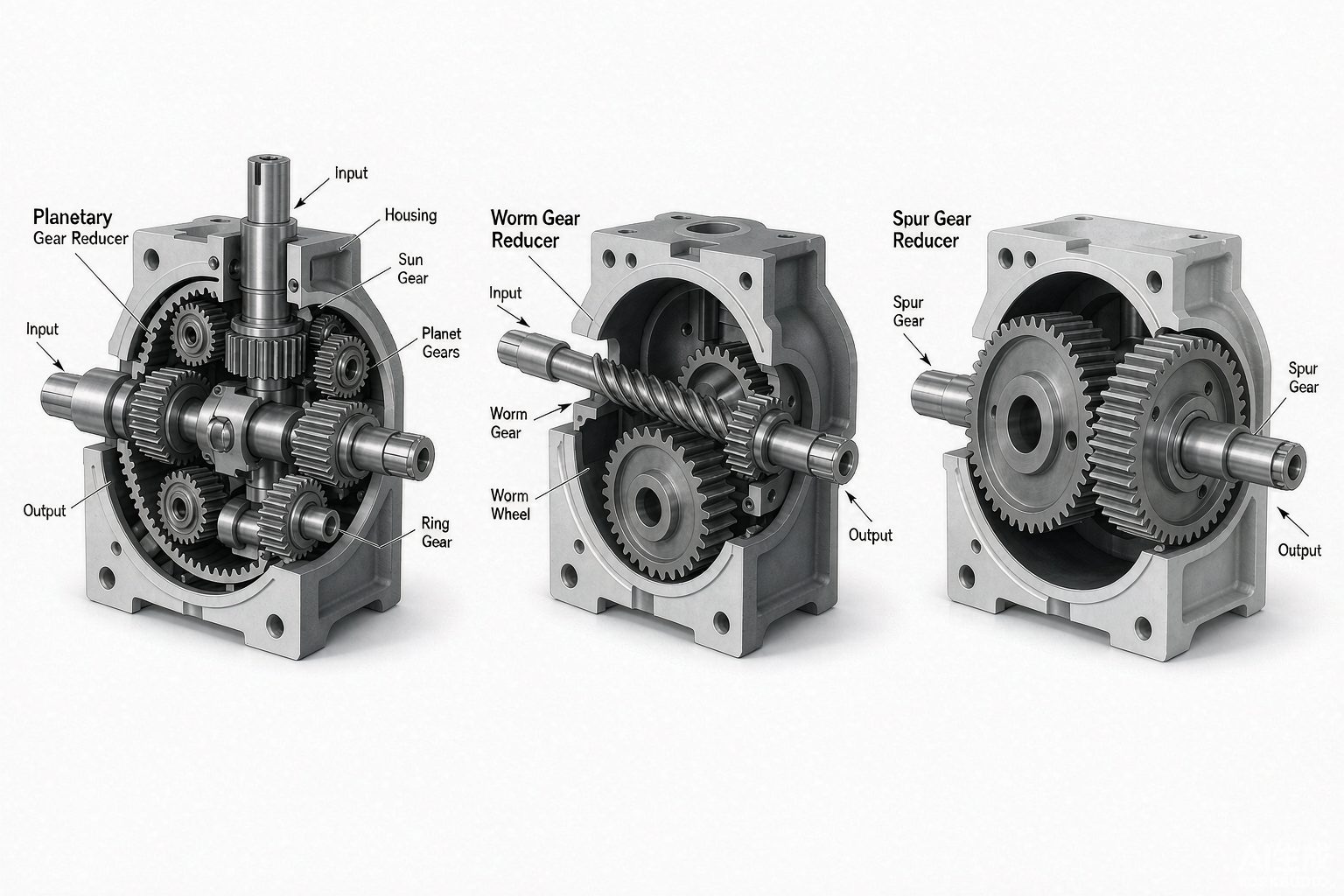
No single gearbox type fits all applications. Each family offers distinct trade-offs in torque density, backlash, efficiency, stiffness, and cost. Understanding these differences is essential for reliable, long-term motion system performance.
1. Planetary Gearboxes
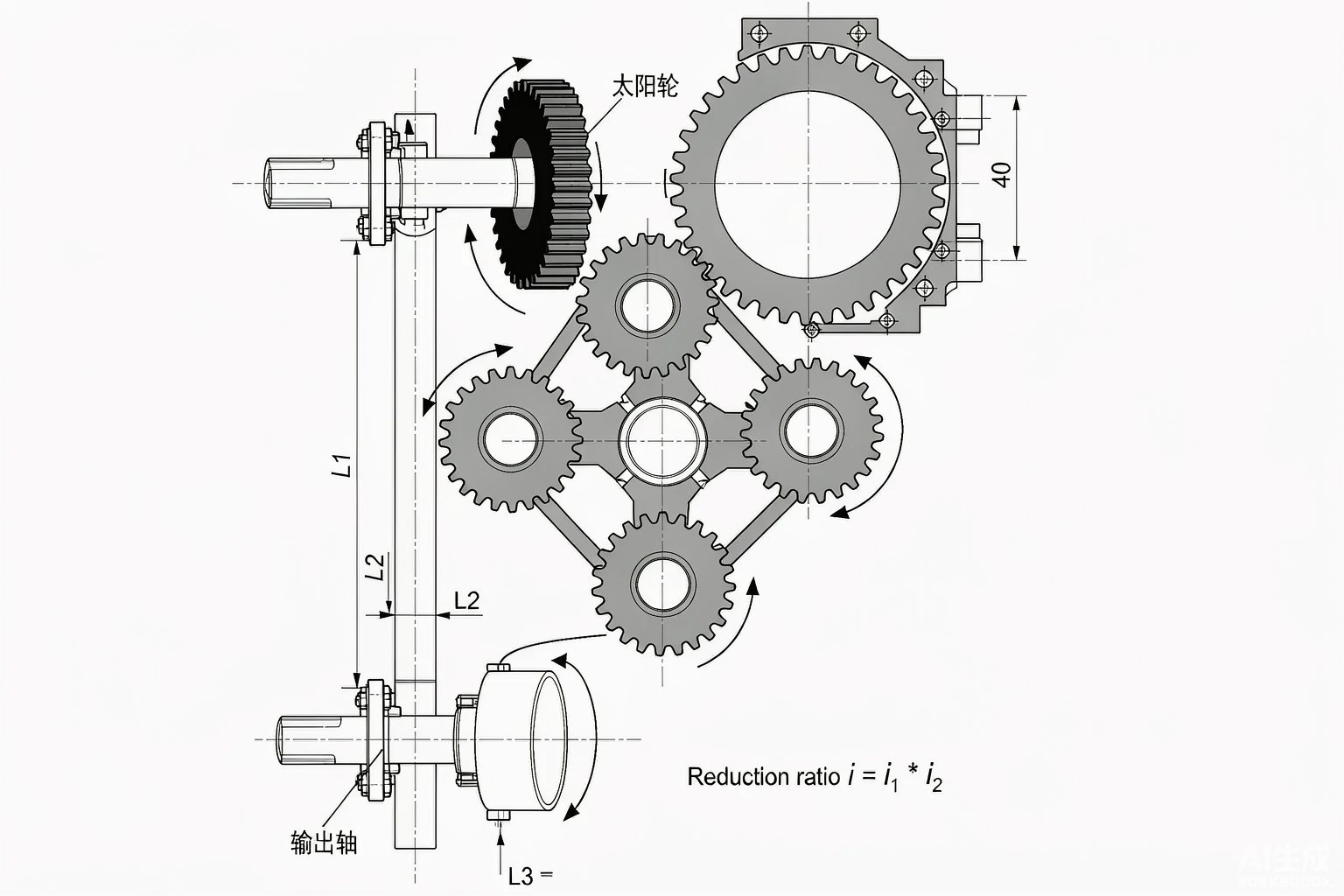
Planetary reducers feature a central sun gear, multiple orbiting planet gears (meshed with both sun and ring gears), and a carrier that outputs motion. Their coaxial design delivers high torque-to-volume ratio, excellent torsional stiffness, and balanced load distribution.
- Typical ratios: 3:1 to 100:1 (multi-stage)
- Backlash: As low as 1–3 arcmin (standard); sub-arcmin in precision variants
- Efficiency: 90–97% per stage
- Best for: General-purpose automation, packaging machinery, and applications requiring high repeatability and compact integration
HDB integrates planetary reduction directly into our motor lines—including our Planetary Reduction Stepper Motor and Planetary Reduction BLDC Motor. These pre-assembled units eliminate coupling misalignment, reduce assembly time, and guarantee verified torque transmission curves and thermal derating data.
2. Harmonic Drives (Strain Wave Gears)
Harmonic reducers use a flexible spline, circular spline, and wave generator to achieve motion through elastic deformation. This principle enables zero-backlash operation, exceptional positional accuracy, and extremely high reduction ratios in a single stage.
- Typical ratios: 30:1 to 320:1 (single-stage)
- Backlash: Near-zero (≤ 1 arcsec typical)
- Efficiency: 65–85%, depending on ratio and load
- Best for: Collaborative robots (cobots), surgical robots, and optical positioning stages where absolute positioning fidelity is non-negotiable
For engineers weighing long-term precision against thermal and efficiency constraints, our comparative analysis in Planetary vs Harmonic Reducer: Trade-offs for Robotics & Automation details real-world performance boundaries and lifetime considerations.
3. RV (Rotary Vector) Reducers
RV reducers combine planetary gearing with a cycloidal mechanism—offering higher torsional rigidity and overload capacity than harmonic drives, with similarly low backlash. Their dual-stage architecture delivers superior shock resistance and smooth torque transfer under cyclic loads.
- Typical ratios: 41:1 to 181:1
- Backlash: ≤ 1 arcmin (high-precision models)
- Efficiency: 80–90%
- Best for: Industrial robot joints (especially 6-axis arms), heavy-duty pick-and-place, and applications demanding high stiffness + high torque
4. Cycloidal Reducers
Cycloidal drives use eccentric cam followers and pinwheel output plates to convert rotational input into smooth, low-vibration output. Known for extreme overload tolerance and near-zero backlash, they excel where shock loads or continuous reversing are common.
- Typical ratios: 11:1 to 119:1
- Backlash: ≤ 1 arcmin (standard); custom zero-backlash options available
- Efficiency: 75–88%
- Best for: Material handling conveyors, rotary indexing tables, and high-inertia inertia applications
5. Worm Gear Reducers
Worm reducers rely on a worm screw meshing with a worm wheel. Their self-locking nature (at low ratios) provides inherent holding torque without brakes—a unique safety advantage in vertical lift or gravity-loaded axes.
- Typical ratios: 5:1 to 100:1
- Backlash: Moderate (2–10 arcmin), but highly predictable
- Efficiency: 40–90% (drops sharply at high ratios)
- Best for: Cost-sensitive, low-speed, high-torque applications like valve actuators, solar trackers, and basic linear actuators
Key Performance Specifications: What You Must Evaluate
Selecting a reducer isn’t about specs in isolation—it’s about how those specs interact with your motor, load, and control loop. Three parameters dominate engineering decisions:
• Reduction Ratio
The ratio defines speed reduction and torque multiplication (ignoring losses). But oversizing ratio can starve your system of bandwidth—especially in servo-controlled BLDC setups. Always verify that the final output speed remains within your encoder resolution and controller update limits.
• Backlash
Backlash—the angular play between input and output—is arguably the most critical spec for positioning accuracy. Even small amounts compound during direction reversals, causing hysteresis and settling delays. In high-dynamic applications, backlash directly impacts contouring error and path fidelity. Learn more in our dedicated deep dive: Backlash in Gearboxes: What It Means for Positioning Accuracy.
• Efficiency & Thermal Behavior
Efficiency affects power consumption, heat generation, and ultimately, continuous torque capability. A 75% efficient harmonic drive may require active cooling at 30% duty cycle—while a 95% efficient planetary unit runs passively at the same load. HDB’s thermal modeling tools and application-specific derating curves help engineers avoid unexpected thermal shutdowns or premature wear.
How HDB Motor Integrates Reducers Into Precision Motion Systems
We don’t sell standalone gearboxes—we deliver motion-ready solutions. Our engineering process begins with your application requirements: load inertia, acceleration profile, ambient temperature, and required lifetime. From there, we match motor and reducer using proprietary coupling dynamics models—not just torque and speed compatibility.
This means:
- Pre-validated motor-reducer combinations with published combined inertia, reflected load inertia, and closed-loop gain margins
- Integrated thermal management (e.g., optimized heat paths in planetary-BLDC hybrids)
- Customizable mounting interfaces, shaft configurations, and feedback options (encoder placement, resolver integration)
- Full traceability—from gear material batch numbers to runout measurements on every assembled unit
Explore all available reducer families—including harmonic, RV, worm, cycloid, and cam indexers—across our full portfolio at all HDB motor products. For deeper guidance on matching reducer specs to your motor’s electrical and mechanical characteristics, see How to Size a Gearbox for Your Stepper or BLDC Motor.
FAQ: Common Questions About Motion-Control Gearboxes
Can I retrofit a gearbox onto an existing stepper or BLDC motor?
Yes—but only if the motor’s flange, shaft, and bearing system are designed for radial and axial loads introduced by the gearbox. Improper retrofitting causes premature bearing failure, increased vibration, and resonance issues. HDB recommends factory-integrated solutions like our Planetary Reduction Stepper Motor, which includes reinforced front bearings and optimized rotor dynamics.
Why do some reducers specify “rated torque” and others “ultimate torque”?
Rated torque reflects continuous operational capability under defined thermal conditions. Ultimate (or peak/stall) torque indicates short-duration overload capacity—typically for <1 second. Always size based on rated torque; using ultimate torque for continuous operation risks overheating and accelerated wear.
Do I need a gearbox if my motor already has high torque?
Often, yes—even high-torque motors benefit from gear reduction. Reducers improve load-to-motor inertia matching (critical for stability), lower reflected inertia seen by the controller, and enable finer microstepping resolution. A 10:1 gearbox effectively multiplies encoder resolution 10× and reduces perceived inertia by 100×—both vital for responsive, jitter-free motion.
Conclusion
Gearboxes and reducers are far more than mechanical multipliers—they’re precision enablers that define the performance ceiling of any motion-control system. Whether you're optimizing for nanometer-level repeatability in lab automation or rugged torque delivery in factory-floor robotics, selecting the right reducer family—and integrating it correctly—is a systems-level decision. At HDB Motor, we bridge the gap between theoretical specs and real-world reliability through application-first engineering, rigorous validation, and seamless motor-reducer co-design. To explore which solution aligns with your motion challenge—or to request custom support—contact HDB Motor today. For a broader overview of technologies, specifications, and implementation best practices, refer to our Gearboxes & Reducers guide.