
 Русский

Brushless DC Motors: The Complete Guide for Engineers
For engineers designing high-performance automation systems, robotics, medical devices, or industrial machinery, selecting the right motor is foundational. Among modern motion-control options, brushless DC (BLDC) motors stand out for their efficiency, reliability, power density, and controllability. This pillar guide unpacks everything engineers need to know — from electromagnetic fundamentals to real-world implementation — with practical insights grounded in HDB Motor’s precision engineering heritage.
How Brushless DC Motors Work: The Core Principle
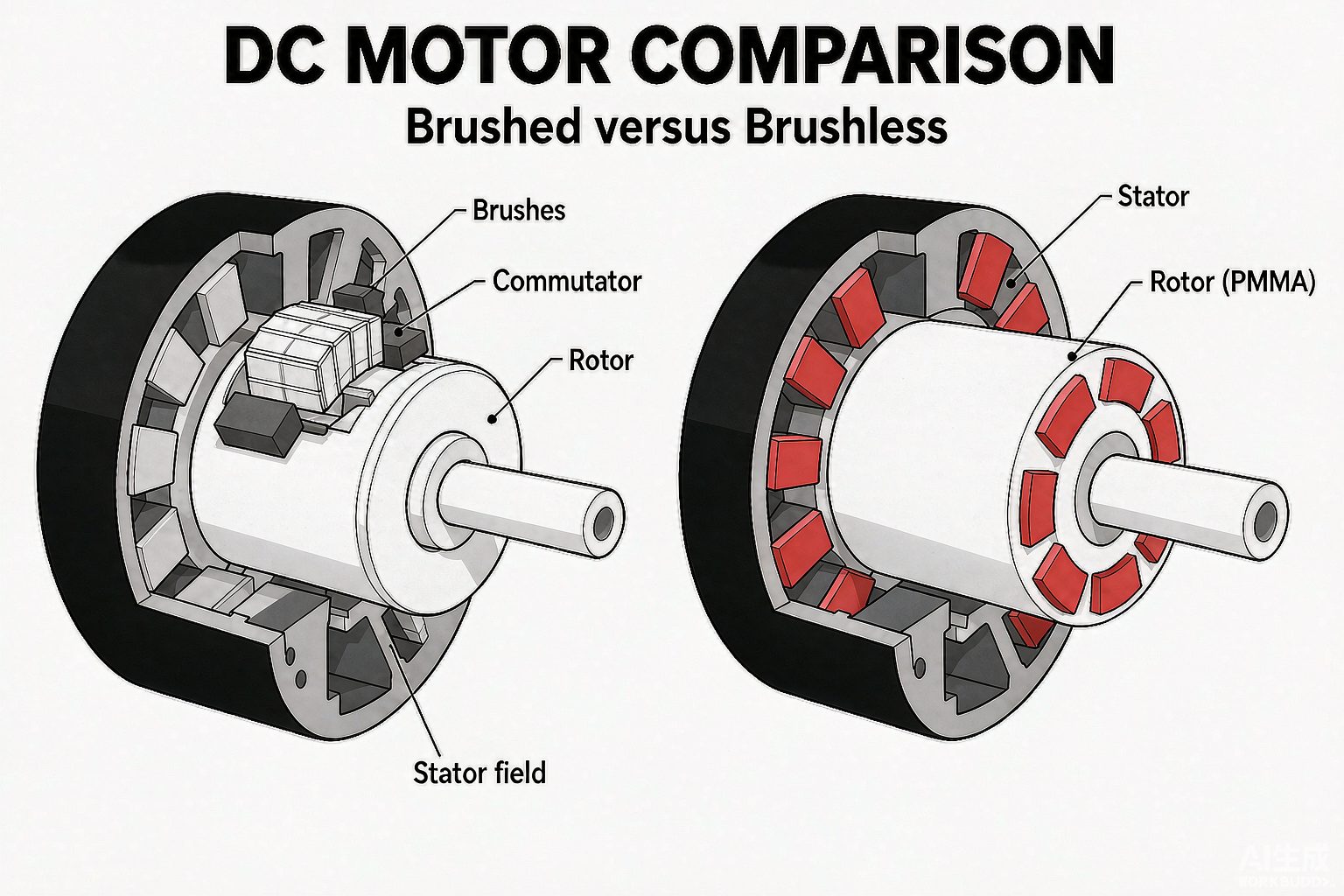
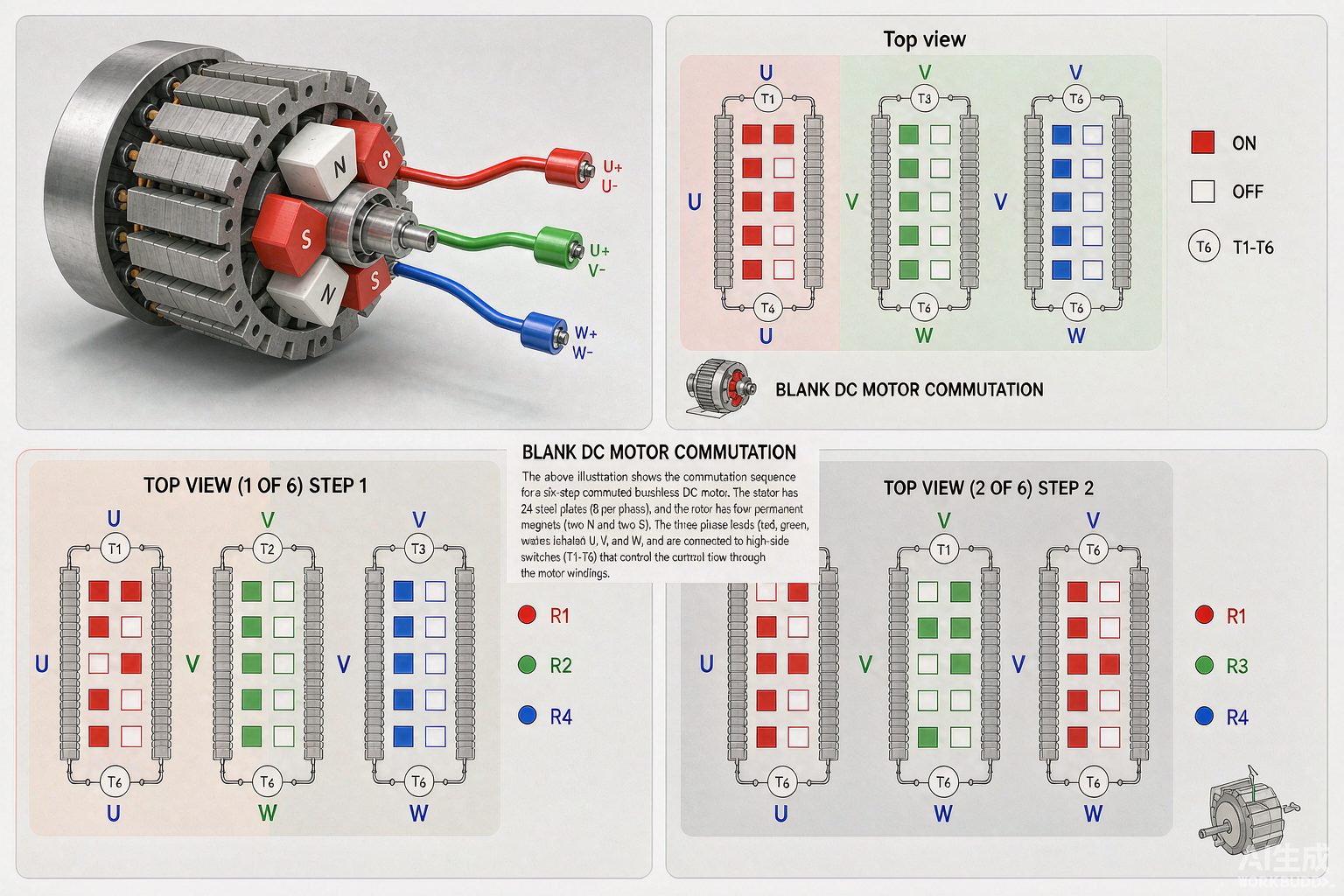
Unlike traditional brushed DC motors, BLDC motors eliminate mechanical commutation. Instead, they rely on electronic switching to energize stator windings in sequence — a process called electronic commutation. This requires coordination between rotor position sensing and a dedicated controller (ESC). The result? No brush wear, minimal maintenance, higher thermal efficiency (typically >85%), and superior speed-torque linearity.
The fundamental physics remains rooted in Lorentz force: when current flows through a conductor in a magnetic field, a mechanical force is generated. In BLDC motors, permanent magnets are mounted on the rotor, while the stationary stator houses three-phase windings. As the controller switches current among these phases — timed precisely to rotor position — a rotating magnetic field is synthesized, pulling the rotor along smoothly and efficiently.
Construction: Key Components & Design Considerations
A typical BLDC motor comprises four critical subsystems:
- Rotor: Features high-energy neodymium (NdFeB) or ferrite magnets arranged in surface-mounted (SPM) or interior (IPM) configurations — optimized for torque density and back-EMF profile.
- Stator: Laminated steel core with distributed three-phase windings (often Wye-connected), designed for low cogging torque and high thermal conductivity.
- Position Feedback System: Either Hall-effect sensors (for robust low-speed operation) or sensorless algorithms (using back-EMF zero-crossing detection). Each has trade-offs in cost, complexity, and startup behavior — explored in depth in our Sensorless vs Hall-Sensor BLDC Commutation: Pros and Cons.
- Electronic Speed Controller (ESC): The brain of the system. It interprets commands (e.g., PWM, analog voltage, or CAN bus signals), executes commutation logic, and manages closed-loop control (speed, torque, or position).
At HDB Motor, our BLDC designs emphasize precision manufacturing tolerances, balanced rotors, and optimized thermal paths — enabling continuous-duty operation even in compact form factors.
Control Architecture: From ESC to Closed-Loop Performance
Effective BLDC control goes beyond simple on/off switching. Modern applications demand dynamic responsiveness, smooth acceleration, and stable regulation under varying loads. That’s why HDB supports multiple control modes:
- Open-loop speed control (e.g., using fixed-frequency PWM) — suitable for fans or pumps where absolute accuracy isn’t critical.
- Closed-loop speed control, often using PID tuning with encoder or hall feedback — essential for conveyors or CNC feed axes.
- Torque control, enabled by current sensing and vector-based modulation — vital for robotic joints or tensioning systems.
- Position control (with integrated or external encoders), bridging into servo-like performance — increasingly common in collaborative robotics.
Engineers should also consider commutation timing (6-step vs sinusoidal), filtering requirements, and EMI mitigation — especially in noise-sensitive environments like lab equipment or imaging systems. For a focused introduction, see our BLDC Speed & Torque Control Basics for Beginners.
BLDC vs Brushed DC: Why Go Brushless?
Brushed DC motors offer simplicity and low-cost control — but at significant operational costs:
- Brush erosion limits lifespan (typically 1,000–3,000 hours), especially under high load or speed.
- Electrical noise from arcing degrades nearby electronics and fails EMC compliance without heavy filtering.
- Lower efficiency (60–75%) means more heat, larger heatsinks, and reduced battery life in portable systems.
- Speed regulation suffers due to nonlinear torque-speed curves and brush voltage drop.
In contrast, BLDC motors deliver longer service life (>10,000 hours), quieter operation, tighter speed regulation, and up to 30% higher efficiency — making them the default choice for mission-critical and energy-conscious designs.
BLDC vs Stepper Motor: When to Choose Which?
Stepper motors excel in open-loop positioning, low-speed torque, and cost-sensitive point-to-point motion (e.g., 3D printers, lab automation). However, they lose torque rapidly with speed, can stall silently, and require careful acceleration profiling.
BLDC motors dominate where high-speed continuous rotation, dynamic load response, or energy efficiency is paramount — such as rotary tables, automated guided vehicles (AGVs), or centrifugal pumps. They also scale better in power: while steppers top out around ~2 N·m, BLDCs easily deliver 10+ N·m in similarly sized packages.
For detailed decision criteria, refer to our comparative analysis: BLDC vs Stepper Motor: When to Use Each in Automation.
HDB’s Precision BLDC Motor Portfolio
HDB Motor designs BLDC motors specifically for engineers who prioritize repeatability, thermal stability, and integration readiness — not just peak specs on a datasheet. Our offerings include:
- Standard BLDC Motors: Available in frame sizes from 42 mm to 110 mm, with rated voltages from 12 VDC to 48 VDC, and optional integrated drivers or encoders. These are ideal for modular automation subassemblies and OEM integration. Explore the full range in Brushless DC Motors.
- Planetary Reduction BLDC Motors: Pre-integrated gearmotor solutions combining high-efficiency BLDCs with precision planetary gearboxes (ratios from 3:1 to 100:1). These deliver high output torque in compact footprints — perfect for rotary indexing tables, robotic arms, and actuated valves. Learn more about our Planetary Reduction BLDC Motor series.
All HDB BLDC products undergo 100% functional testing, including back-EMF profiling, insulation resistance, and thermal soak validation. We support custom winding configurations, shaft modifications, and feedback options — ensuring seamless fit into your mechanical and electrical architecture.
Design Integration Tips for Engineers
Successful BLDC deployment hinges on system-level thinking:
- Thermal Management: BLDCs generate heat primarily in the stator windings. Ensure adequate convection, forced air, or conductive cooling — especially for continuous high-torque operation.
- Power Supply Sizing: Account for peak current during acceleration and regenerative braking spikes. Use low-ESR capacitors near the ESC input to suppress voltage ripple.
- Mechanical Coupling: Avoid misalignment or overhung loads that stress bearings. HDB offers precision-machined mounting flanges and keyed/shrink-fit shaft options.
- EMC Compliance: Implement proper grounding, shielded cables for feedback and power, and ferrite chokes — particularly for Class B (residential) environments.
Need help matching a motor to your application’s inertia ratio, duty cycle, or environmental rating? Our engineering team provides free sizing support — contact HDB Motor directly.
Frequently Asked Questions
Can I run a BLDC motor without an ESC?
No — BLDC motors require precise electronic commutation synchronized to rotor position. Unlike universal or brushed motors, they cannot self-start or sustain rotation with DC voltage alone. An ESC (or integrated driver) is mandatory.
Do all BLDC motors require Hall sensors?
No. While Hall sensors simplify startup and improve low-speed control, many modern BLDCs use sensorless commutation based on back-EMF detection. Trade-offs exist in startup reliability and minimum speed — covered in our Sensorless vs Hall-Sensor BLDC Commutation: Pros and Cons.
How does a Planetary Reduction BLDC compare to adding a gearbox separately?
Pre-integrated units like HDB’s Planetary Reduction BLDC Motor ensure optimal alignment, reduced backlash (<0.1° typical), higher torsional stiffness, and simplified assembly — versus field-assembled gearmotor combinations which risk misalignment, lubrication issues, and inconsistent performance.
Conclusion
Brushless DC motors represent the gold standard for efficient, scalable, and controllable electromechanical motion — especially in demanding industrial, medical, and automation applications. Understanding their construction, control principles, and comparative strengths relative to brushed and stepper alternatives empowers engineers to make confident, future-proof design decisions. At HDB Motor, we combine deep motor physics expertise with precision manufacturing to deliver BLDC solutions that perform reliably across thousands of cycles — not just on paper, but in your machine. Browse all HDB motor products, or dive deeper with our Brushless DC Motors guide for additional technical resources.