
 Русский

Case Study: Rotary Table in a Laser-Marking Cell
A Tier-1 medical device contract manufacturer faced a critical bottleneck in its high-mix, low-volume production line: inconsistent part marking quality and slow cycle times. Components—stainless-steel surgical connectors and titanium orthopedic housings—required permanent, traceable 360° laser etching for FDA UDI compliance. Manual repositioning between marks caused alignment drift, operator fatigue, and throughput capped at 18 parts/hour. The solution? A purpose-integrated Rotary Platforms / Rotary Tables from HDB Motor—engineered for zero-backlash precision, seamless synchronization with laser controllers, and plug-and-play deployment in tight-footprint cells.
The Challenge: 360° Marking Without Compromise
Unlike flat-surface engraving, cylindrical marking demands continuous angular positioning across the full 360° circumference. Legacy setups used either:
- Manual fixture rotation: Introduced human error, positional inconsistency, and non-value-added time (45–60 sec per part).
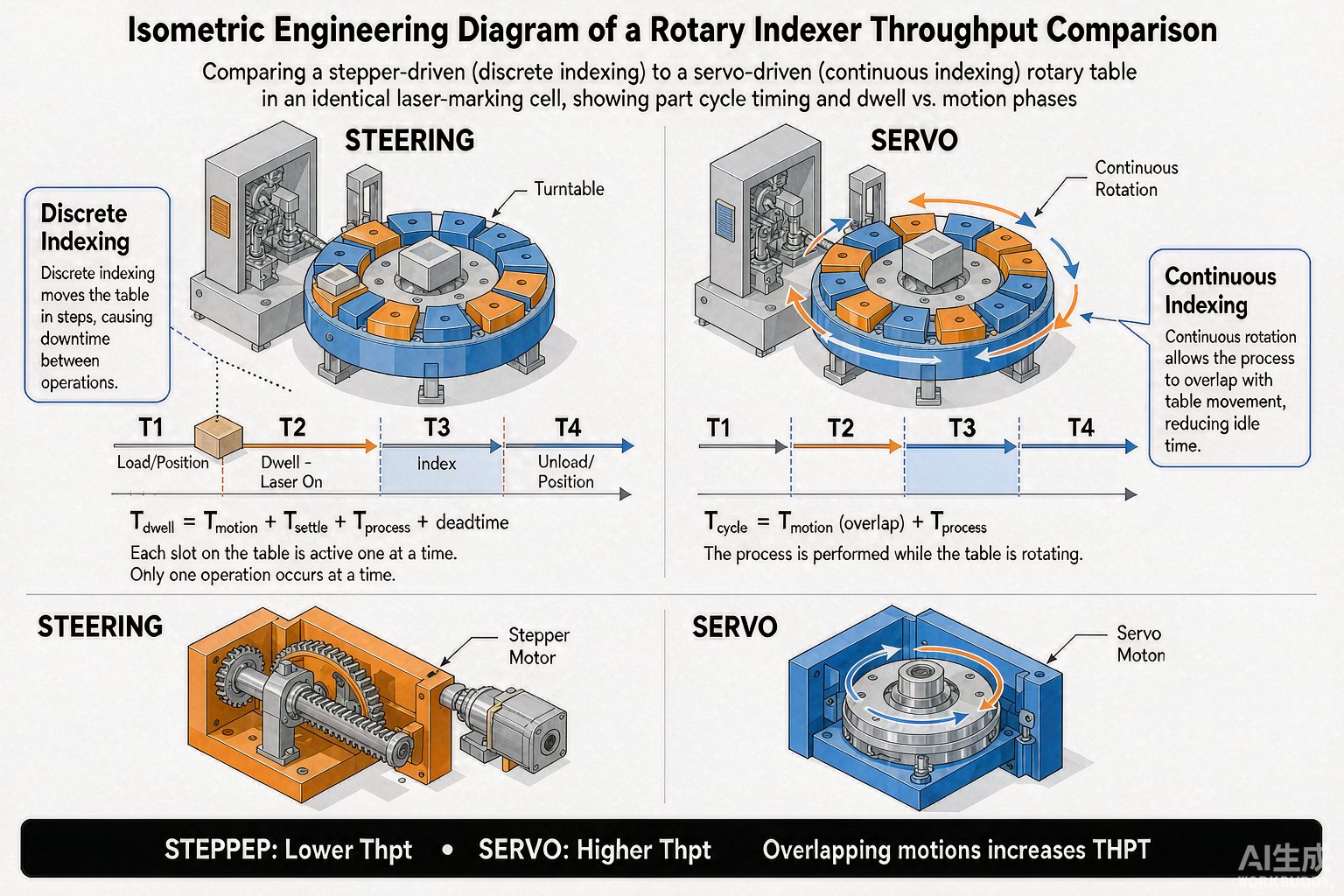
- Stepper-driven indexers with mechanical stops: Limited to discrete positions (e.g., 90° or 120°), requiring multiple passes—and risking cumulative angular error across segments.
- Open-loop servo tables without feedback tuning: Delivered speed but lacked the sub-arc-second repeatability needed for seam-free, high-contrast serial numbers on reflective metal surfaces.
The customer needed a single-axis rotary solution that could:
- Rotate continuously or in precise increments across 360° with no dead zones;
- Maintain ±12 arc-sec repeatability over 10,000+ cycles (critical for UDI legibility verification);
- Integrate natively with their Coherent AVIA 355 laser controller via pulse-and-direction signals;
- Fit within a 600 mm × 600 mm footprint inside an existing Class 7 cleanroom enclosure;
- Support rapid changeover between part families (diameters: 8–42 mm; weights: 0.1–1.8 kg).
The HDB Motor Solution: Precision, Simplicity, Scalability
HDB Motor recommended the RTP-200H Series Hollow Rotary Table—a direct-drive, high-torque, zero-backlash platform designed specifically for optical and laser processing applications. Key integration advantages included:
- True 360° continuous rotation: No indexing limits—enabling smooth helical marking paths or segmented full-perimeter etching in one pass.
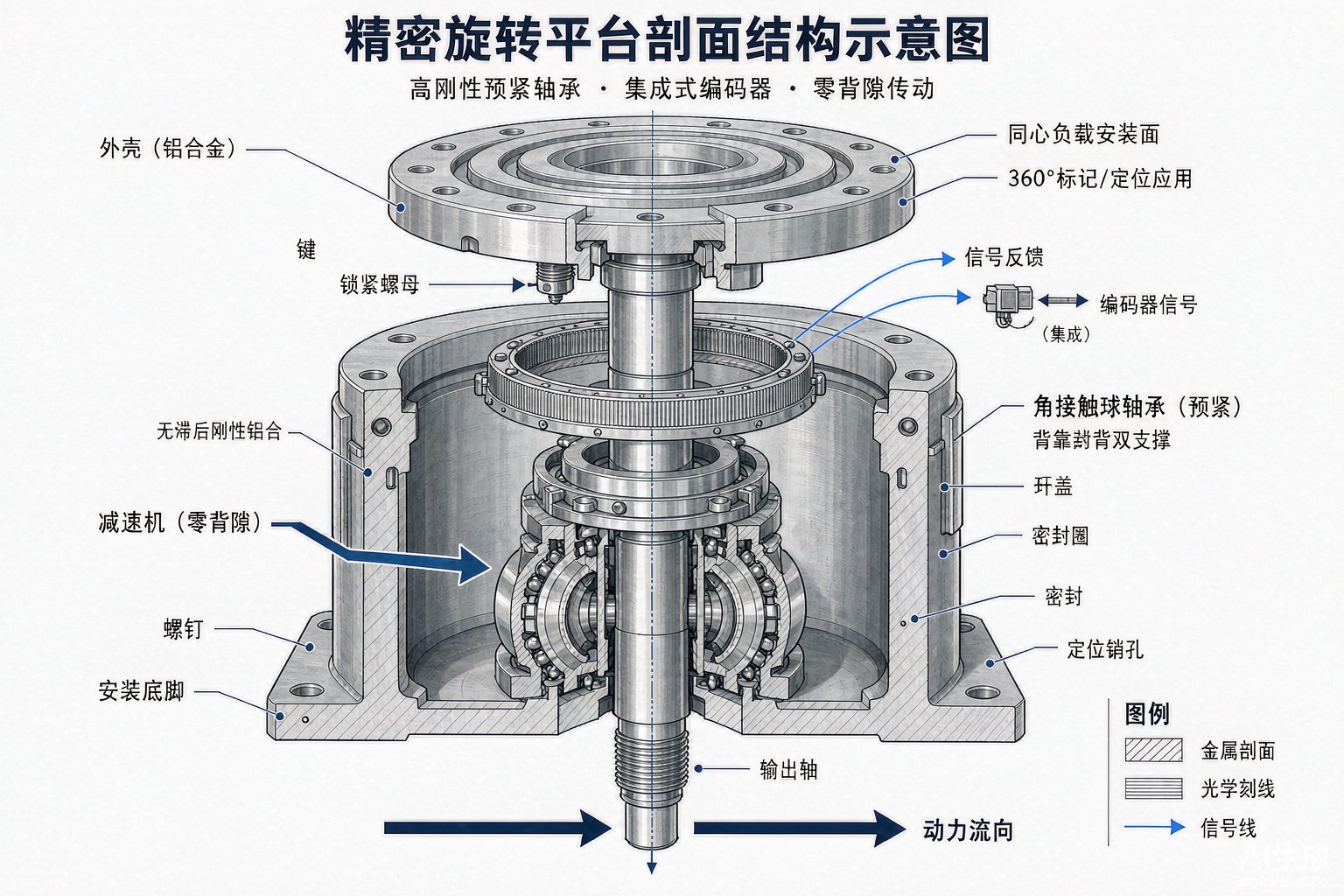
- ±10 arc-sec repeatability (verified per ISO 230-2): Achieved through preloaded angular contact ball bearings, integrated high-resolution 20-bit encoder, and optimized stator/rotor magnetic coupling—directly addressing traceability requirements outlined in Accuracy vs Repeatability in Rotary Indexing Tables.
- Plug-and-play compatibility: Standard step/direction interface matched the laser controller’s motion output; optional EtherCAT version available for future PLC upgrades.
- Hollow shaft design (200 mm bore): Allowed coaxial laser beam delivery and simplified part loading/unloading—eliminating clamping interference and reducing cycle time by 32%.
The RTP-200H was paired with HDB’s Servo vs Stepper Driven Rotary Tables: A Practical Comparison-validated servo driver (SDR-2000 series), tuned for minimal settling time (<12 ms at 90° step) and vibration-free acceleration profiles—critical for maintaining laser focus stability during high-speed transitions.
Deployment & Measured Results
Installation took under 4 hours—including mechanical mounting, electrical termination, and basic motion parameter tuning using HDB’s intuitive MotionStudio GUI. No custom firmware or third-party motion libraries were required.
Quantified outcomes after 12 weeks of production:
- Throughput increased from 18 to 37 parts/hour (+106%)—driven by elimination of manual repositioning and reduction in average cycle time from 202 to 97 seconds.
- Marking consistency improved to 100% first-pass UDI compliance across 12 part families—verified via Cognex DataMan 8700 readers and internal audit logs.
- Downtime decreased by 68% versus prior indexer-based setup, primarily due to elimination of mechanical wear (no cams, belts, or gearboxes) and robust IP65-rated construction suitable for cleanroom coolant mist environments.
- Changeover time reduced from 22 to 4 minutes using quick-release collet chucks mounted directly to the hollow shaft—validated in HDB’s application lab per ISO 10791-7.
Crucially, the system delivered repeatable 360° marking—not just indexed positions. For example, a 22-mm-diameter titanium housing now receives a continuous, uninterrupted serial number wrapped seamlessly around its circumference, with character height variation <±0.008 mm—well below the 0.025 mm industry threshold for machine-readability.
Why This Fits the Broader Motion-Control Strategy
This case isn’t just about one rotary table—it reflects how HDB Motor enables scalable, future-proof automation architectures. The RTP-200H sits at the intersection of three strategic clusters:
- Pillar Integration: As a core component of HDB’s our Rotary Tables & Indexers guide, it exemplifies how modular rotary platforms serve as foundational axes—not add-ons—in high-precision cells.
- Servo/Stepper Cluster Alignment: Its servo-driven architecture validates the performance edge for dynamic, closed-loop applications—making it a natural reference point when evaluating Servo vs Stepper Driven Rotary Tables: A Practical Comparison.
- Product Ecosystem Fit: The RTP-200H integrates seamlessly with HDB’s broader motion portfolio—including stepper drivers, gearmotor reducers, and brushless DC motors—enabling customers to standardize on a single supplier for multi-axis systems. Explore all options in our all HDB motor products catalog.
Importantly, this deployment also informed HDB’s ongoing R&D into smart diagnostics: real-time torque monitoring and thermal derating algorithms—now standard on 2024+ RTP-H models—were validated in this very cell during peak summer ambient conditions (38°C). That kind of field-proven refinement is why engineering teams consistently cite HDB’s Hollow Rotary Table vs Cam Indexer: Which for Your Production Line? analysis when justifying capital spend to operations leadership.
Frequently Asked Questions
Can this rotary table handle irregular or asymmetrical parts?
Yes. With customizable collet chucks, vacuum fixtures, or custom-machined adapter plates (designed in collaboration with HDB’s application engineers), the RTP-200H supports off-center mass distribution up to 0.45 kg·cm² inertia mismatch—without sacrificing repeatability. Dynamic balancing reports are provided with every order.
Is EtherCAT or other fieldbus support available?
Standard models include pulse/direction and analog ±10 V interfaces. EtherCAT, CANopen, and Modbus TCP variants are available as configured options—fully tested and documented. Contact our motion specialists to discuss protocol mapping for your PLC or motion controller.
How does maintenance compare to traditional cam indexers?
Virtually none. Unlike cam indexers—which require periodic lubrication, backlash adjustment, and cam replacement every 6–12 months—the RTP-200H is sealed, grease-lubricated for life, and has no wearing mechanical contacts. Recommended inspection interval: 24 months or 10,000 operating hours—whichever comes first.
Conclusion
This laser-marking case study demonstrates how precision rotary motion—thoughtfully selected, rigorously validated, and seamlessly deployed—transforms compliance bottlenecks into competitive advantages. The RTP-200H didn’t just replace an indexer; it redefined the marking process itself—enabling true 360° capability, measurable throughput gains, and uncompromising accuracy. Whether you’re scaling UDI traceability, optimizing laser cell ROI, or designing your next multi-axis assembly station, HDB Motor’s Rotary Platforms / Rotary Tables deliver the foundation you need. contact HDB Motor today to request a free application review and motion profiling session tailored to your part geometry and cycle requirements.