
 Русский

Integrating Rotary Tables: A Practical Guide for Machine Builders
For machine builders designing automated assembly cells, packaging lines, or multi-station inspection systems, rotary tables are indispensable. They deliver precise angular positioning, high torque density, and repeatable indexing—critical for throughput and part quality. Yet integrating a rotary table isn’t just about bolting it in place. Missteps in mounting, coupling, or control configuration can degrade accuracy, shorten service life, or cause costly downtime.
This guide walks through the four foundational integration phases—mounting, coupling, control integration, and troubleshooting—with real-world considerations drawn from HDB Motor’s field experience supporting OEMs across automotive, medical device, and electronics manufacturing. We’ll also clarify where to start when selecting between stepper and servo-driven solutions—and how to align your choice with your motion-control architecture.
1. Mounting: Stability Starts at the Base
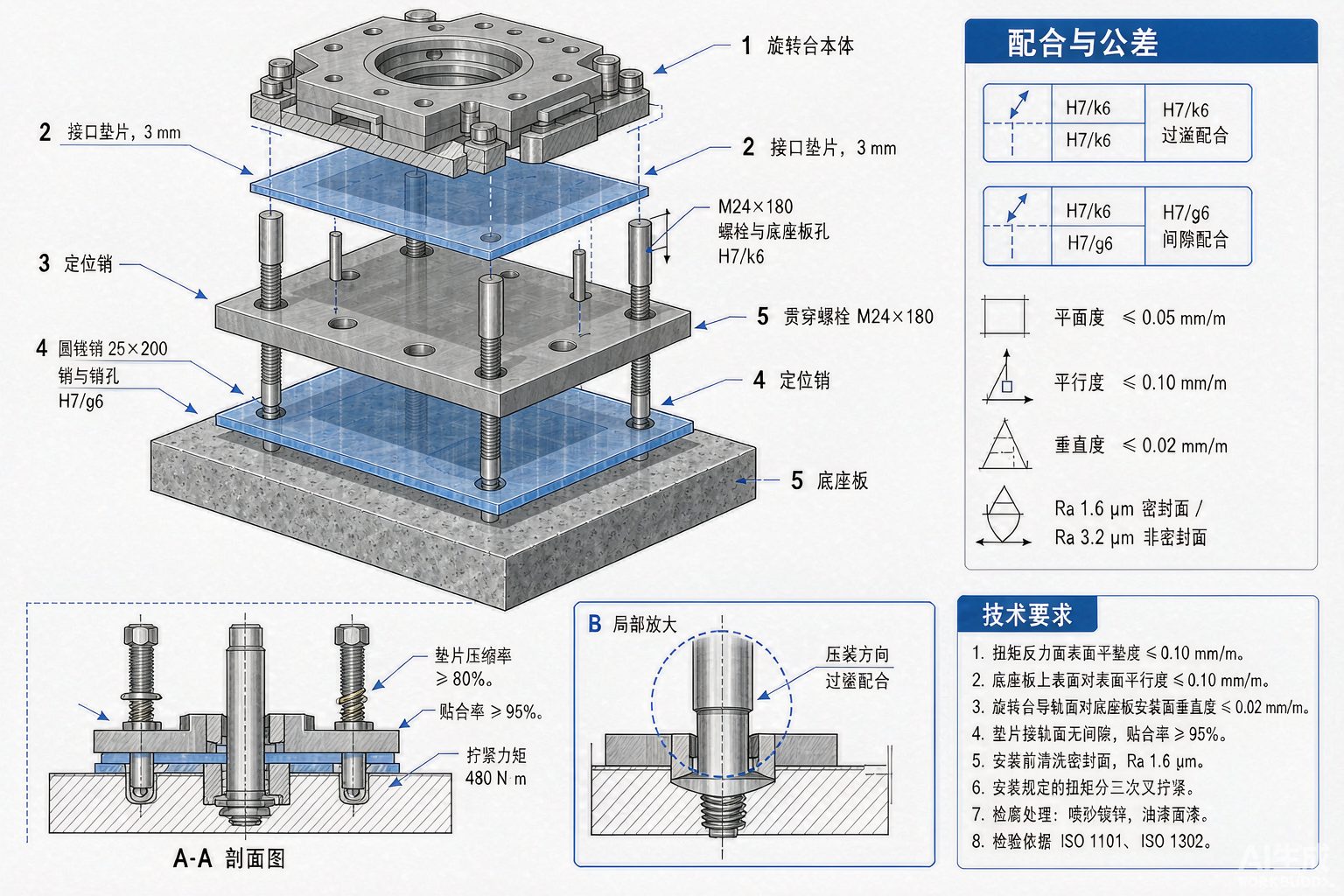
Rotary tables rely on rigid mechanical support to maintain positional fidelity under load. Even minor deflection in the mounting surface translates directly into angular error or bearing preload variation.
- Surface flatness & parallelism: The mounting surface must be within ±0.02 mm flatness over the full footprint. Use precision ground steel or cast iron plates—not structural aluminum extrusions unless reinforced and qualified.
- Bolt pattern alignment: Verify bolt hole spacing and thread depth match the table’s base plate. Over-torquing or misaligned fasteners induce frame distortion. Refer to the torque specs in the Rotary Platforms / Rotary Tables datasheets before final tightening.
- Thermal expansion: In high-cycle or temperature-variable environments (e.g., cleanroom ovens or outdoor test rigs), account for differential expansion between table housing (typically aluminum) and base plate (often steel). Use thermal isolation shims or floating mounts where appropriate.
- Vibration isolation: If the machine frame transmits significant low-frequency vibration (e.g., from hydraulic presses or large conveyors), consider elastomeric isolators rated for both static load and resonant frequency suppression.
Pro tip: Always mount the rotary table *before* attaching tooling or workholding. Adding mass post-mounting changes center-of-gravity dynamics and may require re-trimming leveling feet or rechecking runout.
2. Coupling: Transmitting Motion Without Compromise
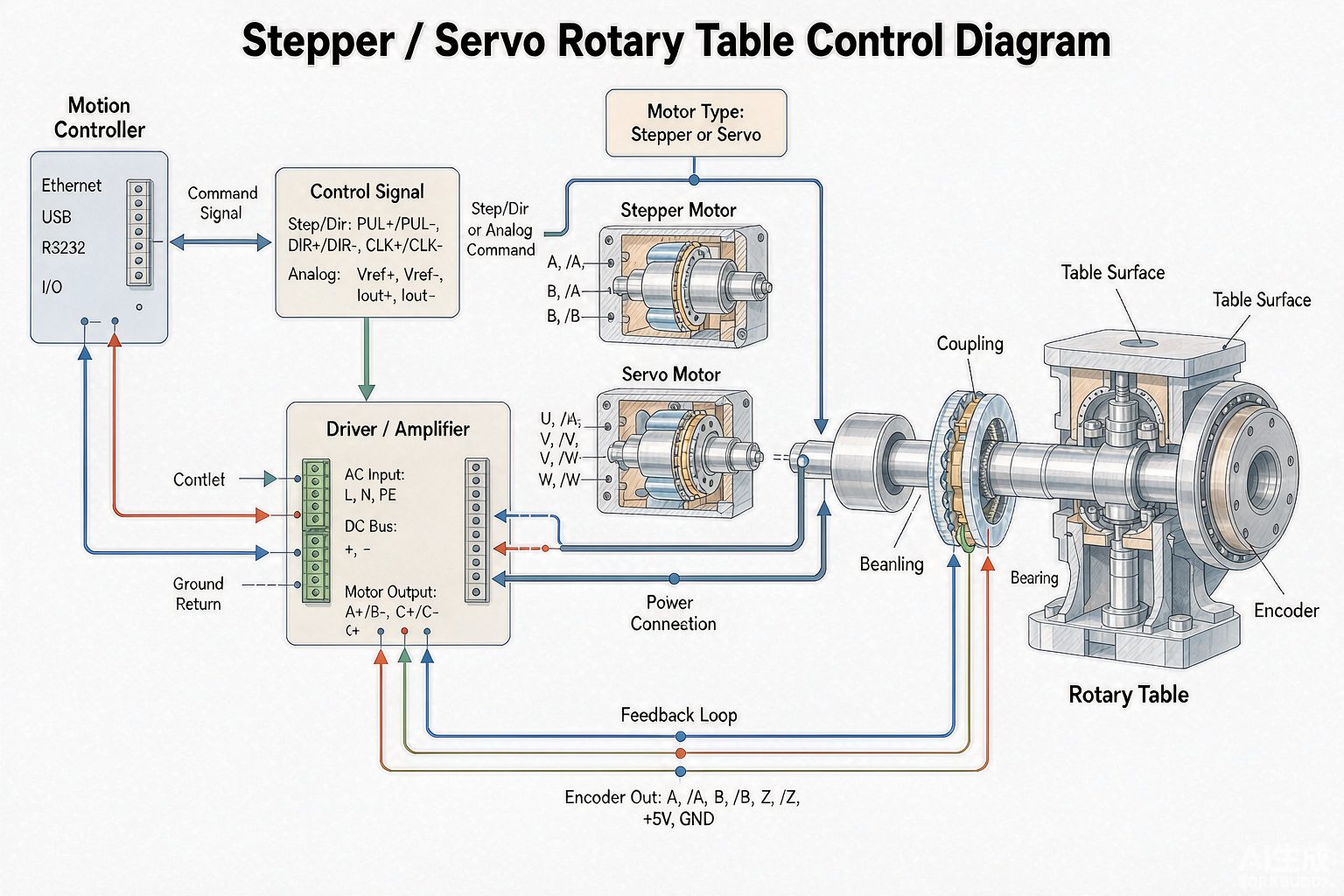
Coupling connects your motor (stepper or servo) to the rotary table’s input shaft. It must accommodate slight misalignment while minimizing backlash, torsional wind-up, and dynamic imbalance.
- Type matters: For most HDB applications, zero-backlash bellows or beam couplings are preferred over jaw or Oldham types—especially when paired with high-resolution encoders or tight repeatability requirements. Bellows couplings offer excellent torsional stiffness and angular misalignment compensation; beam couplings provide better radial forgiveness and lower inertia.
- Axial float & set screws: Ensure the coupling allows for axial float (typically 0.5–1.0 mm) to prevent bearing preloading during thermal expansion. Use clamping-style hubs—not set-screw types—on hardened motor shafts to avoid slippage or shaft scoring.
- Dynamic balance: At speeds above 300 RPM, unbalanced couplings generate harmonic vibration that accelerates bearing wear. Specify dynamically balanced couplings for continuous rotation applications—even if indexing is your primary use case.
- Length-to-diameter ratio: Keep coupling length ≤3× its outer diameter. Longer couplings increase torsional compliance and reduce system bandwidth—especially problematic in closed-loop servo tuning.
When sourcing components, remember that coupling performance is only as strong as its weakest link: mismatched motor shaft diameters, incorrect keyway depths, or undersized fasteners all undermine precision. Always verify dimensional compatibility using the mechanical drawings in our our Rotary Tables & Indexers guide.
3. Control Integration: Matching Drive, Feedback, and Logic
How you control the rotary table defines its functional envelope—whether it indexes 8 positions per cycle or sweeps continuously at 60 RPM with synchronized I/O triggering.
Stepper vs. Servo: Choose Based on Your Needs
Stepper-driven tables (e.g., HDB’s integrated stepper rotary platforms) suit cost-sensitive, open-loop applications with predictable loads and moderate speed/torque demands. Servo-driven versions excel where high acceleration, variable loads, or real-time position correction are required.
The decision isn’t binary—it’s architectural. Review our detailed comparison: Servo vs Stepper Driven Rotary Tables: A Practical Comparison. It breaks down torque curves, tuning effort, encoder resolution trade-offs, and total cost of ownership across 50+ real OEM deployments.
Driver Selection & Setup
- Current matching: Size your stepper driver (e.g., from our Stepper Drivers (companion) series) to the table’s motor phase current—not voltage. Undersizing causes missed steps; oversizing increases heat and EMI without benefit.
- Microstepping: Use ≥1/16 microstepping for smooth motion and reduced resonance—but don’t assume higher values always improve accuracy. Mechanical backlash and friction dominate below 1/32, and excessive microstepping can mask tuning issues.
- Feedback integration: For servo tables, ensure your controller supports the encoder protocol (incremental quadrature, absolute SSI, or EnDat). Verify cable shielding, grounding topology, and maximum cable length to avoid signal degradation—especially near VFDs or welding equipment.
- I/O synchronization: Many HDB rotary tables include built-in home sensors, index markers, or limit switches. Wire these into your PLC or motion controller using noise-suppressed inputs and proper debounce logic (≥5 ms).
4. Common Pitfalls—and How to Avoid Them
Even experienced integrators stumble on subtle but consequential details. Here are five recurring issues we see—and how to resolve them upfront:
- Pitfall #1: Ignoring moment load limits. Rotary tables specify maximum permissible moment (Nm) about X/Y/Z axes. Exceeding this—even briefly during rapid deceleration—can deform the internal gear train or preload bearings beyond spec. Always calculate worst-case inertial and gravitational moments using your tooling mass, CG offset, and max acceleration. Our Accuracy vs Repeatability in Rotary Indexing Tables article includes a quick-reference moment-load estimation worksheet.
- Pitfall #2: Using non-HDB motors with integrated tables. While mechanically possible, mixing third-party motors with HDB’s pre-tuned stepper or servo rotary platforms voids performance guarantees and complicates warranty support. Stick with factory-matched motor-driver-table combinations unless you’ve validated full system behavior—including thermal rise and resonance modes.
- Pitfall #3: Skipping homing routine validation. A single missed home pulse can shift all subsequent positions by one full index. Test homing under load, at operating temperature, and after 100+ cold starts. Confirm repeatability stays within ±1 arc-second across conditions.
- Pitfall #4: Assuming hollow shaft = automatic part-through capability. Hollow rotary tables (like our HR series) simplify cabling and pneumatic routing—but require careful attention to shaft concentricity, internal clearances, and feedthrough connector selection. Compare design trade-offs in Hollow Rotary Table vs Cam Indexer: Which for Your Production Line?
- Pitfall #5: Neglecting firmware updates. Newer HDB drivers and controllers ship with optimized motion profiles, improved stall detection, and enhanced communication robustness. Check release notes before commissioning—and schedule quarterly firmware audits for deployed machines.
Frequently Asked Questions
Do I need a gearbox if my rotary table already has an internal reducer?
No—HDB’s Rotary Platforms / Rotary Tables integrate planetary or harmonic reducers optimized for torque multiplication and backlash control. Adding an external gearbox introduces extra compliance, backlash, and alignment complexity unless you require extreme reduction ratios (>100:1) or specialized output geometry.
Can I retrofit a stepper-driven table with a servo motor later?
It depends on mechanical and electrical compatibility. Some HDB platforms (e.g., SR-series) offer dual-motor interface options. But most integrated stepper tables lack encoder mounting provisions, brake ports, or servo-rated bearings. For future flexibility, select a servo-capable platform from the start—or consult our engineering team before committing to a stepper-only build.
Where can I get application-specific integration support?
HDB offers free pre-commissioning reviews for qualified machine builders. Share your kinematic layout, load profile, and control architecture, and we’ll validate coupling specs, moment loading, driver sizing, and feedback wiring. Contact HDB Motor to request an integration checklist or schedule a 30-minute technical alignment call.
Conclusion
Integrating a rotary table successfully hinges less on component selection than on disciplined execution across mounting, coupling, control, and validation. Each step interlocks: poor mounting magnifies coupling stress; undersized drivers erode repeatability; skipping moment-load analysis risks premature failure. By anchoring decisions in verified data—not assumptions—and leveraging purpose-built components like those in our all HDB motor products portfolio, machine builders gain predictable performance, faster commissioning, and lower lifetime cost of ownership. Start with the right foundation—and let precision follow.