
 Русский

HDB Rotary Platform Series: Compact Indexing for Tight Spaces
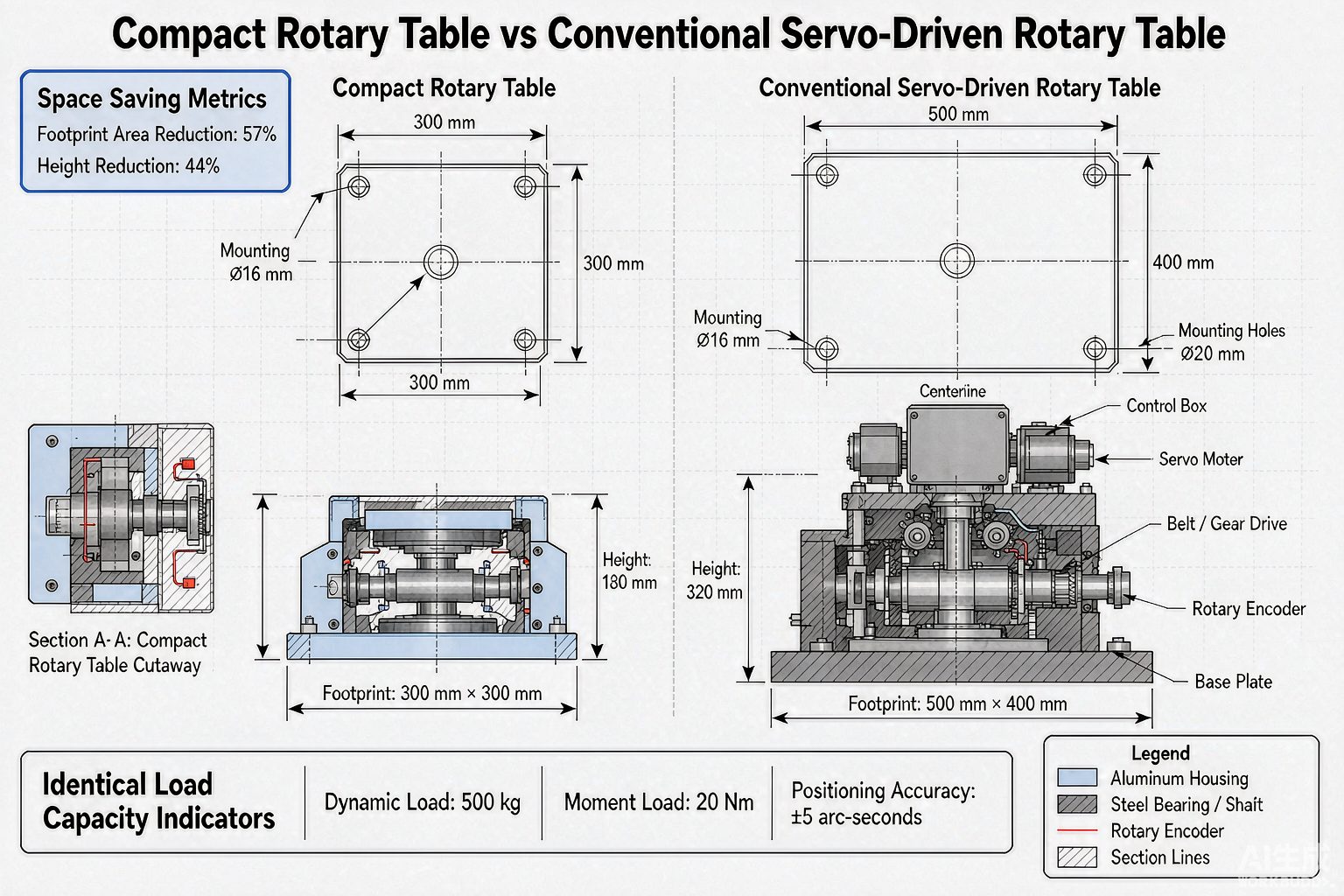
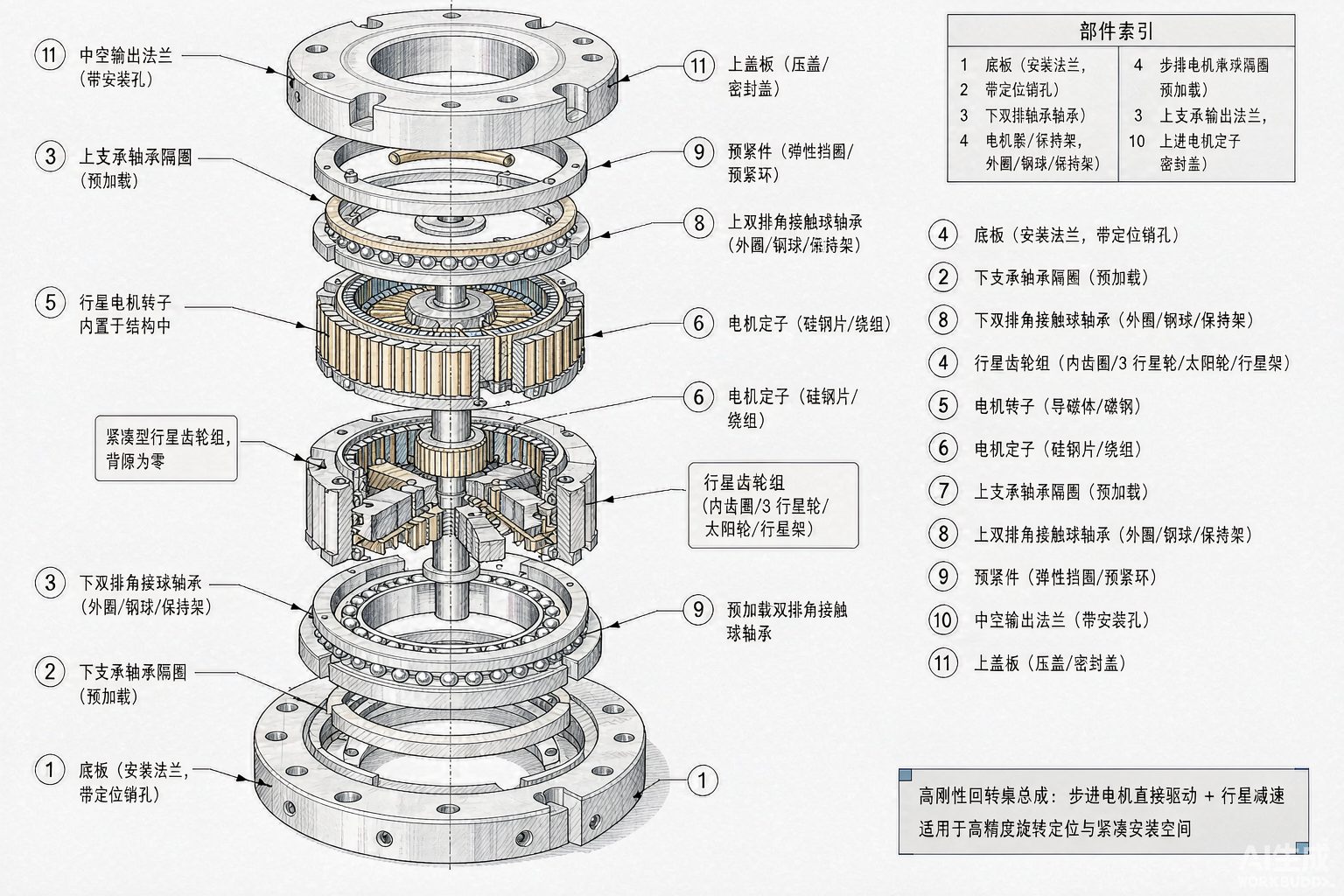
When factory floor real estate is at a premium — and performance demands are non-negotiable — engineers turn to purpose-built solutions that deliver precision without bulk. The HDB Rotary Platform Series answers that need with a tightly integrated family of compact, high-rigidity rotary indexing platforms designed specifically for applications where space, accuracy, and mechanical stability converge.
Engineered for Constrained Environments — Without Compromise
Unlike traditional rotary tables that rely on external mounting flanges or bulky support structures, the HDB Rotary Platform Series features an optimized hollow-shaft architecture. This isn’t just about saving inches: it enables direct integration of tooling, sensors, pneumatic lines, or wiring through the center — eliminating external feedthroughs, reducing assembly complexity, and cutting overall system footprint by up to 40% in typical mid-size automation cells.
The series achieves this compactness without sacrificing structural integrity. Each platform uses a monolithic aluminum alloy housing with strategically reinforced ribbing and preloaded angular contact bearings. Rigidity is further enhanced by dual-side bearing support and torsionally stiff gear train options (including planetary and harmonic drive variants), resulting in angular stiffness values exceeding 15 N·m/arcmin — critical for resisting deflection during high-torque indexing or dynamic load changes.
Hollow Shaft Design: More Than Just a Convenience
The hollow shaft isn’t merely a space-saving feature — it’s a functional enabler. With bore diameters ranging from 20 mm to 80 mm across standard models, users gain unobstructed access to the centerline for:
- Pass-through cabling (encoder feedback, motor power, I/O signals)
- Integrated air or vacuum lines for end-of-arm tooling
- Coaxial alignment of optical encoders or laser positioning sensors
- Direct coupling to linear actuators or secondary rotary stages
This eliminates cable management headaches, reduces EMI interference from coiled wires, and improves long-term reliability in high-cycle environments like packaging, semiconductor handling, or automated assembly.
Where Compact Meets Precision: Accuracy & Repeatability Benchmarks
Compact doesn’t mean approximate. The HDB Rotary Platform Series maintains tight positional fidelity through precision-ground gears, backlash-compensated drivetrains, and high-resolution encoder feedback (standard 17-bit absolute or optional 23-bit multi-turn). Typical repeatability stands at ±5 arcseconds — equivalent to under 0.0014° — across its full 360° range.
That level of consistency supports demanding tasks such as:
- Precision dispensing in medical device manufacturing
- Multi-angle vision inspection in electronics SMT lines
- Synchronized part transfer between pick-and-place stations
- Rotary palletizing with integrated gripper actuation
For deeper insight into how these metrics translate across real-world use cases, see our technical deep dive on Accuracy vs Repeatability in Rotary Indexing Tables.
Flexible Drive Integration: Stepper or Servo? Your Choice.
HDB Rotary Platforms are agnostic by design. Standard models accept either stepper or servo motor inputs — with matching torque curves, inertia matching, and thermal derating profiles validated for both. This flexibility lets integrators scale performance without redesigning the entire motion architecture.
Stepper-driven configurations offer cost-effective, open-loop simplicity ideal for fixed-sequence indexing (e.g., 4-, 6-, or 12-station dial tables). Servo versions provide closed-loop responsiveness, higher acceleration, and dynamic load compensation — essential for variable-speed indexing or contouring applications like rotary CNC engraving or camless motion profiling.
To help you decide which drive architecture best serves your throughput, cycle time, and control requirements, explore our side-by-side analysis: Servo vs Stepper Driven Rotary Tables: A Practical Comparison.
Real-World Fit: Applications That Benefit Most
The HDB Rotary Platform Series shines where legacy solutions fall short — not due to lack of capability, but because of physical or operational constraints. Consider these representative deployments:
• Automated Test Benches (ATE)
A Tier-1 automotive supplier replaced a 220 mm faceplate indexer with an HDB RP-60 platform (60 mm bore) in their ECU functional test cell. The smaller footprint freed up 180 mm of lateral space — enough to add a second parallel test station. Simultaneously, the hollow shaft enabled clean routing of probe cables and thermocouple leads directly through the center, reducing signal noise and improving test repeatability by 22%.
• Miniature Assembly Cells
A medical device OEM building insulin pump components needed sub-0.01 mm positioning tolerance across six micro-assembly stations. Their previous cam indexer required 350 mm of vertical clearance and complex timing belt alignment. Switching to the RP-40 platform cut height by 60%, simplified alignment via integrated zero-backlash gearing, and allowed full integration of vacuum and electrical feeds — all while maintaining ±3 arcsecond repeatability over 10,000+ cycles per day.
• Collaborative Robotics (Cobot) End-of-Arm Tooling
Integrators embedding rotary motion into UR or TM robot wrists often face weight, size, and torque density limits. The RP-30 model (30 mm bore, 1.2 kg mass, 0.8 N·m holding torque) delivers precise 90° or 180° orientation shifts — fully compatible with cobot safety-rated speed monitoring — and fits within ISO 9409-1-50-A interface standards. Its low inertia (<0.00015 kg·m²) minimizes payload impact on robot path planning.
How It Fits Into the Broader Motion-Control Ecosystem
The Rotary Platform Series is not a standalone component — it’s a strategic node in HDB’s precision motion-control architecture. It interoperates seamlessly with:
- all HDB motor products, including our NEMA 17–34 stepper motors and BLDC servo motors
- Our matched stepper drivers (with microstepping, resonance suppression, and stall detection)
- Planetary gearboxes and right-angle reducers for torque multiplication or axis redirection
- Digital motion controllers supporting EtherCAT, CANopen, and Modbus RTU protocols
This ecosystem approach ensures consistent performance, unified firmware updates, and single-point technical support — reducing integration risk and accelerating time-to-production.
Choosing the Right Model: Key Selection Criteria
Selecting the optimal Rotary Platform depends on three interdependent factors:
- Load Profile: Axial, radial, and moment loads must be evaluated separately — especially for cantilevered tooling. HDB provides detailed static/dynamic load charts per model.
- Cycle Requirements: High-speed indexing (>60 rpm) favors servo + harmonic drive; low-speed, high-hold applications favor stepper + planetary.
- Environmental Needs: IP54-rated standard models handle dust and light splashing; optional IP65 sealing and stainless-steel hardware support washdown or cleanroom use.
For guidance navigating trade-offs between mechanical layout, motion profile, and production goals, refer to our Rotary Tables & Indexers guide. It walks through selection workflows, mounting best practices, and common pitfalls in rotary automation design.
Frequently Asked Questions
Q: Can the HDB Rotary Platform Series replace a cam indexer in high-speed applications?
A: Yes — particularly when flexibility, programmability, or variable indexing angles are required. While cam indexers excel in ultra-high-speed fixed-angle motion (e.g., >120 rpm), HDB platforms achieve up to 90 rpm with servo drives and maintain superior adaptability. For a head-to-head comparison, read Hollow Rotary Table vs Cam Indexer: Which for Your Production Line?
Q: Is custom bore sizing or flange interface available?
A: Absolutely. HDB offers rapid-turn custom machining for non-standard bores (up to 120 mm), custom mounting patterns (ISO, JIS, GB), and application-specific encoder resolutions or feedback types. Lead times average 3–4 weeks for most modifications.
Q: Do you provide mounting hardware and alignment fixtures?
A: Yes — each platform ships with precision-ground alignment dowels, grade-12.9 mounting bolts, and optional laser-etched zero-reference marks. Optional alignment jigs and torque-spec calibration tools are available upon request.
Conclusion
The HDB Rotary Platform Series redefines what’s possible in compact rotary indexing: delivering high rigidity, true hollow-shaft utility, and verified sub-arcsecond repeatability — all within footprints traditionally reserved for basic positioning stages. Whether you’re upgrading a legacy line, designing a new collaborative workstation, or solving a spatial bottleneck in high-mix assembly, these platforms offer a proven, scalable, and supported solution. Ready to evaluate which model aligns with your mechanical envelope and motion profile? contact HDB Motor today for a free application review and dimensional compatibility check.