
 Русский

NEMA 17 vs 23 vs 34: How to Choose the Right Stepper Motor Frame Size
Selecting the correct stepper motor frame size is foundational—not an afterthought. In precision motion-control systems, the NEMA designation (e.g., NEMA 17, NEMA 23, NEMA 34) defines physical dimensions, mechanical compatibility, and—critically—torque capability. At HDB Motor, we design and manufacture high-fidelity stepper solutions across all standard NEMA frame sizes, each engineered for distinct performance tiers and integration requirements. This article breaks down the practical differences between NEMA 17, 23, and 34 motors—and helps you determine which frame size best matches your load, speed, accuracy, and space constraints.
What Does “NEMA” Actually Mean?
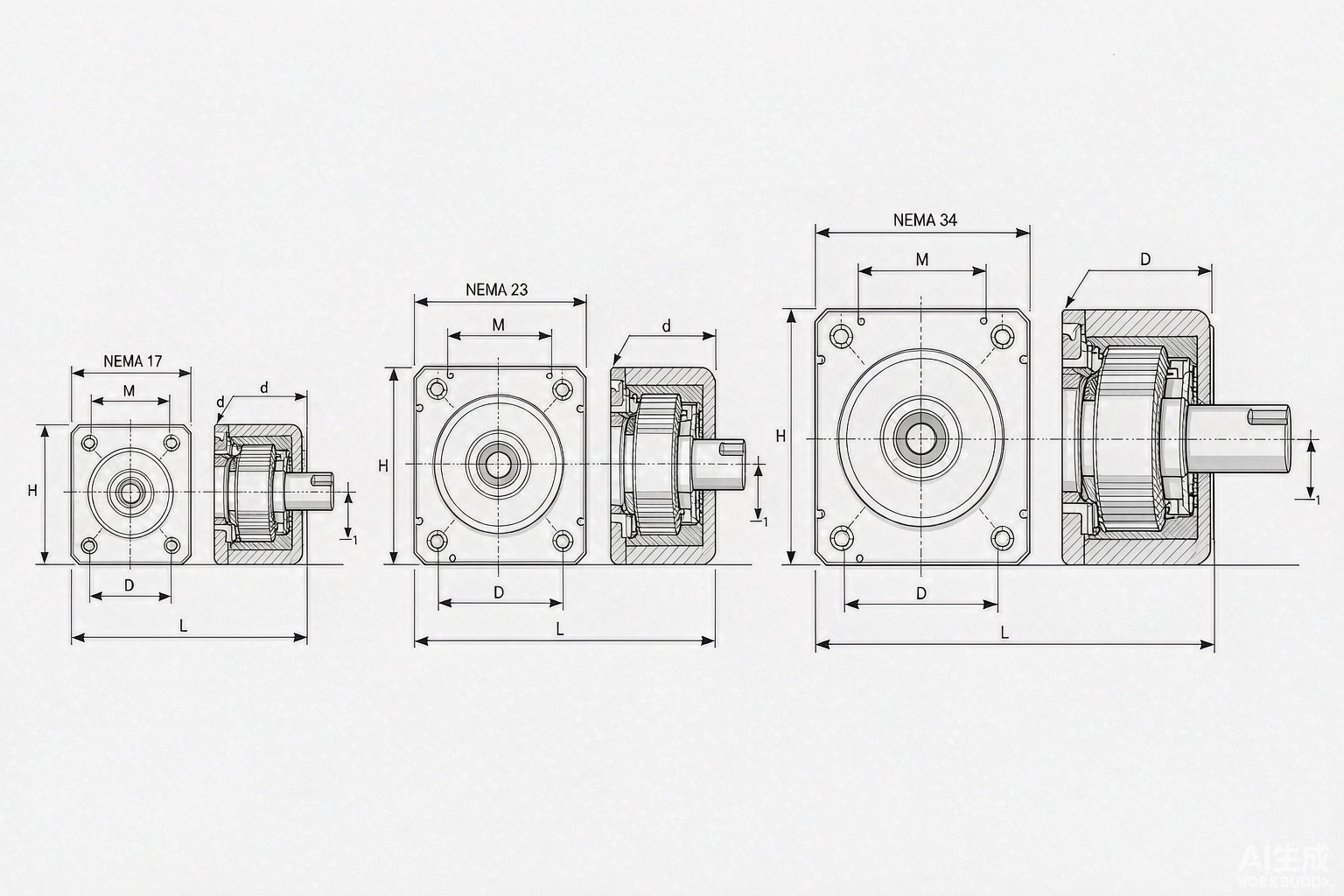
The National Electrical Manufacturers Association (NEMA) sets standardized motor faceplate dimensions—ensuring interchangeability across manufacturers and simplifying mechanical design. The number in "NEMA XX" refers to the motor’s square mounting footprint in inches × 10. So:
- NEMA 17: 1.7″ × 1.7″ (≈43 mm × 43 mm) mounting footprint
- NEMA 23: 2.3″ × 2.3″ (≈58 mm × 58 mm)
- NEMA 34: 3.4″ × 3.4″ (≈86 mm × 86 mm)
Crucially, NEMA does not standardize shaft length, body depth, or electrical specs—but it strongly correlates with available torque and thermal capacity. Larger frames accommodate bigger stators, more copper, and better heat dissipation—enabling higher continuous torque and improved low-speed stability.
Holding Torque Ranges: The Core Differentiator
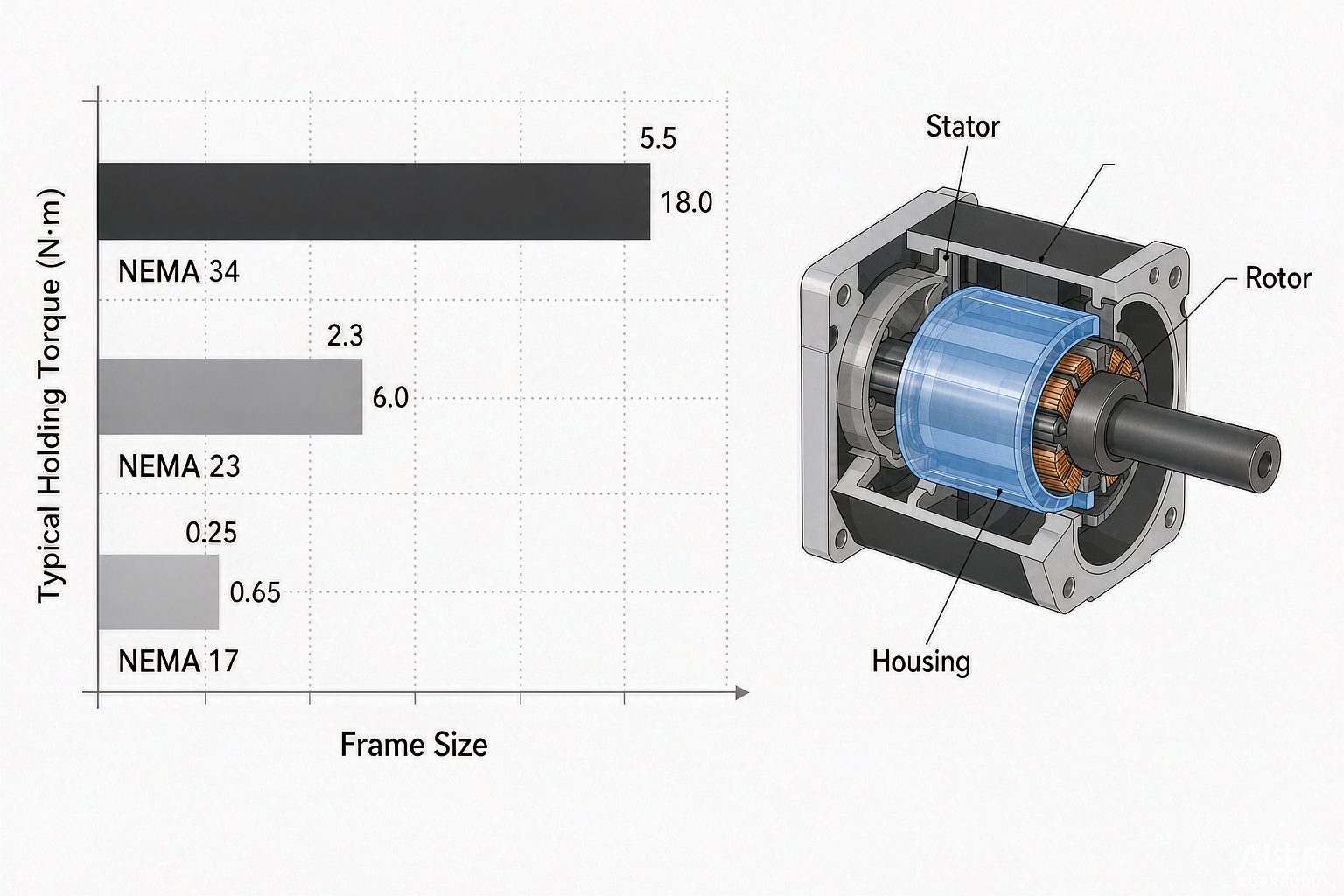
Holding torque—the static torque a motor can exert without rotation—is the most telling metric for comparing frame sizes. While exact values depend on winding configuration, voltage, and cooling, typical ranges across HDB’s product families are:
- NEMA 17: 15–80 oz·in (0.1–0.56 N·m)
Common in compact automation, lab equipment, and light-duty CNC accessories. Ideal for applications requiring fine positioning at modest loads—e.g., micro-adjustment stages or small 3D printer extruders. - NEMA 23: 80–400 oz·in (0.56–2.8 N·m)
The workhorse of mid-tier industrial motion. Widely used in CNC routers, pick-and-place systems, and automated optical alignment. Offers a strong balance of torque, responsiveness, and footprint efficiency. - NEMA 34: 400–1,800+ oz·in (2.8–12.7+ N·m)
Engineered for high-inertia, high-torque applications: large-format CNC mills, rotary indexing tables, robotic joint actuators, and heavy-duty linear stages. Often paired with gear reducers or belt drives to multiply output force.
Keep in mind: torque drops as speed increases. Always consult the full How to Read a Stepper Motor Torque Curve (Holding vs Pull-out Torque) to understand usable torque across your operating speed range—not just peak holding values.
Mounting Footprint & Mechanical Integration
Frame size directly impacts machine layout, rigidity, and modularity:
- NEMA 17 fits seamlessly into tight spaces—ideal for multi-axis modules, embedded systems, and portable devices. Its smaller bolt pattern (typically M3 or #4 screws) allows lightweight mounting but limits structural stiffness under side-loading.
- NEMA 23 uses M4 or #6–#8 mounting hardware and provides significantly greater torsional rigidity. It’s the preferred choice when integrating into aluminum extrusion frames or when driving timing belts or lead screws with >10 mm pitch.
- NEMA 34 demands robust mounting—often with M5/M6 hardware and reinforced brackets. Its mass helps dampen vibration, but inertia must be accounted for in acceleration calculations. For direct-drive rotary tables or high-mass gantries, this size often eliminates the need for external gear reduction.
Also consider shaft options: HDB offers Hollow Shaft Stepper Motors in NEMA 23 and 34 frames for through-shaft sensor integration or cable routing—enhancing system compactness without sacrificing torque.
When Should You Upsize from NEMA 17 to 23—or 23 to 34?
Upsizing isn’t about “more is better”—it’s about matching motor capability to real-world dynamic loads. Consider upgrading if you observe any of these:
- Missed steps under load — especially during acceleration or direction reversal (a sign of insufficient pull-out torque).
- Excessive heating at rated current — indicating the motor is thermally saturated; larger frames dissipate heat more effectively.
- Vibration or resonance near operating speeds — smaller frames have lower natural frequencies and may amplify mechanical ringing.
- Need for higher holding force during power loss — e.g., vertical axis safety hold. Our Two-Phase Brake Stepper Motor line includes NEMA 23 and 34 models with integrated fail-safe brakes.
- Integration with high-ratio gearboxes or planetary reducers — larger frames better absorb radial and axial loads from attached gearheads.
Note: Some applications benefit from hybrid approaches—like using a NEMA 23 closed-loop motor instead of a NEMA 34 open-loop unit. That’s where understanding control architecture matters. See our deep-dive on Open-Loop vs Closed-Loop Stepper Motors: Which Should You Choose?
Electrical & Control Considerations Across Frame Sizes
Larger frames typically support higher phase currents and voltages—but they don’t inherently require more complex drivers. HDB’s Stepper Drivers are optimized for all three frame sizes, with configurable current limiting, microstepping (up to 256×), and adaptive decay modes to maximize torque smoothness.
Winding type also matters. Most NEMA 17 and 23 motors are Bipolar Stepper Motor configurations (4-wire), while select NEMA 34 models offer 6- or 8-wire leads for flexible series/parallel wiring—enabling tuning of torque/speed trade-offs. Three-phase variants (e.g., our Three-Phase Open-Loop Stepper Motor) deliver smoother operation and ~15% higher torque density than equivalent two-phase designs—especially valuable in NEMA 23 and 34 for noise-sensitive environments.
For plug-and-play simplicity, HDB’s Integrated Pulse Stepper Motor series embeds driver + controller in NEMA 23 and 34 housings—eliminating external cabling and reducing EMI concerns in dense control cabinets.
Application Mapping: Which Frame Fits Your Use Case?
- NEMA 17: Desktop CNC engravers, automated microscope focus, fluid dispensing pumps, small robotic arms, educational kits. Best paired with Two-Phase Waterproof Stepper Motor for wet-lab or outdoor enclosures.
- NEMA 23: Mid-size CNC routers, automated packaging lines, XY linear stages, laser cutters, automated door actuators. Frequently selected in our Two-Phase Open-Loop Stepper Motor and Two-Phase Closed-Loop Motors lines for reliability and upgrade flexibility.
- NEMA 34: Large-format milling machines, rotary index tables, industrial sorting conveyors, solar tracker drives, and custom rotary tables. Often combined with Linear / Lead Screw Stepper Motor assemblies or planetary gear reducers for high-force linear motion.
For help navigating trade-offs like step angle, resolution, and microstepping fidelity, refer to our Step Angle, Microstepping & Positioning Resolution Explained.
Frequently Asked Questions
Can I replace a NEMA 23 with a NEMA 17 if I reduce the load?
Yes—if torque, inertia, and thermal requirements are verified. But re-mechanizing mounts, couplings, and drivers may offset cost savings. Always validate with dynamic testing—not just static torque charts.
Do NEMA 34 motors always consume more power?
Not necessarily. Power draw depends on current, voltage, and duty cycle—not frame size alone. A well-tuned NEMA 34 with intelligent current regulation can be more energy-efficient than an overloaded NEMA 23 running at 100% current continuously.
Where can I compare specs across all HDB stepper frame sizes?
Visit all HDB motor products to filter by NEMA size, torque, voltage, and features—or start with our foundational related industry article on key selection parameters.
Conclusion
Choosing between NEMA 17, 23, and 34 isn’t about chasing maximum torque—it’s about aligning mechanical form factor, thermal headroom, and dynamic performance with your system’s real-world demands. Whether you’re scaling a prototype into production or upgrading legacy equipment, HDB Motor provides precision-engineered stepper solutions across all three frame sizes—including open-loop, closed-loop, brake, waterproof, hollow-shaft, and integrated variants. Explore our comprehensive Stepper Motor Overview, dive deeper with our Stepper Motors guide, or contact HDB Motor for personalized sizing support.