
 Русский

Step Angle, Microstepping & Positioning Resolution Explained
When selecting a stepper motor for precision motion-control applications — from automated lab equipment to semiconductor handling or CNC rotary tables — understanding step angle, microstepping, and positioning resolution is essential. These parameters directly influence repeatability, smoothness, noise, torque delivery, and system-level accuracy. This article breaks down the fundamentals in plain language, clarifies common misconceptions, and shows how HDB Motor’s product portfolio supports optimal resolution without sacrificing performance.
What Is Step Angle?
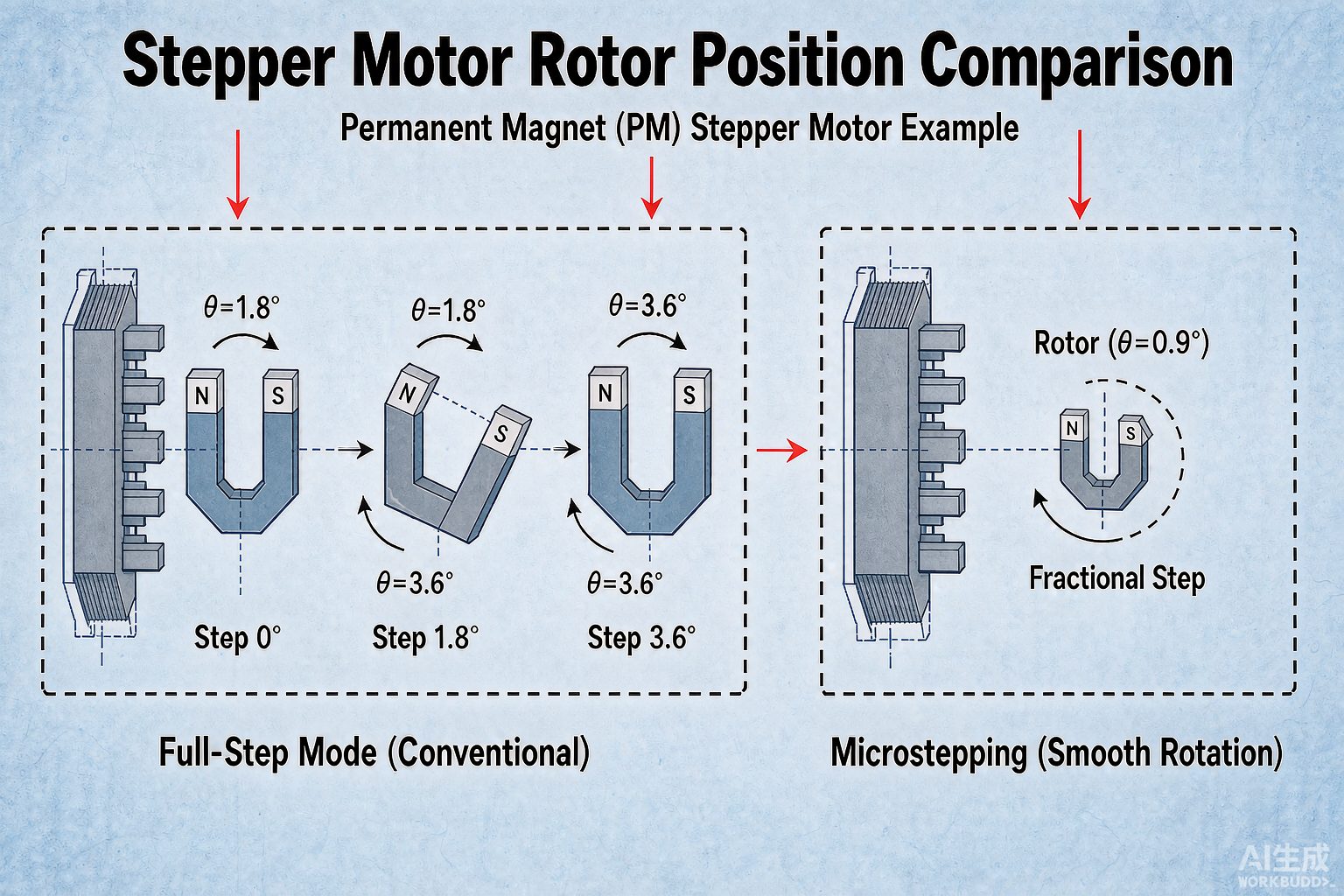
The step angle is the smallest angular increment a stepper motor can move in one full step — determined by its internal construction (number of stator poles and rotor teeth) and drive mode. It’s a fixed mechanical property of the motor, not something software or firmware changes.
For example:
- A standard Two-Phase Open-Loop Stepper Motor typically has a step angle of 1.8° (200 steps per revolution).
- Some high-resolution variants offer 0.9° (400 steps/rev), while specialty motors may go as fine as 0.36° (1000 steps/rev).
Step angle sets the baseline for positional granularity — but it’s only the starting point. Real-world resolution depends heavily on how the motor is driven.
Full-Step vs. Half-Step vs. Microstepping: What’s the Difference?
Full-Step Mode
In full-step operation, the driver energizes two phases simultaneously (bipolar) or alternates single phases (unipolar), advancing the rotor by one discrete step per command pulse. For a 1.8° motor, this means exactly 1.8° per pulse — simple, robust, and delivers maximum holding torque.
However, full-step motion is inherently coarse and can produce audible vibration or resonance at low speeds due to abrupt magnetic transitions.
Half-Step Mode
Half-stepping interleaves full-step and single-phase excitations — e.g., Phase A only → A+B → Phase B only → B+C → etc. This effectively doubles the number of steps per revolution (e.g., 400 steps for a 1.8° motor), halving the step angle to 0.9°.
Trade-off: Torque drops ~15–30% compared to full-step at each position, and torque ripple increases slightly — but motion is smoother and quieter. Half-stepping is widely supported across our Stepper Drivers (companion) lineup, especially in cost-sensitive, moderate-precision applications.
Microstepping: The Standard for Precision Motion
Microstepping goes beyond half-stepping by using analog current control to divide each full step into many smaller increments — commonly 4, 8, 16, 32, 64, 128, or even 256 microsteps per full step.
How it works: Instead of switching coil currents on/off, the driver precisely modulates current amplitude in both phases using sinusoidal (or near-sinusoidal) waveforms. This creates intermediate rotor positions between full steps — not by mechanical interpolation, but by balancing magnetic forces.
For a 1.8° motor with 16x microstepping:
- Steps per revolution = 200 × 16 = 3,200
- Effective step angle = 360° ÷ 3,200 = 0.1125°
Microstepping dramatically improves motion smoothness, reduces resonance and audible noise, and enables higher top speeds by minimizing torque discontinuities. However — and this is critical — microstepping does not automatically increase absolute positioning accuracy. It enhances resolution, not necessarily accuracy or repeatability.
Resolution ≠ Accuracy: A Key Distinction
Let’s clarify three interrelated but distinct terms:
- Resolution: The smallest commanded movement — defined by step angle × microstep divisor. Purely a function of electronics and motor design.
- Accuracy: How closely the actual shaft position matches the theoretical position after one full revolution (often ±3–5% of step angle for open-loop steppers).
- Repeatability: How consistently the motor returns to the same position across multiple cycles (typically ±0.02°–±0.05° for quality steppers).
Microstepping improves resolution and smoothness, but accuracy remains limited by mechanical factors: detent torque, static friction, load inertia mismatch, and back-driving effects. That’s why high-precision applications — such as optical alignment stages or medical robotics — often pair microstepping with feedback: enter Open-Loop vs Closed-Loop Stepper Motors: Which Should You Choose?
Torque Trade-Offs Across Stepping Modes
As step subdivision increases, available torque per microstep decreases — non-linearly. At 16x microstepping, the torque available at each microstep position is roughly 20–30% of full-step holding torque. Why?
- Current in each phase is reduced (e.g., sin(π/32) ≈ 0.1 when stepping near the zero-crossing).
- Magnetic force is proportional to the product of phase currents — so low-current microsteps generate minimal torque.
- Motor inductance limits how quickly current can change, reducing effective torque at higher speeds.
This is why microstepping shines at low-to-moderate speeds. For high-torque, high-speed applications, many engineers use hybrid strategies: microstepping for positioning and settling, then switching to full-step for rapid traversal — a capability supported by advanced drivers in our Stepper Drivers (companion) series.
How to Calculate Positioning Resolution
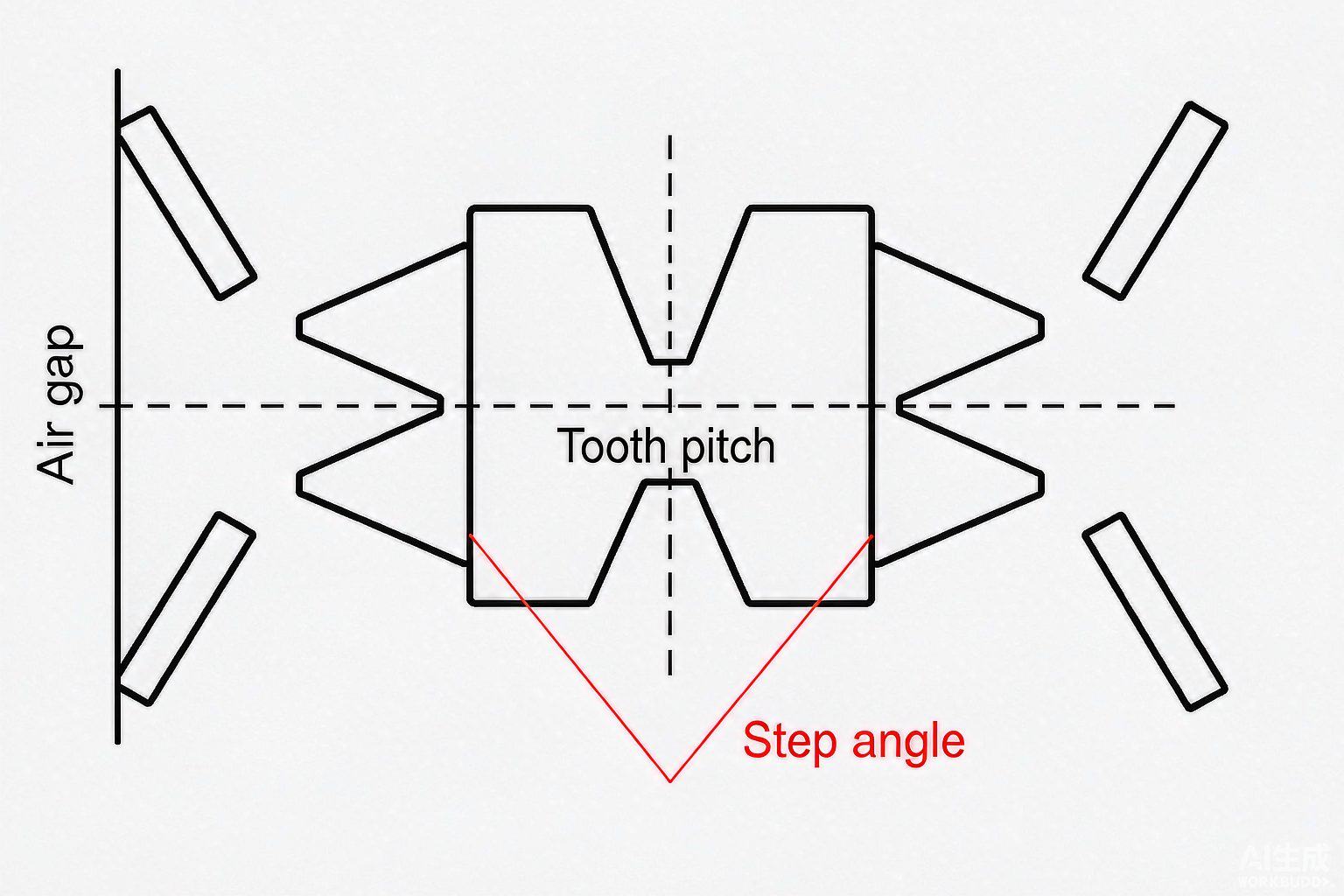
Positioning resolution (in degrees or linear units) is calculated as:
Resolution (°) = 360° ÷ (Steps per Revolution × Microstep Divisor)
But for linear motion — such as with our Linear / Lead Screw Stepper Motor — convert to millimeters or inches:
Resolution (mm) = Pitch (mm/rev) ÷ (Steps per Revolution × Microstep Divisor)
Example: A 2 mm pitch leadscrew + 1.8° motor (200 steps/rev) + 32x microstepping → 2 mm ÷ (200 × 32) = 0.0003125 mm per microstep (0.3125 µm). Impressive on paper — but again, real-world repeatability will depend on mechanical stiffness, preload, and thermal drift.
Choosing the Right Configuration for Your Application
Selecting step mode isn’t just about “more is better.” Consider these application-specific guidelines:
- High-torque, low-speed indexing (e.g., valve actuation, part clamping): Full-step or half-step on a Two-Phase Brake Stepper Motor delivers reliable, jitter-free holding.
- Smooth, quiet motion at mid-range speeds (e.g., camera gimbals, fluid dispensing): 8x–32x microstepping on a Two-Phase Waterproof Stepper Motor balances performance and environmental resilience.
- Nanometer-level repeatability (e.g., wafer inspection, fiber coupling): Combine 64x–256x microstepping with a Two-Phase Closed-Loop Motor — where encoder feedback corrects missed steps and maintains true position fidelity.
- Space-constrained rotary platforms (e.g., robotic joints, compact turntables): Our Hollow Shaft Stepper Motors support high-resolution microstepping while enabling cable or sensor routing through the center.
For deeper selection criteria — including inertia matching, voltage optimization, and thermal derating — refer to our related industry article.
Where Drivers and Motor Design Intersect
Microstepping quality depends as much on the driver as the motor. Poor current regulation, inadequate decay mode control, or insufficient PWM frequency cause current distortion — leading to uneven torque, vibration, and lost resolution. HDB’s Stepper Drivers (companion) feature adaptive current control, selectable decay modes (slow/fast/mixed), and high-frequency PWM to preserve microstep integrity across speed and load ranges.
Motor design matters too. Bipolar configurations (like our Bipolar Stepper Motor) deliver ~30–40% more torque than unipolar equivalents at the same current — making them ideal for microstepped applications demanding usable torque at fine increments. For more on wiring implications, see Bipolar vs Unipolar Stepper Motors: Wiring, Torque & Drive.
Frequently Asked Questions
Can I achieve true sub-micron positioning with microstepping alone?
No — microstepping improves resolution, not inherent accuracy or repeatability. Sub-micron positioning requires closed-loop feedback (e.g., encoder-based Two-Phase Closed-Loop Motors), high-stiffness mechanics, and thermal stability.
Does higher microstepping always improve performance?
No. Beyond 64x–128x, diminishing returns set in: torque per microstep becomes extremely low, current regulation errors dominate, and electromagnetic noise may interfere with sensitive sensors. Match microstep resolution to your mechanical system’s capabilities — not just the driver’s maximum setting.
Do all HDB stepper motors support microstepping?
Yes — all HDB stepper motors are compatible with microstepping drivers. However, optimal performance depends on pairing the right motor (e.g., low-inductance windings for high-speed microstepping) with an appropriately rated driver. See our Stepper Motors overview and our Stepper Motors guide for compatibility notes.
Conclusion
Step angle defines a stepper motor’s fundamental positional grain; microstepping refines that grain electronically; and positioning resolution quantifies the smallest controllable movement. But maximizing resolution without attention to torque delivery, mechanical design, and feedback strategy can undermine system performance. Whether you’re designing with open-loop workhorses like the Two-Phase Open-Loop Stepper Motor, ruggedized variants like the Two-Phase Waterproof Stepper Motor, or high-fidelity closed-loop solutions, always align your stepping mode with your application’s true requirements — not just its datasheet specs. contact HDB Motor for personalized guidance on optimizing resolution, torque, and reliability across your motion-control architecture.