
 Русский

Open-Loop vs Closed-Loop Stepper Motors: A Practical Comparison for Precision Motion Design
When designing automated equipment — from lab instrumentation and CNC routers to packaging machinery and semiconductor handling systems — selecting the right stepper motor architecture is a foundational decision. At first glance, all stepper motors move in discrete steps, but their underlying control philosophy divides them into two distinct categories: open-loop and closed-loop. Understanding the trade-offs between these approaches isn’t just academic — it directly impacts system reliability, cost, complexity, and long-term maintenance.
What Defines Open-Loop vs Closed-Loop Operation?
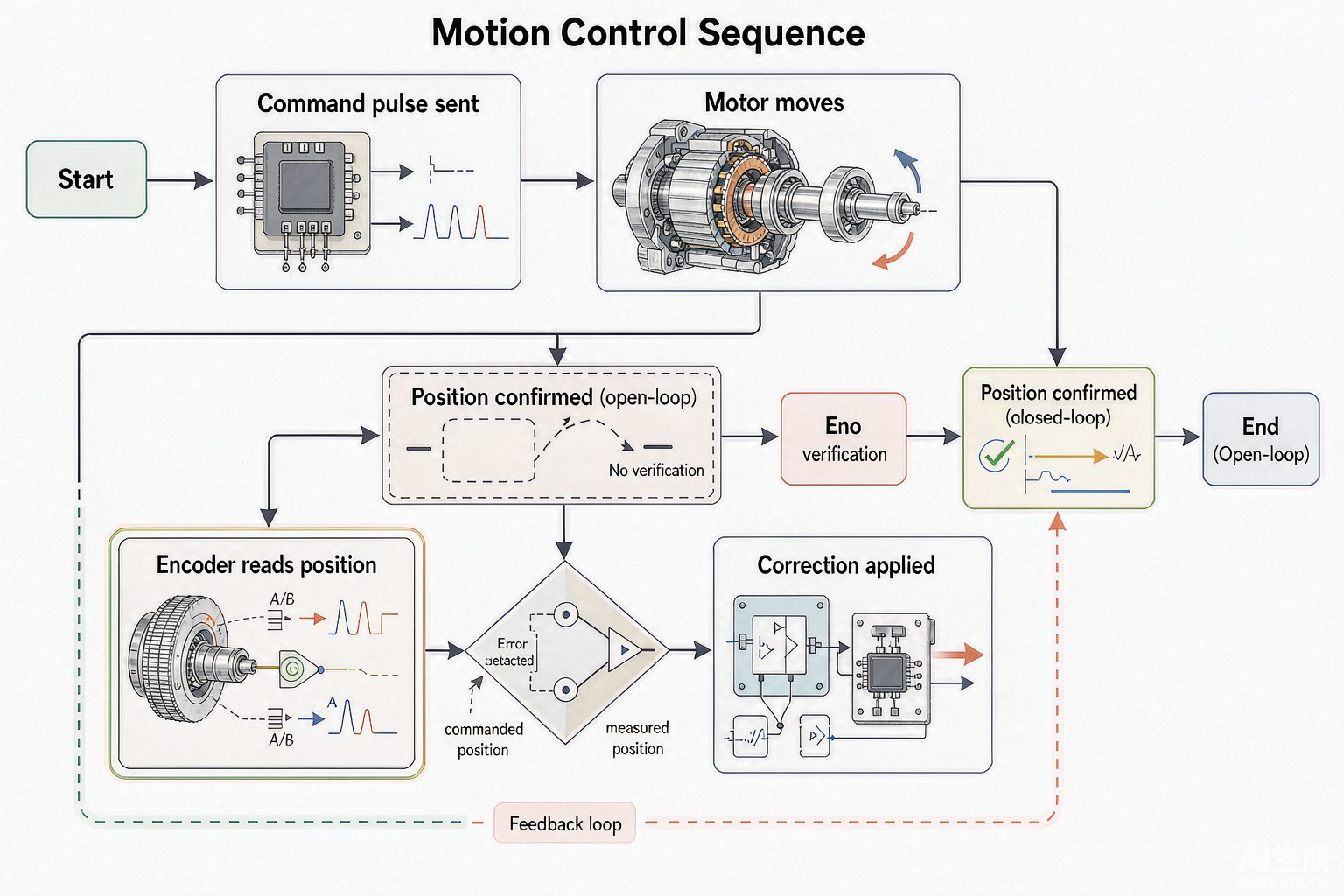
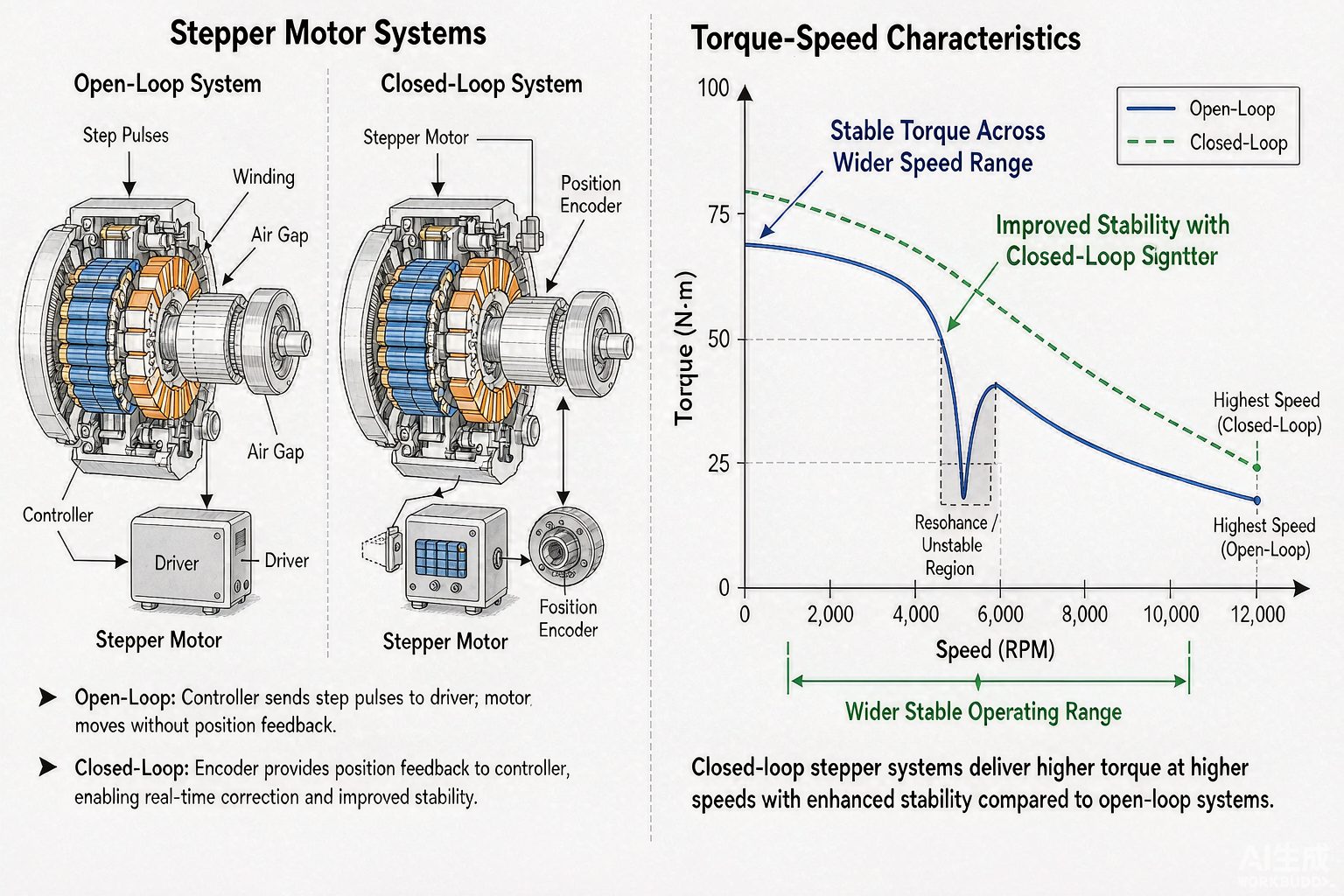
In an open-loop stepper motor system, the controller sends step-and-direction pulses to the motor driver, which energizes the motor windings accordingly. Crucially, no position or velocity feedback is returned to verify whether the motor actually executed each commanded step. The system assumes perfect execution — a reasonable assumption under light loads and conservative acceleration profiles, but one that breaks down under dynamic stress.
A closed-loop stepper motor system, by contrast, integrates real-time feedback — typically via an encoder mounted on the motor shaft — and uses a dedicated controller (often embedded in the driver or motor) to compare actual position against commanded position. If a discrepancy arises — say, due to overload, resonance, or rapid deceleration — the system dynamically adjusts current or reissues steps to correct the error.
Key Comparison Criteria
1. Cost: Upfront Investment vs Total Cost of Ownership
Open-loop systems are inherently less expensive. They require only a basic stepper driver and a motor — no encoder, no advanced control logic, no tuning overhead. For applications where positional accuracy is non-critical or where mechanical limits (e.g., end switches or hard stops) provide coarse validation, this simplicity delivers strong value.
Closed-loop systems carry higher initial cost — both in hardware (encoder, intelligent driver/motor) and engineering time (tuning, validation). However, they often reduce total cost of ownership by eliminating costly downtime from undetected missed steps, avoiding the need for redundant sensors or manual recalibration, and extending motor life through adaptive current control. In high-value production environments, this ROI becomes clear quickly.
HDB offers both paths: economical Two-Phase Open-Loop Stepper Motors for standard automation, as well as robust Two-Phase Closed-Loop Motors engineered for performance-critical tasks where zero-position loss is mandatory.
2. Missed-Step Risk: Reliability Under Load and Acceleration
This is arguably the most consequential difference. Open-loop steppers can miss steps silently — meaning the motor fails to rotate the expected amount, yet the controller remains unaware. Causes include:
- Sudden load changes or mechanical shock
- Exceeding pull-out torque at speed (see our guide on How to Read a Stepper Motor Torque Curve (Holding vs Pull-out Torque))
- Resonance-induced stalling during microstepping
- Insufficient power supply or driver current
Because there’s no feedback, recovery requires external intervention — a homing routine, reset pulse, or full system restart. That’s unacceptable in unattended operation or safety-critical sequences.
Closed-loop systems detect and recover from step loss in real time — often within milliseconds. They also enable features like stall detection without motion, adaptive current reduction at standstill (reducing heat and energy use), and smoother acceleration profiles. This makes them ideal for applications like Hollow Shaft Stepper Motors used in robotic wrists or rotary indexing tables where backdriving or inertia mismatches are common.
3. Feedback: Visibility Into System Behavior
Open-loop systems provide zero visibility into actual motor behavior. You command — you hope. Diagnostics are limited to thermal shutdowns or driver fault codes (if supported).
Closed-loop systems deliver rich telemetry: real-time position error, velocity deviation, load percentage, and even vibration signatures. This data enables predictive maintenance, process traceability, and tighter integration with PLCs or industrial IoT platforms. Many HDB Two-Phase Closed-Loop Motors support Modbus RTU or CANopen for seamless factory-floor communication.
4. Efficiency & Thermal Performance
Traditional open-loop steppers run at full rated current regardless of load — leading to unnecessary heating, especially at standstill. This reduces torque margin over time and shortens insulation life.
Closed-loop systems dynamically scale current to demand. At rest, current drops significantly (often to 30–50% of running value); under load, it ramps up precisely as needed. The result? Lower operating temperatures, quieter operation, improved torque utilization, and extended service intervals.
For harsh environments, consider pairing efficiency gains with ruggedization — like our Two-Phase Waterproof Stepper Motor or Two-Phase Brake Stepper Motor, both available in closed-loop variants for added safety and repeatability.
When to Choose Open-Loop (and When Not To)
Open-loop is still an excellent choice — if your application meets these conditions:
- Predictable, low-inertia loads with generous torque margins
- Low-to-moderate speeds (well below the motor’s resonant zone)
- No requirement for traceability or diagnostics
- Budget sensitivity outweighs risk of occasional re-homing
- Mechanical hard stops or limit switches provide position verification
Examples include simple conveyors, basic XY stages, valve actuators, and educational kits. HDB’s Bipolar Stepper Motor line — including Linear / Lead Screw Stepper Motors — is widely deployed in such roles thanks to its high torque density and plug-and-play compatibility with standard Stepper Drivers (companion).
However, avoid open-loop when:
- Positional errors could damage tooling or workpieces
- The system operates unattended for hours or days
- You’re integrating with vision systems or force sensors requiring sub-millisecond timing alignment
- Your application demands consistent microstepping resolution — see Step Angle, Microstepping & Positioning Resolution Explained
When Closed-Loop Becomes the Smarter Default
Closed-loop shines where open-loop assumptions fail — particularly in modern high-throughput, high-precision, or human-collaborative settings. It’s not just about preventing missed steps; it’s about enabling new capabilities:
- Higher sustained speeds without sacrificing torque (via active current optimization)
- True servo-like responsiveness while retaining stepper simplicity (no tuning PID loops)
- Integrated intelligence — e.g., HDB’s Integrated Pulse Stepper Motor combines encoder, driver, and controller in one compact package
- Compatibility with advanced motion profiles (S-curve, electronic gearing) when paired with capable Stepper Drivers (companion)
Three-phase open-loop options — like our Three-Phase Open-Loop Stepper Motor — offer smoother torque than two-phase but still lack feedback. Their closed-loop counterparts deliver even greater stability — especially in direct-drive rotary tables or high-dynamic gantries.
Choosing the Right Driver Architecture
The motor is only half the system. Your driver determines how much intelligence you can leverage. Basic drivers (e.g., for Two-Phase Open-Loop Stepper Motors) accept step/direction signals only. Advanced closed-loop drivers embed real-time controllers and support fieldbus protocols, auto-tuning, and multi-axis synchronization.
For designers weighing upgrade paths, note that many HDB Stepper Drivers (companion) support both architectures — letting you start open-loop and migrate seamlessly to closed-loop as requirements evolve.
Frequently Asked Questions
Can I retrofit feedback onto an existing open-loop stepper motor?
Technically yes — but it’s rarely advisable. Mounting an encoder introduces mechanical compliance, alignment challenges, and latency. Purpose-built closed-loop motors (like our Two-Phase Closed-Loop Motors) integrate encoder placement, signal conditioning, and firmware for optimal performance and reliability.
Do closed-loop steppers behave like servo motors?
They share key traits — feedback, error correction, and high-speed torque — but differ fundamentally in control philosophy and construction. Servos rely on continuous rotation and complex PID tuning; closed-loop steppers retain the inherent holding torque and deterministic step resolution of stepper technology. For a deeper comparison, see our related industry article.
Is microstepping more accurate in closed-loop systems?
Yes — significantly. Open-loop microstepping accuracy degrades rapidly beyond 1/8 or 1/16 step due to nonlinear torque distribution and resonance. Closed-loop systems actively compensate for these effects, delivering near-linear positioning across 1/256 or finer microstep resolutions — essential for optical alignment or medical dispensing.
Conclusion
There’s no universal “best” choice between open-loop and closed-loop stepper motors — only the best fit for your application’s operational, financial, and reliability requirements. Open-loop remains a cost-effective, proven solution for stable, low-risk motion tasks. But as automation grows more autonomous, precise, and interconnected, closed-loop is rapidly shifting from premium option to baseline expectation. With HDB’s full range — from ruggedized Two-Phase Waterproof Stepper Motor to intelligent Integrated Pulse Stepper Motor — you can scale performance without redesigning your entire motion stack. Explore all HDB motor products, consult our our Stepper Motors guide, or contact HDB Motor for personalized architecture advice.