
 Русский

Bipolar vs Unipolar Stepper Motors: What Engineers Need to Know
When designing or upgrading a precision motion-control system—whether for CNC stages, lab automation, semiconductor handling, or medical devices—the choice between bipolar and unipolar stepper motors is foundational. It affects not only mechanical performance but also driver selection, wiring complexity, thermal behavior, and overall system efficiency. At HDB Motor, we engineer both configurations across our Two-Phase Open-Loop Stepper Motor, Two-Phase Brake Stepper Motor, and Hollow Shaft Stepper Motors families—but the underlying electrical architecture makes all the difference.
Core Difference: Winding Configuration
The fundamental distinction lies in how the motor’s coils are wired and energized:
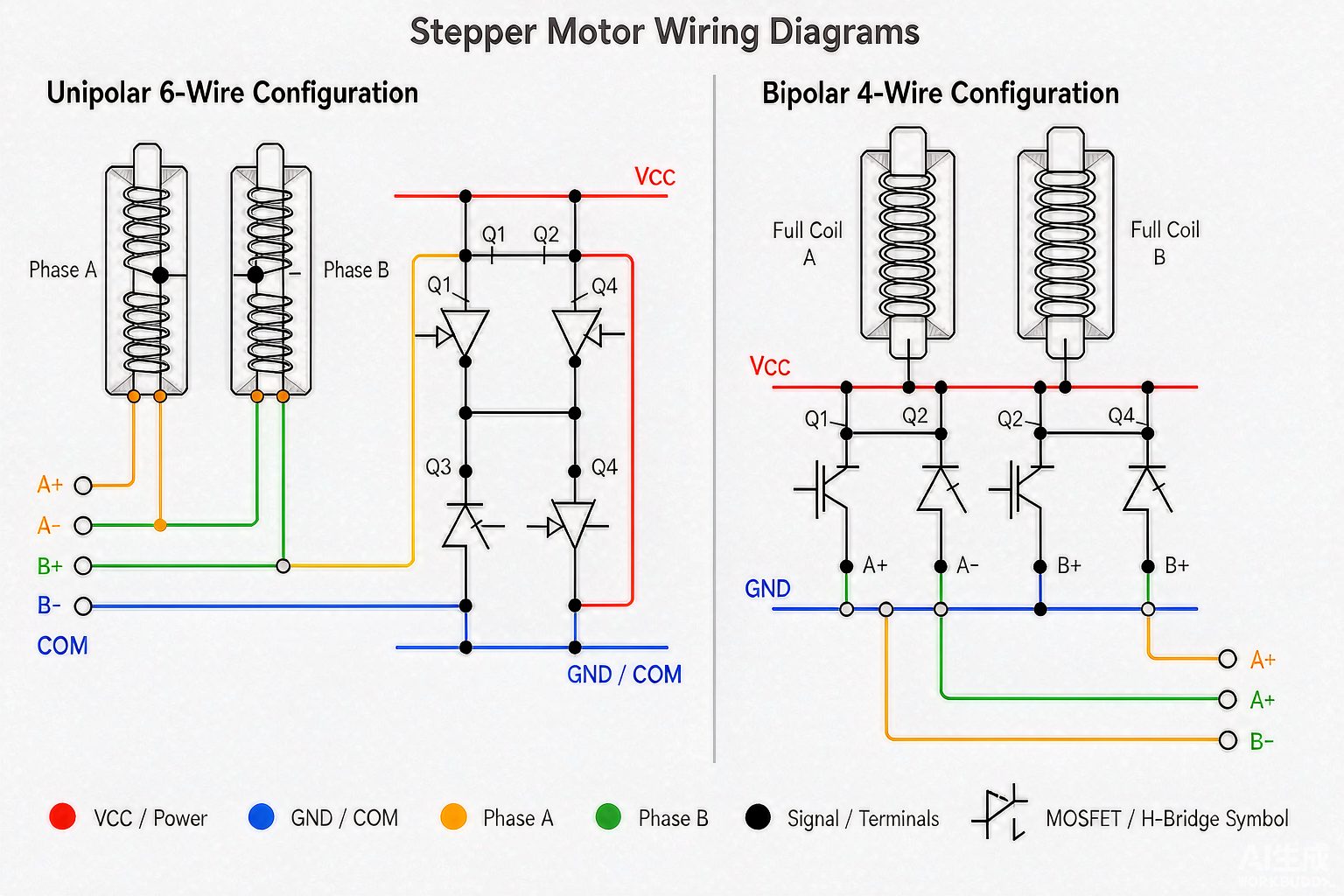
- Unipolar stepper motors feature center-tapped windings—each phase has three leads: two outer coil ends and one center tap. This allows current to flow in only one direction per half-coil at a time. A typical 5- or 6-wire unipolar motor uses four phases (two per coil) driven with simple transistor switches—no H-bridge required.
- Bipolar stepper motors have non-center-tapped windings—just two leads per phase (e.g., 4 wires total for a two-phase motor). To reverse magnetic polarity and step the rotor, current must be reversed through each coil. This requires an H-bridge driver per phase—a more complex but higher-performing topology.
This structural difference cascades into measurable impacts on torque, efficiency, and system design.
Why Bipolar Motors Deliver Higher Torque
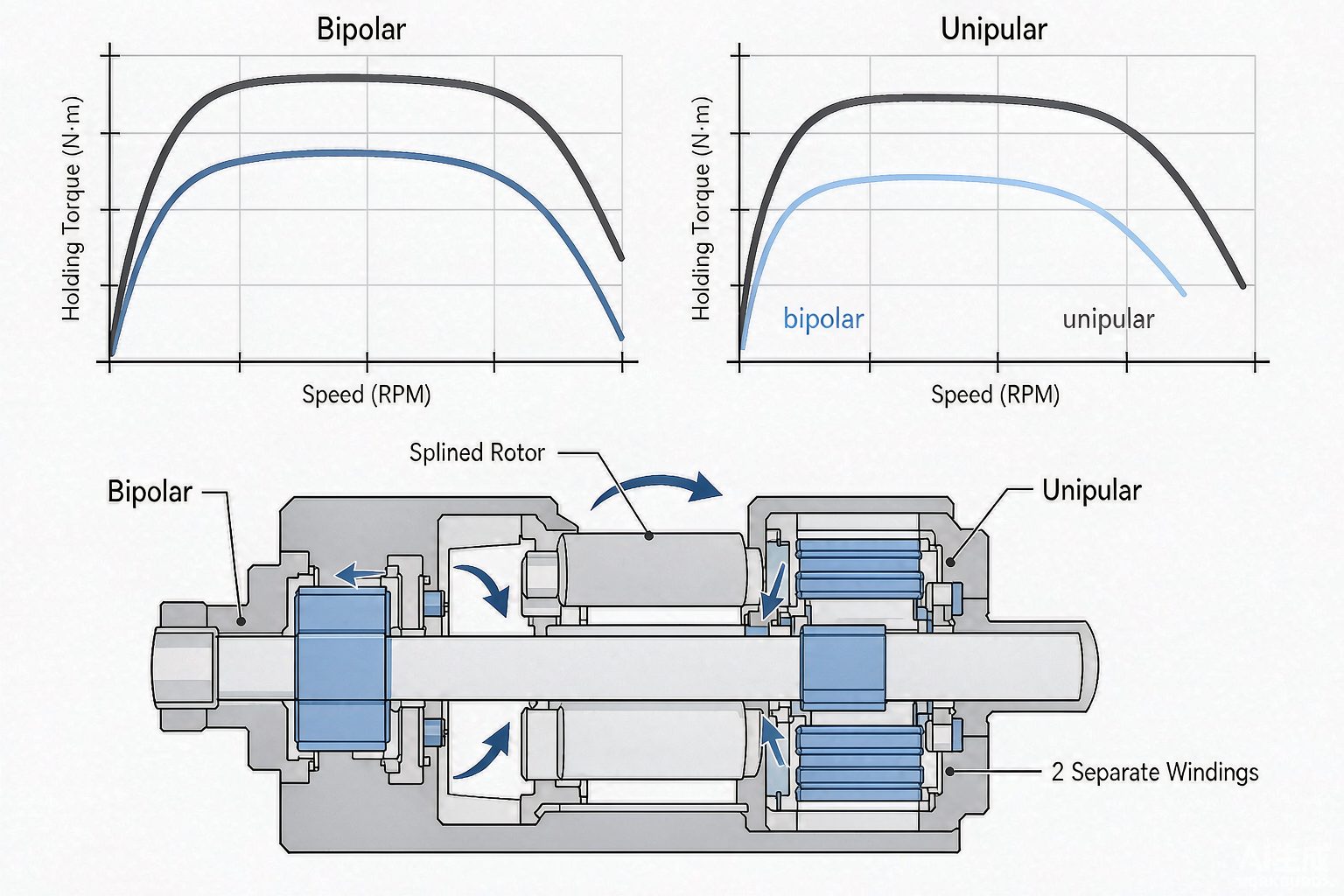
Bipolar operation yields up to ~40% more torque than equivalent unipolar setups—and here’s why:
- Full winding utilization: In unipolar mode, only half of each coil (between center tap and one end) carries current at any moment—effectively using just 50% of the copper. Bipolar drives energize the entire winding, doubling the effective ampere-turns for the same supply voltage and current limit.
- No center-tap losses: The center tap introduces resistance and potential imbalance; eliminating it improves thermal uniformity and reduces I²R losses.
- Better inductance management: Full-coil excitation allows optimized current ramp-up/down timing—especially critical at higher speeds. This translates directly into superior pull-out torque across the speed range.
For applications demanding high holding torque or dynamic responsiveness—like our Two-Phase Closed-Loop Motors or Integrated Pulse Stepper Motor—bipolar architecture is the de facto standard. To understand how torque behaves across speed, see our guide on How to Read a Stepper Motor Torque Curve (Holding vs Pull-out Torque).
Wiring Implications: Simplicity vs Performance
Wiring a unipolar motor is straightforward: connect center taps to common power (or ground), then drive outer leads with low-side switches. But simplicity comes at a cost—reduced torque density and limited microstepping fidelity.
Bipolar wiring is cleaner in lead count (4 wires for two-phase), but demands precise driver coordination. Miswiring—even swapping A+ and A−—can stall the motor or cause erratic rotation. That’s why proper identification of phase pairs (e.g., using an ohmmeter to find continuity between leads) is essential before connection.
For comprehensive guidance—including color-code standards, multimeter verification steps, and pinout diagrams for NEMA 17/23/34 frames—refer to our related industry article. It covers everything from 4-wire bipolar to 8-wire hybrid configurations (which can be wired as either unipolar or bipolar depending on your driver).
Driver Requirements: Not All Drivers Are Equal
A unipolar motor can run on basic ULN2003-style drivers—or even discrete MOSFETs—because polarity reversal isn’t needed. However, these drivers rarely support microstepping beyond full/half-step and lack advanced current regulation.
In contrast, bipolar operation mandates a true bipolar stepper driver—one capable of bidirectional current control per phase via integrated H-bridges, adaptive decay modes, and precise current limiting. Without this, you forfeit the torque advantage entirely.
HDB Motor’s Stepper Drivers (companion) line includes models supporting up to 256x microstepping, automatic idle-current reduction, and configurable step/direction interfaces—all optimized for our Bipolar Stepper Motor series. These drivers intelligently manage back-EMF and thermal rise, enabling smooth operation from standstill to >1,500 RPM without resonance-induced loss of synchronization.
It’s worth noting that many modern “universal” drivers default to bipolar mode—even when connected to 6- or 8-wire motors—because the performance benefits outweigh legacy compatibility concerns. Always confirm your driver’s wiring mode and current rating against your motor’s datasheet.
Real-World Tradeoffs: When Might You Still Choose Unipolar?
While bipolar dominates high-performance applications, unipolar configurations retain niche value:
- Educational or prototyping systems: Lower component count simplifies learning and breadboard testing.
- Low-cost, low-speed positioning: Where torque margins are generous and microstepping isn’t required (e.g., simple valve actuation or dial indexing).
- Legacy integration: Retrofitting into older controllers designed exclusively for 5/6-wire interfaces.
That said, even cost-sensitive OEMs increasingly adopt bipolar + modern drivers due to falling semiconductor prices and rising expectations for resolution and repeatability. Our Linear / Lead Screw Stepper Motor and Two-Phase Waterproof Stepper Motor lines, for example, ship exclusively with bipolar windings—not because unipolar isn’t possible, but because customers demand consistent torque, IP65 reliability, and seamless driver interoperability.
Choosing the Right Motor for Your System
Start by asking three questions:
- What’s your minimum required holding torque at standstill—and at operating speed? If peak torque matters, lean bipolar. Review our Step Angle, Microstepping & Positioning Resolution Explained to correlate torque needs with step resolution.
- Do you need closed-loop feedback or open-loop simplicity? Both bipolar and unipolar motors can be used in open-loop systems—but only bipolar enables high-fidelity closed-loop commutation (e.g., our Two-Phase Closed-Loop Motors). Learn more in Open-Loop vs Closed-Loop Stepper Motors: Which Should You Choose?
- What driver infrastructure exists—or will be deployed? Retrofitting a unipolar system with a bipolar driver often delivers immediate gains in smoothness and torque. Conversely, adding encoder feedback to a bipolar open-loop motor unlocks closed-loop advantages without rewiring.
For deeper technical context—including magnet geometry, detent torque contributions, and laminated core effects—consult our Stepper Motor Overview, which compares two-phase, three-phase (Three-Phase Open-Loop Stepper Motor), and hybrid topologies side-by-side.
Frequently Asked Questions
Can I use a bipolar driver with a unipolar motor?
Yes—but only if you rewire the motor to ignore the center taps (i.e., use only the outer leads per phase, treating it as a 4-wire bipolar). Doing so forfeits the ability to use half-coil drive but unlocks full-winding torque and microstepping capability. Verify coil resistance matches your driver’s current rating first.
Why do some motors have 6 or 8 wires?
These are hybrid motors designed for flexibility. A 6-wire motor has two center-tapped coils (common for unipolar); an 8-wire version separates all coil ends individually—allowing series (high-voltage, high-inductance) or parallel (low-voltage, low-inductance) bipolar wiring. This maximizes compatibility across diverse power supplies and drivers.
Does bipolar always mean better performance?
Not universally—but in >95% of industrial motion applications, yes. Bipolar enables higher torque, finer microstepping, better efficiency, and easier integration with smart drivers and closed-loop controllers. The minor increase in driver complexity is far outweighed by system-level gains in accuracy, noise reduction, and longevity.
Conclusion
Bipolar and unipolar stepper motors represent two paths to motion control—one prioritizing simplicity and accessibility, the other precision and power. At HDB Motor, we build for the latter: engineering robust, high-torque Bipolar Stepper Motor platforms across waterproof, hollow-shaft, brake-integrated, and closed-loop variants—all designed to pair seamlessly with our intelligent Stepper Drivers (companion). Whether you’re selecting your first motor or optimizing a high-throughput production line, understanding winding fundamentals ensures smarter decisions from schematic to installation. Explore all HDB motor products, or contact HDB Motor for application-specific recommendations backed by decades of motion-control expertise.