Русский

Why Stepper Motors Get Hot—and What It Really Means for Your Application
Stepper motors are prized for their precise positioning, simplicity, and reliability in automation, robotics, medical devices, and industrial machinery. Yet one of the most common field observations—especially among new users—is that stepper motors can become noticeably warm or even hot during operation. While some heating is normal, persistent or excessive temperature rise signals inefficiency, potential torque loss, or accelerated wear. Understanding why stepper motors get hot—and how to mitigate it—is essential for optimizing system longevity, accuracy, and safety.
The Physics Behind the Heat: Where Energy Loss Occurs
Heat generation in stepper motors stems primarily from two sources: copper losses (I²R heating) and iron losses (eddy currents & hysteresis). In standard two-phase or three-phase open-loop stepper motors—like our Two-Phase Open-Loop Stepper Motor or Three-Phase Open-Loop Stepper Motor—current flows continuously through the windings, even when the motor is stationary and holding position. Because resistance in the copper windings converts electrical energy into heat, this results in significant I²R losses at standstill.
Iron losses become more prominent at higher speeds and depend on core material quality, lamination thickness, and drive waveform fidelity. Poorly tuned drivers or high-frequency microstepping without proper filtering can exacerbate these losses—especially in compact, high-torque models like our Hollow Shaft Stepper Motors or Linear / Lead Screw Stepper Motor variants.
Idle Current: The Silent Culprit in Thermal Buildup
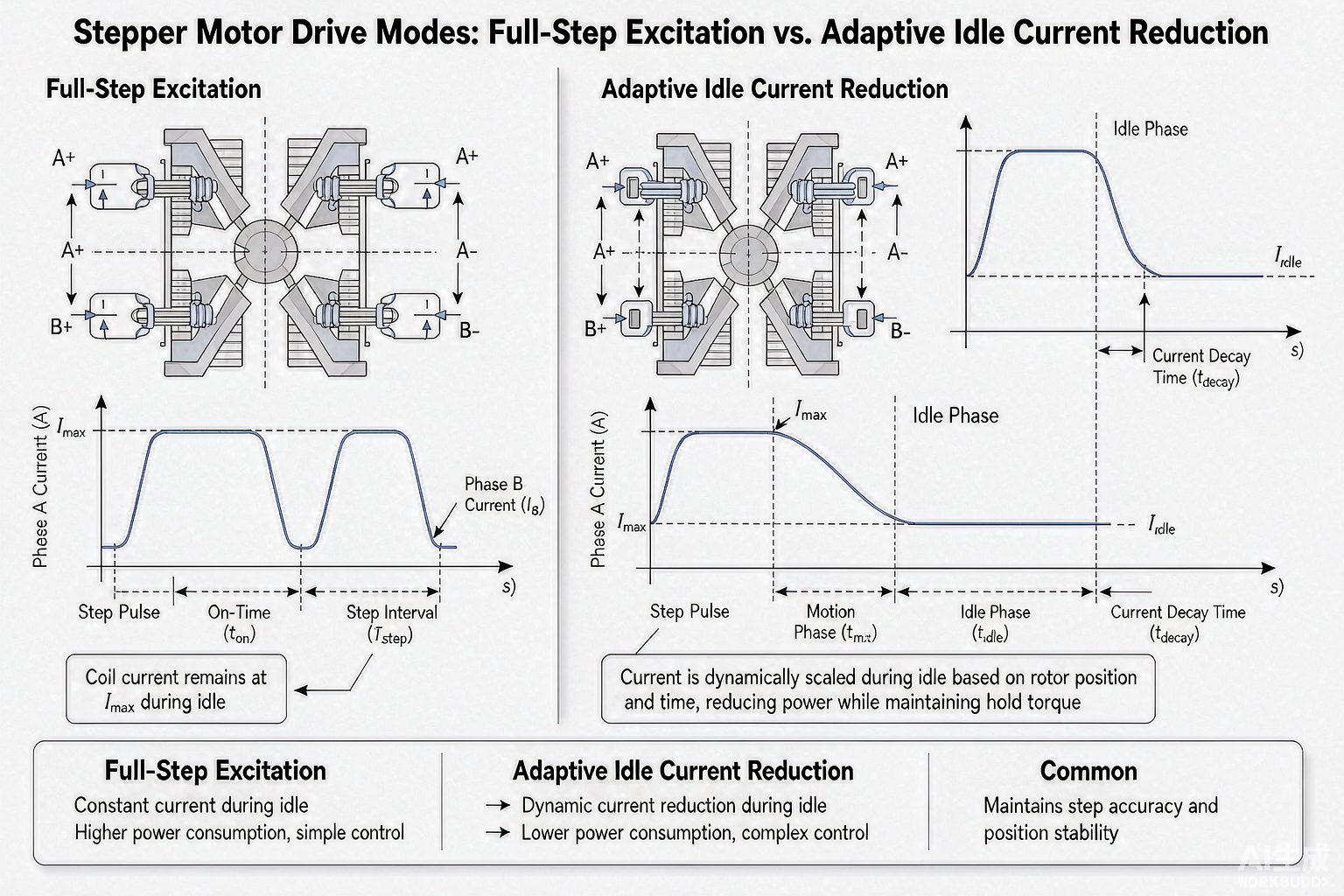
One of the most underappreciated contributors to motor heating is idle current—the full rated current supplied to hold position while the motor isn’t moving. Unlike servo systems, traditional open-loop steppers don’t reduce current automatically during dwell periods. This means a motor rated for 3 A may draw 3 A continuously just to resist external loads or maintain alignment—even with zero motion.
Modern stepper drivers (such as those in our Stepper Drivers lineup) offer automatic idle-current reduction—typically cutting current to 30–70% of running value after a programmable timeout. This simple feature can reduce holding temperature by 20–40°C, dramatically extending insulation life and improving repeatability in thermally sensitive environments (e.g., optical stages or lab automation).
For applications requiring rapid response from rest—like pick-and-place systems using our Integrated Pulse Stepper Motor—drivers with fast current ramp-up ensure minimal latency while still delivering thermal efficiency.
Ambient Conditions & Enclosure Design: Hidden Thermal Traps
Even an optimally driven motor will overheat if ambient conditions or mechanical integration work against thermal dissipation. Enclosures with poor airflow, mounting directly to heat-conductive surfaces (e.g., aluminum frames), or placement near other heat-generating components (PLCs, power supplies, hydraulic valves) compound thermal stress.
Consider these real-world factors:
- Ambient temperature: Every 10°C rise above 40°C ambient reduces allowable continuous torque by ~5–10%, per standard NEMA/IEC derating curves.
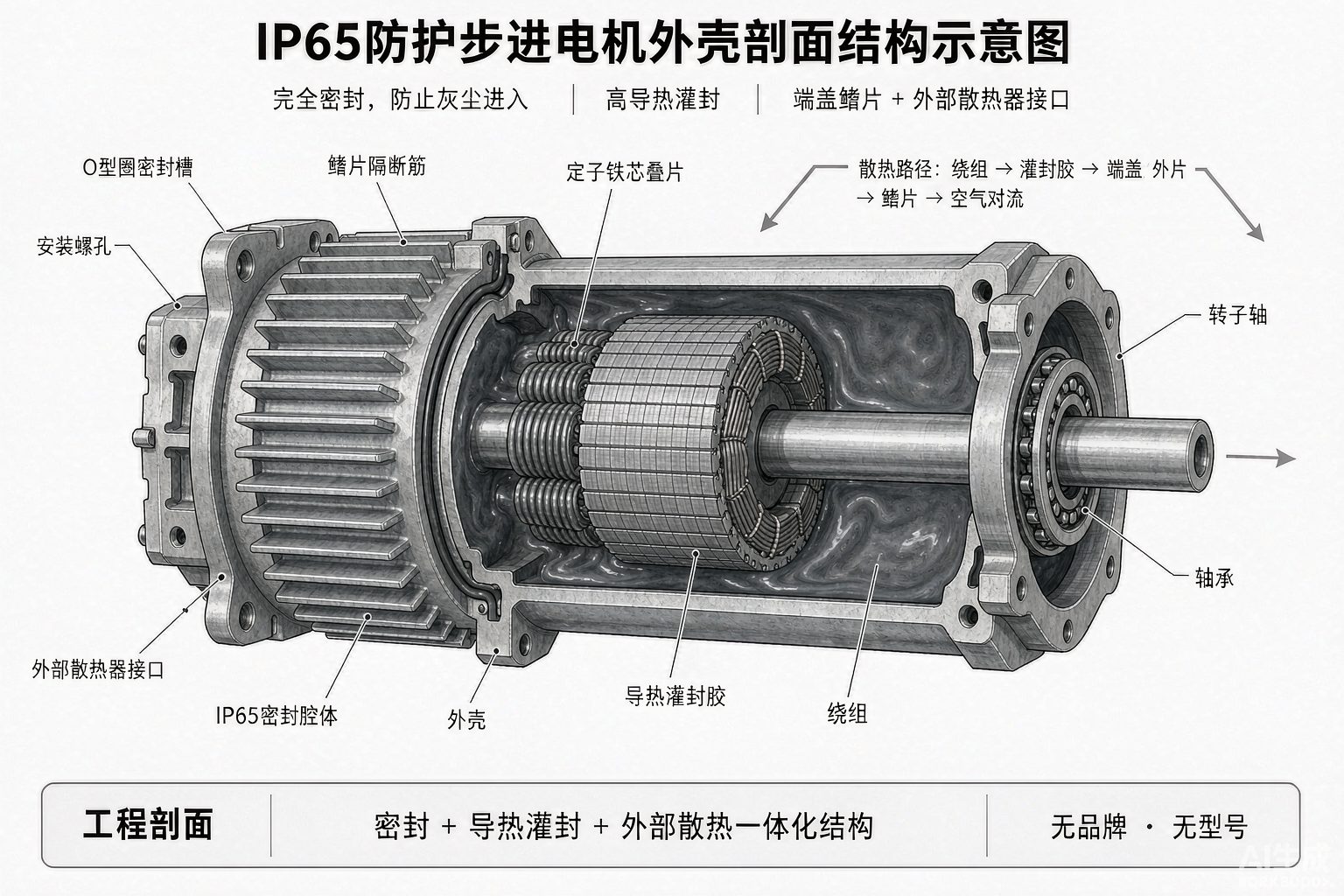
- Enclosure IP rating: Sealed enclosures trap heat—yet many washdown or outdoor applications demand protection. Our Two-Phase Waterproof Stepper Motor, rated IP65/IP67, integrates optimized thermal paths and corrosion-resistant housings to balance environmental protection with surface-area cooling.
- Mounting interface: Direct bolting to large metal plates improves conduction cooling; rubber isolation mounts insulate thermally—and acoustically—but inhibit heat transfer.
For harsh-environment deployments—such as food processing lines or marine instrumentation—pairing a waterproof stepper with active ventilation or heatsink-compatible flanges ensures stable thermal behavior without compromising ingress protection.
When Open-Loop Isn’t Enough: Why Closed-Loop Stepper Motors Reduce Heat
While open-loop stepper systems excel in cost-sensitive, deterministic-motion applications, they inherently waste energy. Without feedback, drivers must oversupply current to guarantee torque margin across worst-case scenarios—leading to unnecessary heating, especially at partial loads or low-speed operation.
Closed-loop stepper systems solve this by adding encoder feedback and intelligent current regulation. Our Two-Phase Closed-Loop Motors dynamically adjust phase current in real time based on actual load demand and position error. The result? Up to 50% lower average winding current during acceleration/deceleration, and near-zero current during precise dwell—without sacrificing torque or responsiveness.
This efficiency translates directly to cooler operation, quieter running, and extended bearing and insulation life. It also enables features like stall detection, automatic resonance suppression, and seamless integration into EtherCAT or CANopen networks—making them ideal for high-precision CNC rotary tables, semiconductor handling, or collaborative robot joints.
For deeper technical context, see our comparative guide: Open-Loop vs Closed-Loop Stepper Motors: Which Should You Choose?
Specialized Designs for Extreme Thermal Environments
HDB Motor offers purpose-built solutions where thermal management intersects with functional requirements:
- Brake-integrated models: Our Two-Phase Brake Stepper Motor eliminates the need for continuous holding current in vertical-axis or safety-critical applications—reducing heat and power consumption significantly when the brake engages.
- Bipolar configurations: With higher efficiency than unipolar wiring, our Bipolar Stepper Motor line leverages full winding utilization and lower RMS current for equivalent torque—cutting I²R losses by up to 30%.
- Waterproof + thermal-aware construction: As noted earlier, the Two-Phase Waterproof Stepper Motor uses dual-purpose materials—stainless hardware, sealed stator joints, and thermally conductive epoxy—to move heat outward while resisting moisture intrusion.
These specialized options demonstrate how thermal optimization isn’t just about cooling—it’s about aligning motor architecture, control strategy, and application constraints from the outset.
Practical Heat Management Checklist
Before deploying any stepper-based system, consider this actionable checklist:
- ✅ Use drivers with configurable idle-current reduction—and verify it’s enabled and tuned.
- ✅ Confirm ambient temperature stays within motor datasheet limits (typically 0–50°C for standard models).
- ✅ Avoid fully sealed enclosures unless using IP-rated motors designed for internal thermal management.
- ✅ For variable-load or high-dwell applications, evaluate Two-Phase Closed-Loop Motors instead of upgrading frame size.
- ✅ Refer to How to Read a Stepper Motor Torque Curve (Holding vs Pull-out Torque) to avoid oversizing—and thus over-heating—based on peak rather than RMS load.
- ✅ Consult Step Angle, Microstepping & Positioning Resolution Explained to ensure microstepping settings match your motion profile—not just resolution needs.
Frequently Asked Questions
Is it normal for my stepper motor to feel hot to the touch?
Yes—up to a point. Surface temperatures between 60–80°C are typical for many open-loop steppers under continuous load. However, sustained >90°C may indicate undersized motor, insufficient cooling, or missing idle-current reduction. Always refer to your specific model’s thermal class rating (e.g., Class B = 130°C max winding temp).
Can I add a fan or heatsink to cool my stepper motor?
You can—but carefully. Forced-air cooling helps, especially for larger NEMA 34+ frames. However, attaching heatsinks to standard motor bodies rarely improves conduction (due to air gaps and paint layers). Instead, use motors with integrated thermal pads (e.g., select Integrated Pulse Stepper Motor variants) or opt for closed-loop models that simply generate less heat.
Do waterproof stepper motors run hotter than standard ones?
Not necessarily—if designed properly. Lower-quality waterproof units may trap heat due to thick potting or non-conductive seals. HDB’s Two-Phase Waterproof Stepper Motor uses engineered thermal pathways and high-conductivity encapsulants to maintain thermal performance comparable to standard equivalents—while meeting IP67 requirements.
Conclusion
Heat in stepper motors isn’t a flaw—it’s a natural consequence of electromagnetic energy conversion. But unmanaged thermal buildup degrades performance, shortens service life, and limits design flexibility. By understanding the root causes—copper losses, idle current, enclosure effects—and selecting appropriate technologies—from intelligent drivers to Two-Phase Closed-Loop Motors and purpose-built Two-Phase Waterproof Stepper Motor units—you gain precise control over both motion and thermal behavior. Whether you’re designing a compact medical actuator or a rugged outdoor positioning system, HDB Motor’s full range of stepper solutions—including our comprehensive Stepper Motors overview and all HDB motor products—are engineered to deliver precision, reliability, and thermal intelligence. Contact HDB Motor today for application-specific thermal modeling and motor selection support.
Related Reading