
 Русский

Worm Gear Reducers Explained: Self-Locking, Efficiency and When to Use Them
Worm gear reducers are a staple in precision motion-control applications where holding torque, simplicity, and inherent safety matter more than raw efficiency. Unlike planetary or harmonic drives, the worm-and-wheel geometry delivers unique mechanical properties — most notably self-locking — that make them indispensable in vertical lifts, indexing tables, medical devices, and safety-critical actuators. In this article, we break down how worm gear reducers work, clarify common misconceptions about efficiency and heat, explain the limits of their ratio range, and help you decide whether they’re the right choice for your stepper or BLDC motor system.
How Worm Gear Reduction Works (and Why It Locks)
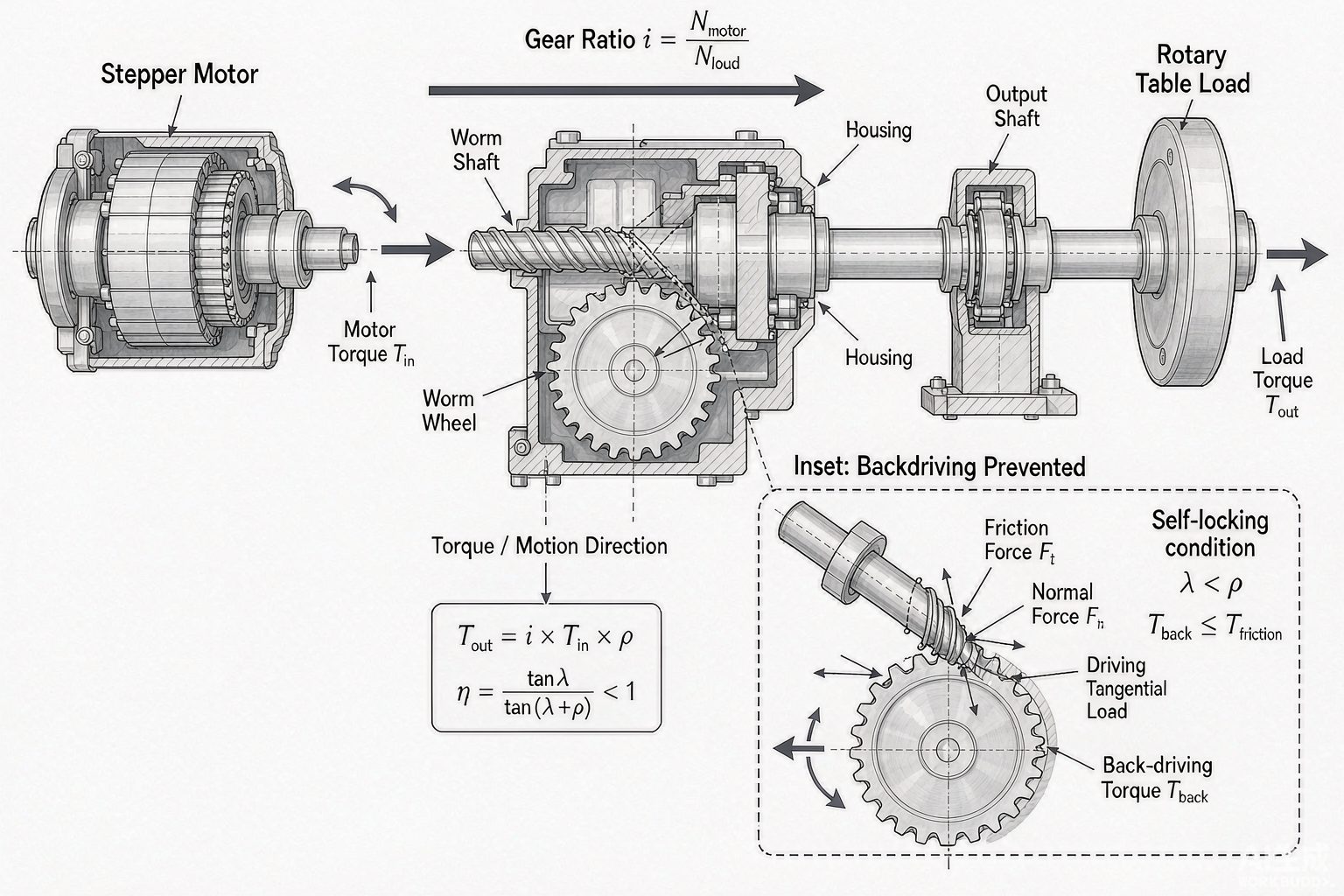
A worm gear reducer consists of two primary components: a screw-like worm (typically made of hardened steel) meshing with a toothed wheel (often bronze or high-strength polymer). The worm rotates and drives the wheel — but not vice versa. This asymmetry arises from the steep lead angle of the worm thread and high sliding friction between mating surfaces.
Self-locking occurs when the lead angle is small enough (typically ≤ 5°) that static friction exceeds the torque required to backdrive the worm. In practice, this means the output shaft cannot rotate the input shaft under load — even when power is removed. That’s why worm gearboxes are widely used in elevator door mechanisms, tilting solar trackers, and robotic joint brakes: they hold position without needing an external brake.
However, self-locking is not guaranteed across all loads, speeds, or lubrication conditions. It’s a function of gear geometry, surface finish, coefficient of friction, and ambient temperature. For mission-critical holding applications, always verify static holding torque and test under worst-case conditions — especially at elevated temperatures where lubricant viscosity drops.
Efficiency: The Trade-Off for Simplicity and Safety
Worm gear reducers are less efficient than planetary or harmonic alternatives — typically ranging from 40% to 90%, depending on ratio, materials, lubrication, and load. Lower ratios (e.g., 5:1–10:1) tend to be more efficient; higher ratios (e.g., 60:1–100:1) suffer greater sliding losses and heat generation.
This inefficiency stems from the sliding contact between worm and wheel — unlike the rolling contact in planetary gears. Sliding generates significant frictional heat, which must be dissipated through housing conduction or forced cooling. As a result, continuous-duty worm gearmotors often require derating at higher ambient temperatures or duty cycles.
If energy efficiency, thermal management, or high-speed operation is critical, consider alternatives like our Planetary Reduction Stepper Motor, which achieves >90% efficiency and superior heat dissipation due to its low-friction, multi-point load distribution.
Ratio Range and Mechanical Advantage
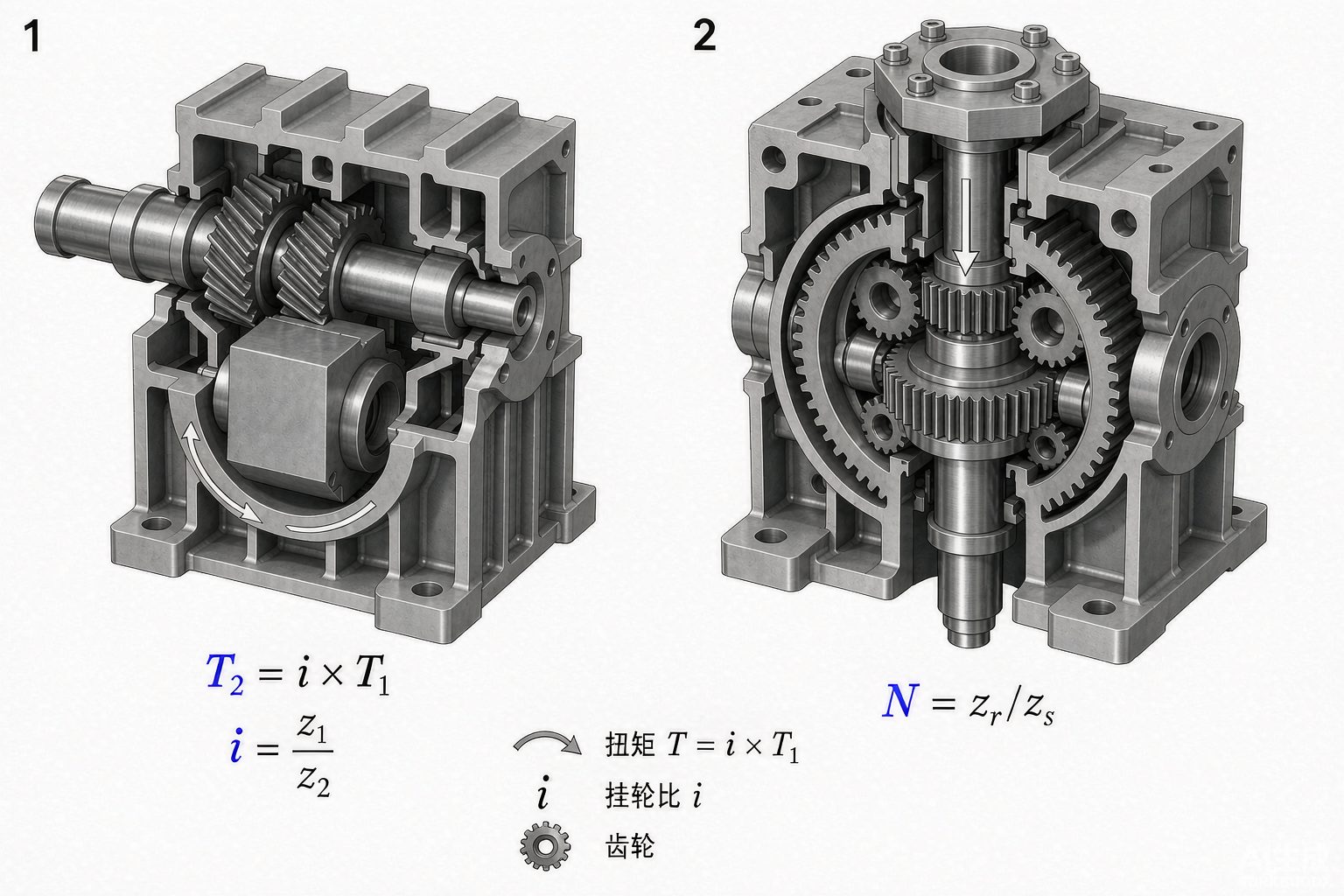
Worm gearboxes excel at delivering high reduction ratios in a single stage — commonly from 5:1 up to 100:1, with some custom designs reaching 300:1. This contrasts sharply with planetary gearboxes, which usually max out around 10:1 per stage (though multi-stage units can reach 100:1+ with added complexity and backlash).
The high single-stage ratio simplifies mechanical design and reduces part count — beneficial in compact enclosures or cost-sensitive OEM assemblies. But it also means trade-offs: larger physical size for equivalent torque capacity, slower acceleration due to higher reflected inertia, and tighter thermal constraints.
For applications demanding both high torque density and wide speed range — such as collaborative robot arms or automated guided vehicles — engineers increasingly turn to hybrid solutions or compare options using our comprehensive our Gearboxes & Reducers guide.
Heat Generation and Thermal Management
Because ~10–60% of input power converts directly to heat inside the gearbox, thermal performance dictates real-world capability. Overheating accelerates lubricant oxidation, increases wear, and can compromise self-locking behavior. Key mitigation strategies include:
- Selecting bronze wheels with high thermal conductivity and anti-wear additives
- Using synthetic lubricants rated for high sliding velocities and temperature stability
- Mounting the reducer on thermally conductive surfaces or adding heatsinks/fans
- Applying conservative torque and duty-cycle derating — especially above 40°C ambient
Unlike planetary reducers — whose compact, symmetrical layout promotes natural convection cooling — worm gear housings rely more heavily on external thermal pathways. Always consult manufacturer datasheets for thermal derating curves before finalizing a design.
Backdriving: When Self-Locking Isn’t Enough
While self-locking prevents unintended motion under static load, it does not guarantee immunity to dynamic backdriving. Sudden shocks, vibration, or rapid deceleration can momentarily overcome static friction and cause rotation. In safety-critical applications (e.g., patient lifts or overhead conveyors), designers often add redundant braking or use dual-stage worm configurations to increase effective lead-angle resistance.
Also note: backlash in worm gearboxes tends to be higher than in planetary or harmonic types — though still acceptable for many non-precision tasks. If sub-arcminute repeatability is required, review our analysis of Backlash in Gearboxes: What It Means for Positioning Accuracy before selecting a reducer family.
Worm vs Planetary: A Practical Comparison
Choosing between worm and planetary depends less on “which is better” and more on “what problem are you solving?” Here’s how they compare across key criteria:
- Self-locking: Worm — yes (geometry-dependent); Planetary — no (requires external brake)
- Typical efficiency: Worm — 40–90%; Planetary — 90–97%
- Standard ratio range: Worm — 5:1 to 100:1 (single stage); Planetary — 3:1 to 10:1 (per stage)
- Backlash: Worm — 10–30 arcmin; Planetary — 3–15 arcmin (standard), <1 arcmin (precision)
- Torque density: Planetary wins for space-constrained, high-torque apps; Worm offers simpler integration for high-ratio needs
- Noise/vibration: Worm — quieter at low speeds; Planetary — smoother at high RPM
For deeper insights into trade-offs in robotic joints or automated machinery, see our side-by-side comparison: Planetary vs Harmonic Reducer: Trade-offs for Robotics & Automation.
When Should You Choose a Worm Gear Reducer?
Worm gear reducers shine in these scenarios:
- Vertical load-holding applications — e.g., linear actuators lifting payloads without power
- Cost-sensitive, moderate-precision systems — where ultra-low backlash isn’t required but reliability is
- Low-speed, high-torque indexing — such as rotary tables or packaging cam indexers
- Safety-first environments — where failure-mode analysis favors passive locking over active braking
- Applications requiring simple, robust, field-serviceable gearheads
They’re less ideal for battery-powered mobile robots, high-speed dispensing systems, or closed-loop servo applications demanding tight positional tolerance and fast dynamic response.
Integration Tips: Sizing and Matching with Motors
Proper sizing ensures longevity and performance. Always calculate:
- Required output torque (including acceleration, friction, and safety margin)
- Reflected inertia at the motor shaft — worm reducers have higher inertia ratios than planetary equivalents
- Thermal capacity at your expected duty cycle and ambient temperature
- Input speed compatibility — avoid exceeding maximum recommended worm shaft RPM
To avoid oversizing or undersizing, refer to our step-by-step resource: How to Size a Gearbox for Your Stepper or BLDC Motor. And remember: HDB offers integrated solutions across multiple reducer families — including worm, planetary, harmonic, RV, cycloid, and cam indexers — all designed for seamless pairing with our stepper and BLDC motors. Explore all HDB motor products to find the optimal match for your application.
Frequently Asked Questions
Can a worm gear reducer be backdriven?
Yes — but only under specific conditions: high input speed, low friction (e.g., warm lubricant), light load, or impact loading. Self-locking is not absolute; it’s a function of geometry, material, and operating environment. Never assume full backdrive immunity without validation.
Why is worm gear efficiency lower than planetary?
Because worm gearing relies on sliding contact — generating significant frictional heat — whereas planetary gearing uses predominantly rolling contact with minimal slip. This fundamental difference explains the 10–50% efficiency gap.
Do HDB’s worm reducers come pre-lubricated and sealed?
Yes — most standard HDB worm gear reducers are factory-filled with long-life synthetic lubricant and sealed for life under normal operating conditions. Custom variants with serviceable ports or high-temp grease options are available upon request. contact HDB Motor for application-specific guidance.
Conclusion
Worm gear reducers offer a compelling blend of simplicity, inherent safety, and high single-stage reduction — making them ideal for applications where holding torque and fail-safe behavior outweigh efficiency concerns. While planetary and harmonic alternatives dominate in high-performance robotics and precision automation, worm gears remain unmatched in vertical-load holding, cost-sensitive industrial motion, and mechanically robust actuation. Understanding their thermal behavior, efficiency limits, and self-locking boundaries empowers engineers to select — or reject — them with confidence. Whether you’re designing a new machine or upgrading legacy equipment, explore HDB’s full range of motion-control solutions — from All Products (reducer families: harmonic / RV / worm / cycloid / cam indexer) to integrated stepper and BLDC gearmotors — and let application engineering support guide your decision.