
 Русский

BLDC Motor Sourcing: What OEMs Should Verify Before Ordering
For OEMs integrating motion control into medical devices, lab automation, semiconductor handling, or precision packaging systems, selecting the right brushless DC (BLDC) motor supplier is a make-or-break decision—not just for performance, but for long-term reliability, supply continuity, and compliance. Unlike off-the-shelf consumer-grade motors, industrial BLDC motors operate under tight thermal, mechanical, and regulatory constraints. A single overlooked specification in sourcing can cascade into field failures, costly redesigns, or production delays.
Yet many procurement teams rely on datasheet comparisons alone—or worse, on distributor assurances—without verifying the foundational build quality behind the specs. This article outlines four non-negotiable verification points OEMs must confirm before placing a BLDC motor order: winding construction, bearing grade and lubrication, certifications and traceability, and realistic lead time transparency. We’ll also show how HDB Motor’s engineering-first approach addresses each point—backed by our dedicated manufacturing processes and customer-centric support.
1. Winding Integrity: Beyond the Nameplate Torque Rating
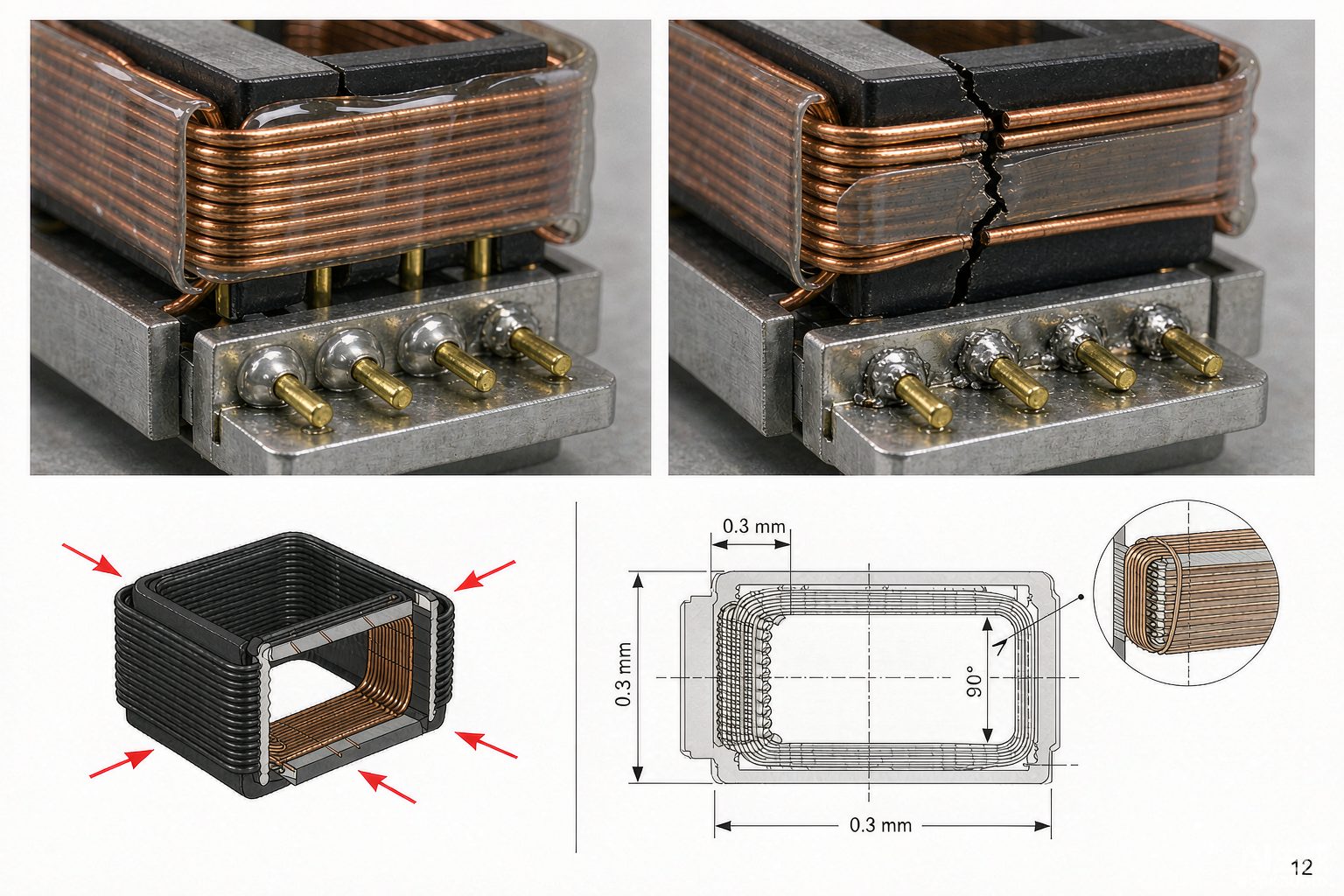
Torque and efficiency ratings are only as trustworthy as the winding process that delivers them. Poorly wound stators suffer from uneven copper fill, inconsistent turn counts, insulation voids, or inadequate varnish impregnation—all of which degrade thermal performance, increase resistance drift, and accelerate insulation breakdown under cyclic loads.
OEMs should ask suppliers:
- Is winding automated (e.g., needle-winding or toroidal winding), or hand-wound? Automated winding ensures repeatable slot fill and tension control.
- What insulation class is used (e.g., Class H, 180°C)? And is it verified per IEC 60034-1?
- Are windings vacuum-pressure impregnated (VPI) with thermally stable resin—not just dipped?
- Is partial discharge testing performed on 100% of production units—or only sampled?
At HDB Motor, every BLDC stator undergoes automated precision winding with real-time tension monitoring, followed by VPI using Class H epoxy resin. Each motor batch includes full winding resistance, inductance, and Hi-Pot test reports—traceable to lot number. This discipline ensures consistent torque linearity and thermal resilience across tens of thousands of operational hours—critical for closed-loop applications like robotic joints or optical stage positioning. Explore our full range at Brushless DC Motors.
2. Bearing Grade & Lubrication: The Silent Determinant of Lifetime
Bearings account for over 60% of motor-related field failures in continuous-duty applications. Yet bearing selection is often treated as an afterthought—especially when sourcing from generalist suppliers. OEMs must verify not just bearing type (e.g., deep-groove ball), but grade, preload, grease formulation, and relubrication capability.
Key questions include:
- Are bearings rated ABEC-5 or higher (or ISO P5/P4 for high-speed variants)? Lower grades introduce runout and vibration that compromise encoder feedback accuracy.
- Is grease selected for temperature range, oxidation stability, and compatibility with shaft material? For example, polyurea-thickened lithium complex grease performs reliably from –30°C to +120°C—unlike standard mineral greases.
- Are bearings preloaded to minimize axial play without inducing excessive friction heat? This is especially vital in direct-drive or low-backlash gearmotor configurations.
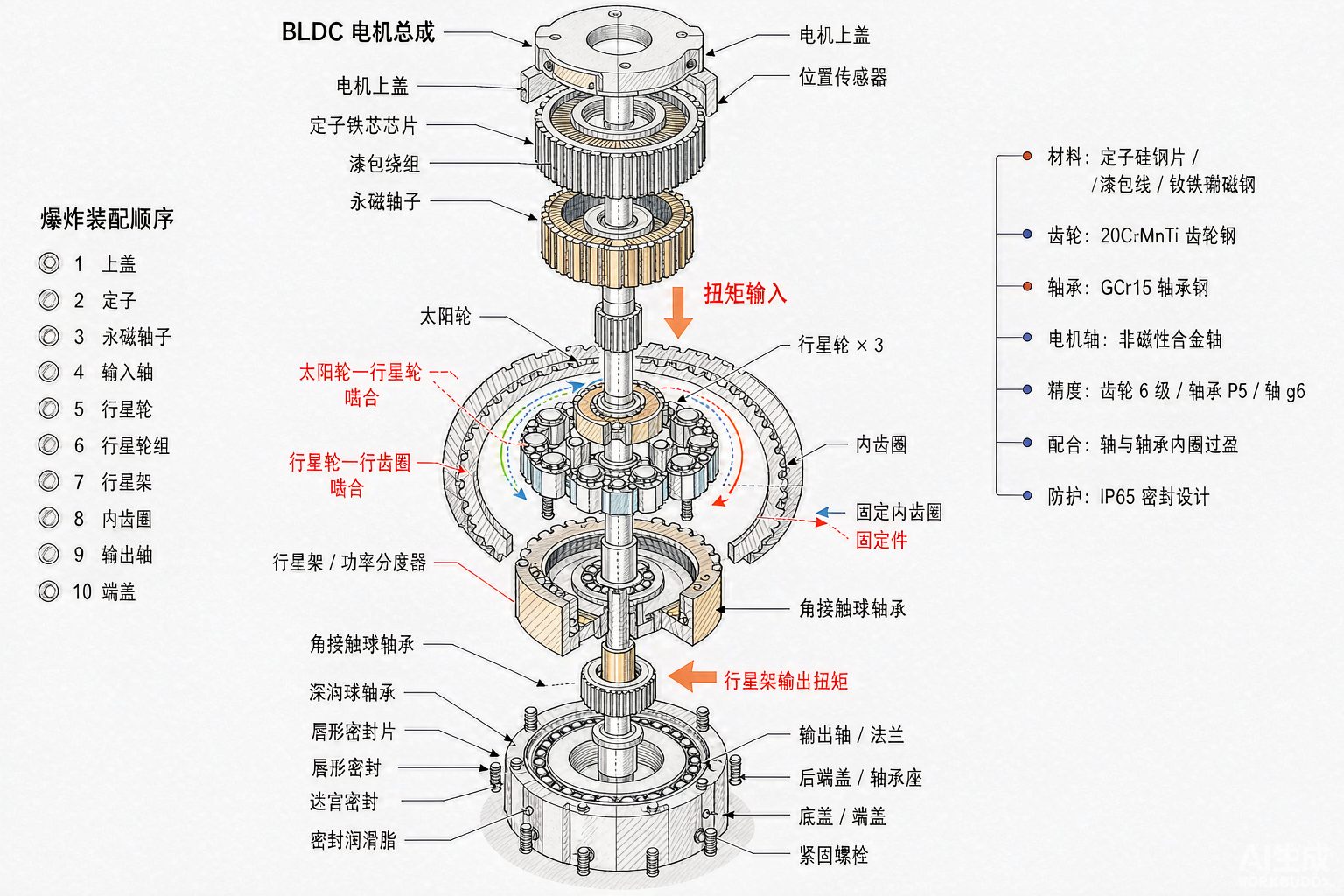
HDB’s Planetary Reduction BLDC Motor series uses ABEC-5 angular contact bearings on both ends, preloaded to ±0.005 mm axial play, and lubricated with NSK PS2 grease—rated for 20,000+ hours at 60°C ambient. In applications requiring extended life under high radial loads (e.g., rotary indexing tables), we offer optional ceramic hybrid bearings with Si3N4 balls. All bearing data—including grease type, fill volume, and re-lube intervals—is documented in the motor’s Certificate of Conformance.
3. Certifications, Traceability & Compliance Documentation
Regulatory and quality certifications aren’t checkboxes—they’re evidence of process maturity. OEMs serving FDA-regulated (medical), UL-listed (industrial equipment), or CE-marked (EU export) markets need more than a generic “CE” logo on a brochure.
Verify that your supplier provides:
- RoHS 3 and REACH declarations—with substance-level reporting (not just ‘compliant’ statements).
- UL recognition or ENEC certification for motor insulation systems (e.g., UL 1004-1, ENEC 07), not just end-product listings.
- Full traceability: serial-numbered motors linked to winding batch logs, bearing lot numbers, and final test data.
- ISO 9001:2015 certified manufacturing—with internal audit records available upon request.
HDB Motor maintains ISO 9001:2015 certification across its Shenzhen and Suzhou facilities, with annual third-party audits. Every motor ships with a digital Certificate of Conformance containing test curves (no-load speed vs. voltage, locked-rotor torque vs. current), winding resistance, and insulation resistance values. For medical OEMs, we support Design History File (DHF) documentation and provide full material declarations aligned with IEC 62474. Learn more in our Brushless DC Motors guide.
4. Lead Time Transparency: From Quote to Shipment
“4–6 weeks” means little if it excludes engineering review, custom labeling, or firmware validation. Unreliable lead times erode production schedules and inflate safety stock costs—especially for motors with integrated drivers or encoders.
OEMs should demand clarity on:
- What portion of the quoted lead time is consumed by engineering sign-off (e.g., custom winding, shaft keyway, or connector pinout)?
- Is inventory held for standard configurations—or is everything built-to-order?
- What is the supplier’s on-time delivery (OTD) rate over the past 12 months? Can they share quarterly OTD dashboards?
- Do they offer early-bird scheduling windows or consignment stocking for strategic SKUs?
HDB Motor publishes real-time lead time visibility for all standard Brushless DC Motors on our website—and honors quoted dates with >98.2% OTD over FY2023. For custom variants (e.g., IP65-rated housings or dual-channel Hall sensors), our engineering team completes feasibility review within 48 business hours. We also support JIT delivery programs with buffer stock held at regional hubs in Singapore and Dallas. Questions? contact HDB Motor directly for a lead-time consultation.
Why These Verifications Matter in Real Applications
Consider two real-world scenarios:
- A semiconductor handler OEM sourced BLDC motors with unverified Class F insulation and ABEC-3 bearings. After 14 months of 24/7 operation, 22% of units showed increased acoustic noise and encoder jitter—traced to bearing micro-pitting and winding delamination. Redesign cost: $320K in tooling and validation.
- An analytical instrument manufacturer chose HDB’s planetary-reduction BLDC motors after verifying VPI winding, ABEC-5 bearings, and UL-recognized insulation. With zero field returns over 36 months and predictable 5-week lead times, they reduced spare parts inventory by 40% and accelerated new product launch by 7 weeks.
The difference wasn’t price—it was verifiable process rigor. As automation complexity grows, so does the cost of under-specifying motion components. That’s why forward-looking OEMs treat motor sourcing as a co-engineering engagement—not a transaction.
Frequently Asked Questions
How do I compare BLDC motor commutation methods during supplier evaluation?
Ask for test reports showing speed stability at low RPM (<100 rpm), torque ripple % across load range, and startup reliability without position sensor assistance. Sensorless algorithms vary widely in robustness—especially under high inertia or variable load. Our technical deep dive compares trade-offs: Sensorless vs Hall-Sensor BLDC Commutation: Pros and Cons.
Should I choose BLDC or stepper motors for my application?
It depends on your priority: open-loop simplicity and holding torque at standstill (stepper), versus high-speed efficiency, smooth torque delivery, and scalability to higher power. See our side-by-side analysis: BLDC vs Stepper Motor: When to Use Each in Automation.
Where can I access technical fundamentals for motor selection and integration?
HDB’s engineering resources cover core topics—from tuning PID loops for BLDC speed regulation to interpreting torque-speed curves. Start with BLDC Speed & Torque Control Basics for Beginners, then explore all HDB motor products to match specs to your use case.
Conclusion
Sourcing BLDC motors isn’t about finding the lowest quote—it’s about partnering with a supplier whose process discipline matches your application’s mission-critical demands. Winding quality defines thermal headroom; bearing grade governs lifetime and precision; certifications validate compliance readiness; and lead time transparency enables supply chain resilience. At HDB Motor, these aren’t marketing claims—they’re engineered into every motor, documented in every CoC, and backed by direct engineering collaboration. Whether you’re scaling a new platform or replacing legacy motion systems, start with verification. Then contact HDB Motor to discuss your requirements with our OEM support team.