
 Русский

Delivering Precision, Silence, and Trust: How HDB’s BLDC Motors Power a Critical Medical Diagnostic Device
In the high-stakes world of medical diagnostics, every component must perform flawlessly — not just once, but over thousands of cycles, across diverse clinical environments, and under strict regulatory scrutiny. When a Tier-1 medical equipment OEM needed to upgrade the motion subsystem of its next-generation portable ultrasound-guided biopsy positioning system, reliability, acoustic performance, and electromagnetic compatibility weren’t optional features. They were non-negotiable requirements — baked into FDA 510(k) submission protocols and IEC 60601-1 safety standards.
The challenge? Replace aging brushed DC actuators with a compact, high-efficiency solution capable of delivering smooth, repeatable 0.1° angular positioning at speeds up to 120 rpm — all while operating below 32 dB(A) in quiet-room conditions and maintaining ±0.05° positional stability over 5+ years of continuous clinical use.
Why BLDC — Not Stepper or Brushed — Was the Only Viable Choice
Early feasibility studies ruled out traditional stepper motors due to resonance-induced vibration at mid-range speeds and insufficient torque density for the required acceleration profile. Brushed DC motors were eliminated for their limited service life, audible commutation noise, and brush wear — a major concern in sealed, maintenance-free medical enclosures.
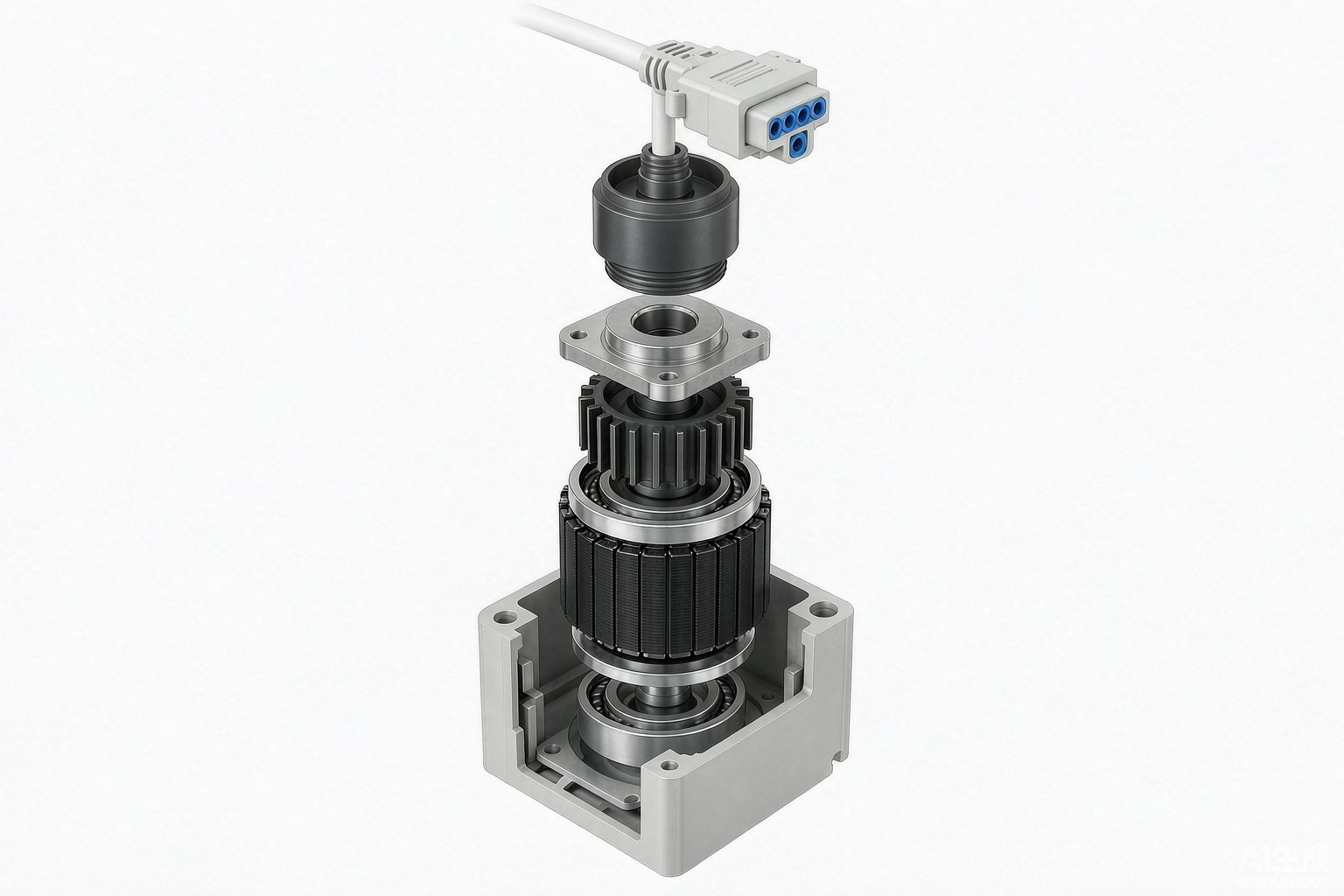
Instead, the engineering team turned to Brushless DC Motors, recognizing their inherent advantages: no brushes to wear, higher power-to-size ratios, superior thermal management, and precise electronic commutation. But not all BLDC motors are built for healthcare. What set HDB apart was our ability to co-engineer a solution aligned with both functional performance and regulatory rigor.
Custom Integration: Low Noise, High Reliability, Full Compliance
HDB collaborated closely with the OEM’s design and validation teams across three critical domains:
- Acoustic Optimization: Using proprietary stator winding patterns and balanced rotor dynamics, HDB reduced electromagnetic and mechanical noise sources at the source — not via external dampening. The final motor assembly achieved 29.4 dB(A) at 1 meter during continuous operation — well below the 32 dB(A) ceiling mandated for silent diagnostic zones.
- Reliability & Lifetime Validation: Accelerated life testing (ALT) over 15,000 hours at 40°C ambient confirmed >10-year MTBF (Mean Time Between Failures), exceeding the OEM’s 8-year field warranty requirement. Bearings were upgraded to hybrid ceramic units; insulation systems rated to Class H (180°C) ensured long-term dielectric integrity.
- EMC & Safety Compliance: All motor variants were pre-tested per IEC 61000-6-3 (emission) and IEC 61000-6-2 (immunity), with integrated RFI filtering and shielded cabling interfaces. Full documentation — including test reports, RoHS/REACH declarations, and traceable material certifications — was delivered as part of the production package to support the OEM’s 510(k) filing.
Speed & Torque Control: Predictability Meets Clinical Workflow Needs
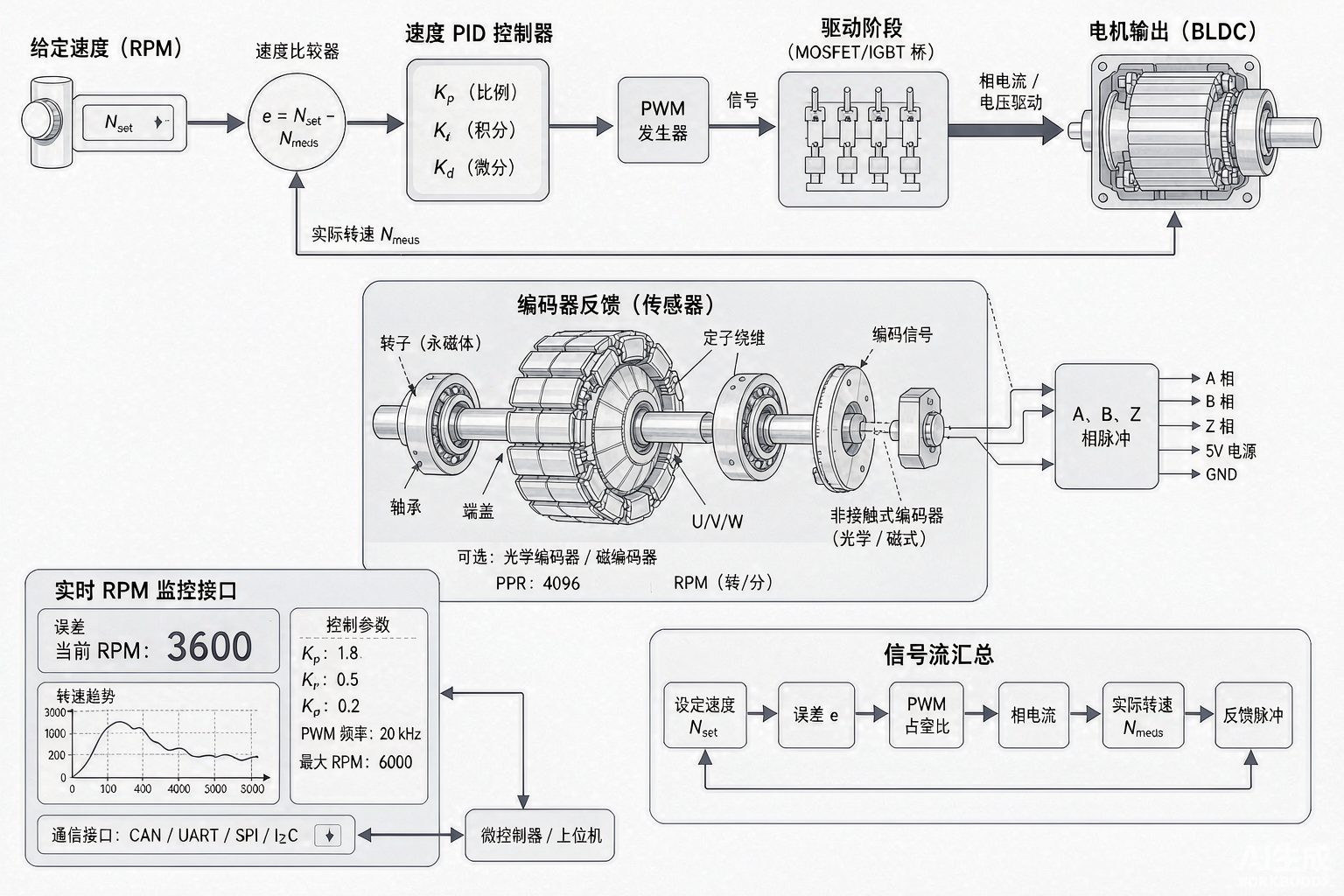
Unlike industrial applications where raw speed dominates, this device demanded adaptive, responsive, and predictable motion. During needle guidance, operators require near-instantaneous torque response (<50 ms from command to full holding torque) and ultra-smooth ramping — no jerk, no overshoot. To achieve this, HDB supplied motors paired with custom-tuned sensorless commutation firmware (based on back-EMF zero-crossing detection), validated across the full 0–120 rpm range and load spectrum (0.15–0.45 N·m).
For applications requiring absolute position feedback — such as automated calibration routines — HDB also offered an optional Hall-sensor variant. This gave the OEM flexibility to choose between cost-optimized sensorless control and deterministic Hall-based commutation where traceability was mission-critical. For deeper insight into these trade-offs, see our technical comparison: Sensorless vs Hall-Sensor BLDC Commutation: Pros and Cons.
Planetary Reduction for Clinical Precision — Without Compromise
The original actuator required gear reduction to deliver sufficient torque at low speed. Rather than bolting on an off-the-shelf gearbox (which would add backlash, noise, and failure points), HDB engineered an integrated Planetary Reduction BLDC Motor. This monolithic design featured:
- Single-stage planetary gearhead with ≤12 arc-min backlash and 92% efficiency at nominal load
- Hermetically sealed lubrication system — zero maintenance, zero migration risk inside sterile environments
- Mechanically decoupled motor and gearbox housings to isolate vibration transmission
- IP54-rated enclosure compatible with standard medical-grade cleaning agents
This integration reduced total subsystem footprint by 37%, simplified assembly (one mounting flange, one cable), and eliminated inter-stage alignment errors common in modular solutions.
Commercial Impact: Faster Time-to-Market, Lower TCO
By partnering early in the design phase — rather than responding to a purchase order — HDB enabled the OEM to:
- Eliminate two redesign cycles related to motor noise and thermal drift
- Reduce qualification time by 40% through pre-validated compliance documentation
- Cut total cost of ownership (TCO) by 22% over five years — driven by extended service intervals, lower energy consumption (18% less input power vs. prior brushed solution), and zero field returns attributed to motor failure
The device received FDA clearance six weeks ahead of schedule and has since shipped to over 240 hospitals across North America and the EU — with zero field-reported motion-related incidents.
Why This Case Study Fits the Broader BLDC Ecosystem
This project didn’t exist in isolation. It reflects broader trends shaping motion-control decisions across regulated industries — from diagnostics to lab automation to surgical robotics. As we detail in our related industry article on commercial sweeping applications, BLDC adoption is accelerating not because they’re ‘new’, but because their controllability, longevity, and clean operation align with evolving operational and sustainability KPIs.
For engineers evaluating motor technologies at the system level, understanding when BLDC delivers decisive advantage — versus stepper or other alternatives — is essential. Our comparative guide, BLDC vs Stepper Motor: When to Use Each in Automation, breaks down selection criteria by load profile, precision need, and environmental constraint — helping cross-functional teams align earlier and avoid late-stage pivots.
Getting Started with Your BLDC Motion Project
Whether you’re developing a Class II diagnostic platform, an ISO 13485-certified manufacturing line, or a next-gen point-of-care analyzer, HDB offers more than off-the-shelf motors — we deliver application-ready motion subsystems backed by deep domain knowledge. From initial concept review and thermal modeling to EMC pre-compliance testing and full regulatory documentation packages, our engineering support scales with your development maturity.
Explore our full range of precision motion solutions — including stepper motors, drivers, gearboxes, and rotary tables — at all HDB motor products. For technical deep dives, refer to BLDC Speed & Torque Control Basics for Beginners, or consult our comprehensive reference: our Brushless DC Motors guide.
Frequently Asked Questions
What certifications do HDB BLDC motors carry for medical applications?
HDB BLDC motors are designed to meet the foundational requirements of IEC 60601-1 (3rd ed.), including creepage/clearance, insulation coordination, and mechanical safety. While final system-level certification rests with the OEM, HDB provides full test reports (EMC, thermal, lifetime), material declarations (RoHS/REACH), and design documentation to streamline your regulatory pathway.
Can HDB support custom winding or encoder configurations?
Yes. We routinely develop application-specific windings (e.g., low-inductance for fast response), custom shafts (hollow, keyed, or threaded), and integrated feedback options — including optical encoders, magnetic resolvers, and Hall-effect arrays. Lead times and MOQs vary by scope; contact HDB Motor for a feasibility assessment.
Do you offer speed controllers or drives compatible with your BLDC motors?
HDB supplies matched drive solutions — from compact 24V sensorless controllers to programmable CANopen-enabled drives with PID tuning, regenerative braking, and configurable safety inputs. All are validated for interoperability with our motor families and documented for seamless integration.
Conclusion
This case study underscores a simple truth: in mission-critical medical applications, motor selection isn’t about specs alone — it’s about shared responsibility for performance, predictability, and patient trust. By combining precision-engineered BLDC hardware with application-aware engineering support, HDB helped a leading OEM transform a motion bottleneck into a competitive differentiator. If your next device demands the same balance of silence, strength, and certainty, contact HDB Motor — and let’s engineer reliability, together.