
 Русский

HDB Motor Launches High-RPM Brushless DC Motor Series for Demanding Motion Applications
Today, HDB Motor announces the expansion of its Brushless DC Motors portfolio with a dedicated High-RPM Series—designed from the ground up to deliver exceptional rotational speed, thermal stability, and dynamic responsiveness without compromising torque density or service life. This strategic product launch reflects HDB’s continued investment in next-generation motion solutions for engineers tackling increasingly complex automation challenges across medical instrumentation, semiconductor handling, packaging machinery, and high-speed laboratory equipment.
Why High RPM Matters in Modern Automation
In precision motion systems, RPM is rarely just about speed—it’s a proxy for throughput, system responsiveness, and mechanical simplification. A motor capable of sustained operation at 10,000–15,000 RPM (depending on frame size and voltage) enables designers to eliminate intermediate gear stages, reduce inertia, improve positioning repeatability, and shrink overall footprint. For example, in automated liquid handling platforms, higher spindle speeds cut assay cycle times by up to 35%. In vacuum-compatible optical chopper assemblies, reduced rotor mass and optimized magnetic circuitry minimize windage losses and vibration—critical for nanometer-level stability.
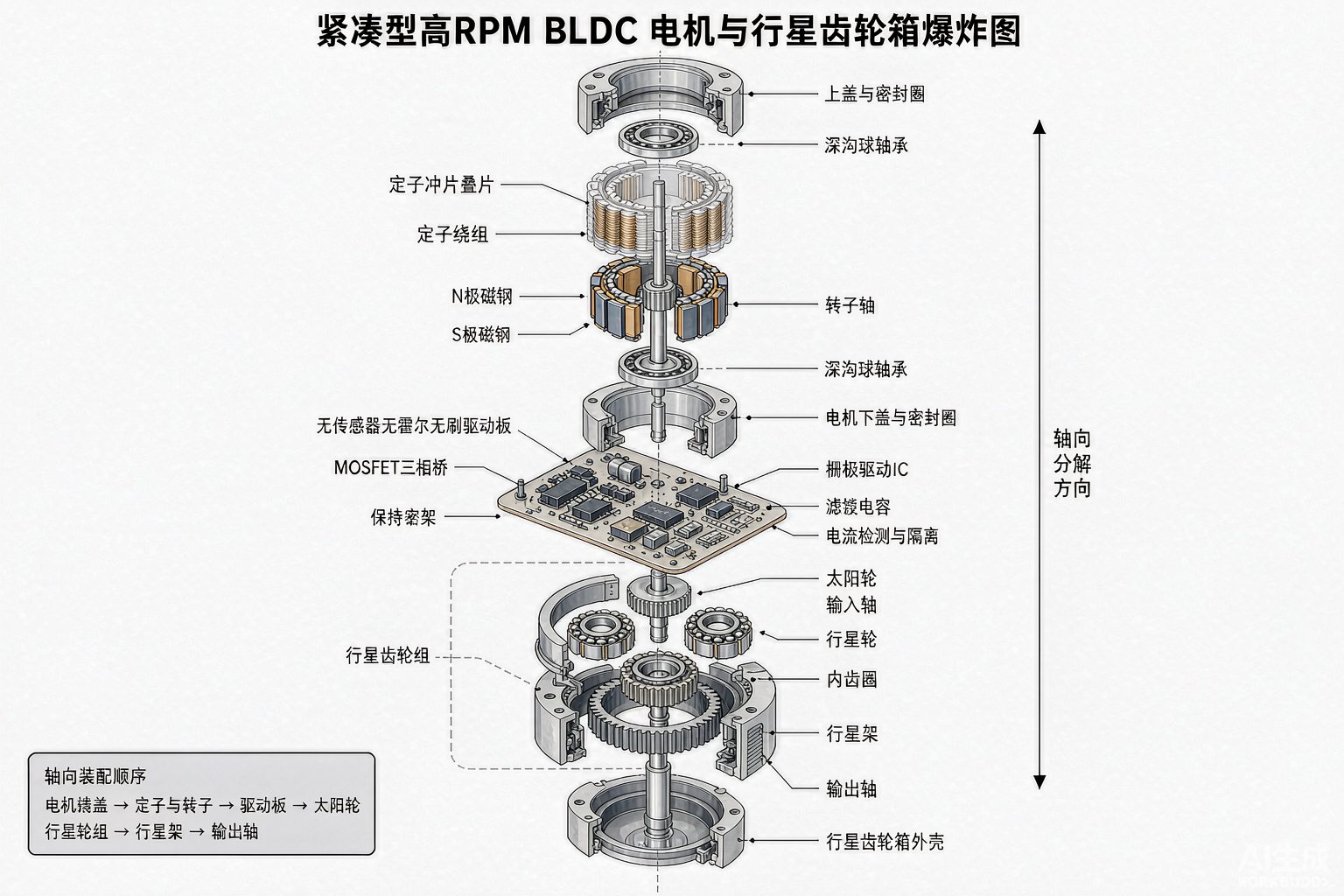
The new High-RPM Series meets these demands through a combination of proprietary stator winding architecture, low-loss laminated cores, high-grade neodymium magnets, and precision-balanced rotors. Each motor undergoes 100% run-in and back-EMF profiling to ensure consistent commutation behavior—especially vital when paired with sensorless control algorithms.
Key Technical Specifications & Design Highlights
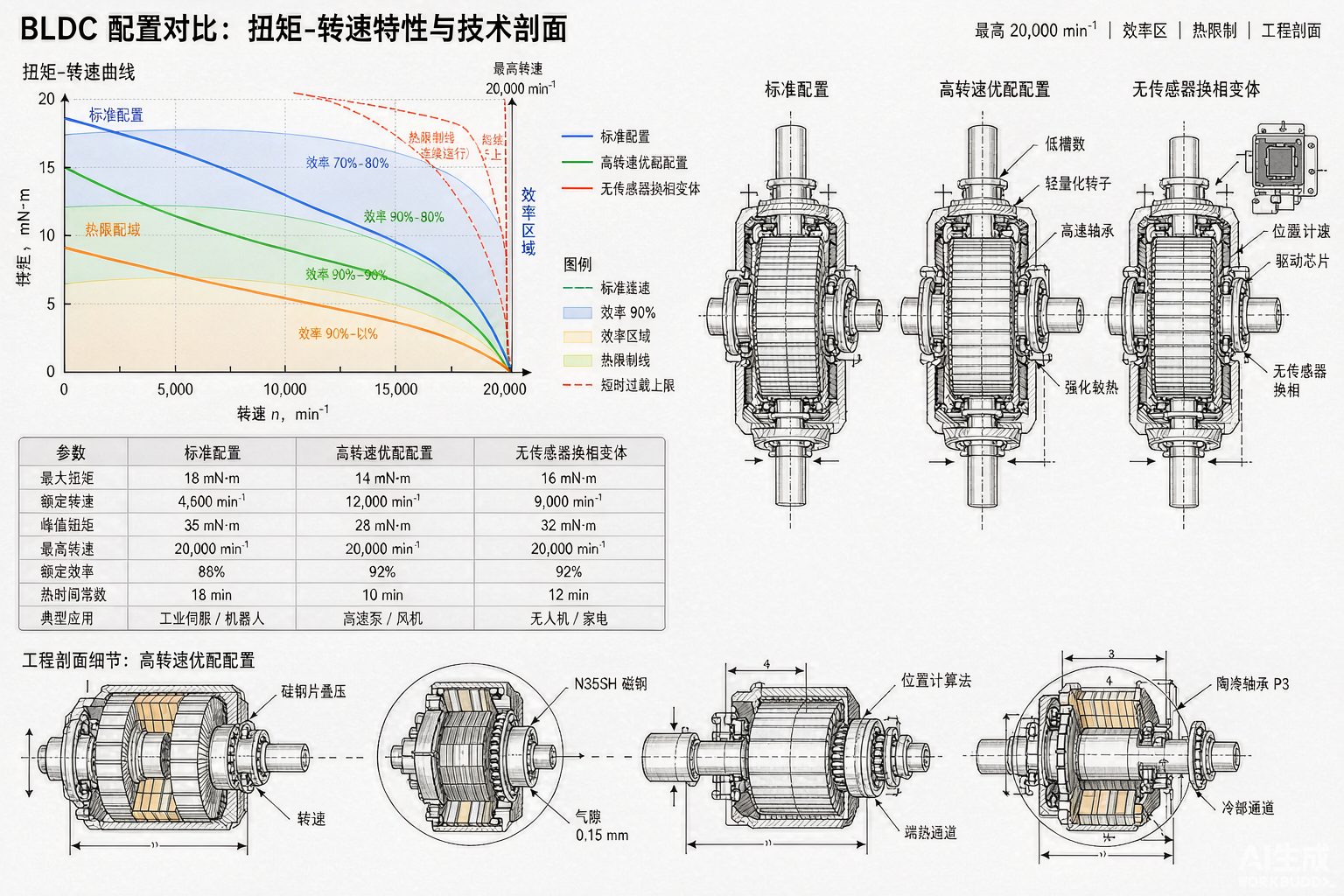
Available in NEMA 17, 23, and 34 frame sizes, the High-RPM Series operates across input voltages of 24 VDC to 75 VDC and delivers continuous speeds ranging from 8,500 RPM (NEMA 17) to 12,000 RPM (NEMA 34), with peak speeds exceeding 15,000 RPM under short-duration duty cycles. Torque output scales intelligently: while rated torque decreases slightly versus standard BLDC offerings at equivalent frame sizes, the series maintains >92% efficiency across 30–95% of base speed—enabling energy-efficient high-throughput operation.
Core engineering features include:
- Optimized Thermal Management: Integrated copper heat-sink paths and thermally conductive epoxy potting allow continuous operation at ambient temperatures up to 60°C without derating.
- Low Cogging & Vibration: Skewed magnet placement and fractional-slot winding suppress torque ripple below 3.5%—critical for smooth scanning motion and noise-sensitive environments.
- Robust Commutation Support: Fully compatible with both Hall-effect and sensorless (BEMF zero-crossing) commutation methods—giving OEMs flexibility to choose based on cost, reliability, and space constraints.
- IP54 Standard Enclosure: Sealed bearings, gasketed end caps, and conformal-coated PCBs ensure reliable performance in dusty or mildly corrosive industrial settings.
- Modular Integration Ready: All models feature standardized mounting patterns and shaft configurations—enabling seamless pairing with our Planetary Reduction BLDC Motor kits or custom gearbox assemblies.
Target Applications: Where Speed Meets Precision
This isn’t a ‘fast motor for fast’s sake’ solution. The High-RPM Series targets applications where speed, precision, and reliability intersect—and where legacy brushed or stepper-based systems have hit diminishing returns.
1. High-Throughput Packaging & Labeling Systems
Rotary indexing tables and label applicators demand rapid acceleration/deceleration cycles with sub-millisecond timing accuracy. The High-RPM BLDC’s low electrical time constant (< 0.8 ms) and high Kv (RPM/V) enable precise velocity profiling—even during 500+ rpm/s ramp rates. Paired with closed-loop drivers, these motors maintain ±0.02° position error over 10M+ cycles.
2. Medical Diagnostics & Lab Automation
In centrifuge modules, microplate shakers, and flow cytometry sample injectors, vibration control and EMI suppression are non-negotiable. The series’ ultra-low acoustic noise (< 42 dB at 1 m) and Class B EMC compliance meet IEC 60601-1 requirements out-of-the-box—reducing validation overhead for medical OEMs.
3. Semiconductor Wafer Handling & Inspection
Vacuum-compatible variants (available upon request) support cleanroom Class 100 operation. With minimal particle shedding and no brush wear debris, they’re ideal for wafer transfer arms and high-resolution stage positioning where contamination directly impacts yield.
Commutation Flexibility: Sensorless or Hall-Based?
One of the most consequential design decisions for any BLDC integration is commutation strategy—and HDB’s High-RPM Series supports both major approaches without hardware modification. Engineers can select Hall sensors for robust low-speed torque and startup reliability (e.g., in vertical lift mechanisms), or opt for sensorless control to reduce BOM cost, simplify wiring, and improve long-term reliability in sealed or hard-to-service enclosures.
Our firmware-tuned sensorless algorithms leverage adaptive filtering and phase advance compensation—delivering stable commutation down to 120 RPM and eliminating the ‘cogging hesitation’ common in generic implementations. For deeper technical context, see our detailed comparison: Sensorless vs Hall-Sensor BLDC Commutation: Pros and Cons.
How It Fits Into HDB’s Broader Motion Ecosystem
The High-RPM Series doesn’t exist in isolation. It’s engineered to interoperate seamlessly across HDB’s precision motion-control stack:
- With Drivers: Fully compatible with HDB’s S-Series smart drivers—including field-oriented control (FOC) and S-curve motion profiles.
- With Gearboxes: Direct-mount options for our Planetary Reduction BLDC Motor kits preserve efficiency while extending torque range for high-inertia loads.
- With Control Architecture: Supports analog (0–10 V), PWM, and CANopen command interfaces—enabling drop-in replacement in existing PLC- or motion-controller-based systems.
This interoperability reinforces HDB’s commitment to modular, future-proof motion solutions. As automation evolves toward tighter software-defined control and edge intelligence, having a scalable BLDC platform—where speed, feedback, and communication layers are co-engineered—is no longer optional. It’s foundational.
Getting Started: Resources & Next Steps
Engineers evaluating the High-RPM Series will find comprehensive support materials available immediately:
- Detailed datasheets, 3D CAD models (STEP, SolidWorks), and thermal simulation reports
- Application notes covering tuning best practices for high-speed FOC loops
- Reference designs for sensorless startup under load and multi-motor synchronization
- Access to HDB’s BLDC Speed & Torque Control Basics for Beginners guide—ideal for cross-training mechanical and controls teams
For those comparing motor technologies early in the design cycle, our BLDC vs Stepper Motor: When to Use Each in Automation article helps clarify trade-offs around resolution, holding torque, heat generation, and control complexity.
To explore full compatibility, integration pathways, or custom configuration options—including vacuum-rated builds, extended temperature ranges, or encoder-ready variants—contact HDB Motor directly. Our application engineers collaborate closely with design teams from concept through prototyping and volume production—ensuring optimal motor selection, driver matching, and thermal/mechanical integration.
Frequently Asked Questions
What’s the difference between the High-RPM Series and HDB’s standard BLDC line?
The High-RPM Series uses specialized electromagnetic design, lower-viscosity bearing grease, and enhanced rotor balancing to sustain significantly higher rotational speeds without sacrificing service life or thermal margin. Standard BLDC models prioritize maximum torque density at mid-range speeds (3,000–6,000 RPM); the High-RPM Series optimizes for dynamic response and efficiency above 8,000 RPM.
Can I use these motors with third-party drivers?
Yes—each motor includes standard Hall sensor outputs (for 3-wire or 6-wire interface) and well-characterized back-EMF waveforms suitable for sensorless implementation. However, for guaranteed performance at rated speed/torque, we recommend pairing with HDB’s S-Series drivers or validated third-party FOC controllers. Full pinout and timing diagrams are provided in the technical documentation.
Is there a version with integrated planetary reduction?
While the High-RPM Series ships as a standalone motor, it’s fully compatible with our Planetary Reduction BLDC Motor kits. These pre-assembled, pre-lubricated units combine the high-speed motor with precision planetary gearheads (3:1 to 10:1 ratios), delivering up to 5x increased output torque while maintaining sub-8 arcmin backlash.
Conclusion
HDB Motor’s High-RPM BLDC Series represents more than an incremental spec bump—it’s a purpose-built answer to the growing need for speed, silence, and scalability in precision automation. By combining rigorous electromagnetic design, intelligent thermal management, and flexible commutation support, this launch strengthens HDB’s position as a partner—not just a supplier—for engineers building tomorrow’s high-performance motion systems. Whether you're optimizing a lab robot, upgrading a packaging line, or designing next-gen diagnostic hardware, this series delivers the blend of speed, precision, and integration readiness that modern applications demand. Explore all HDB motor products or dive deeper into foundational concepts via our Brushless DC Motors guide to begin your evaluation.