
 Русский

Introducing the Next Generation of Precision Motion: HDB Two-Phase Closed-Loop Stepper Motors
At HDB Motor, we believe precision shouldn’t be compromised — especially when system reliability, repeatability, and long-term performance define success. That’s why we’re proud to announce the official launch of our Two-Phase Closed-Loop Stepper Motors, a purpose-built solution designed for engineers and OEMs who demand deterministic motion control without stepping into the complexity or cost of servo systems.
Why Closed-Loop? Solving Real-World Motion Challenges
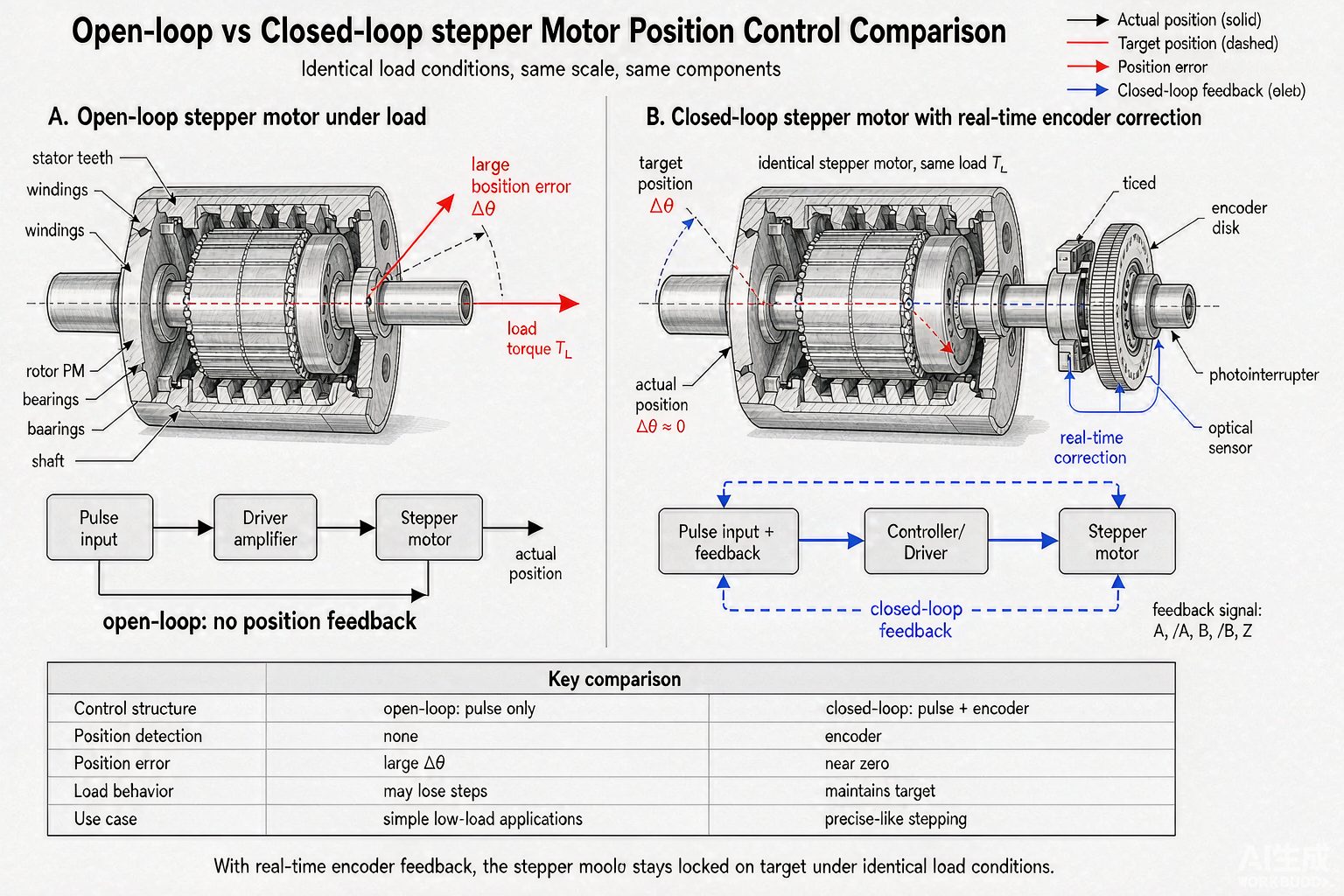
Traditional open-loop stepper motors — while reliable in many applications — face inherent limitations under variable load, rapid acceleration/deceleration, or extended duty cycles. Missed steps, positional drift, and torque drop-off can lead to costly rework, downtime, or quality deviations in high-value processes.
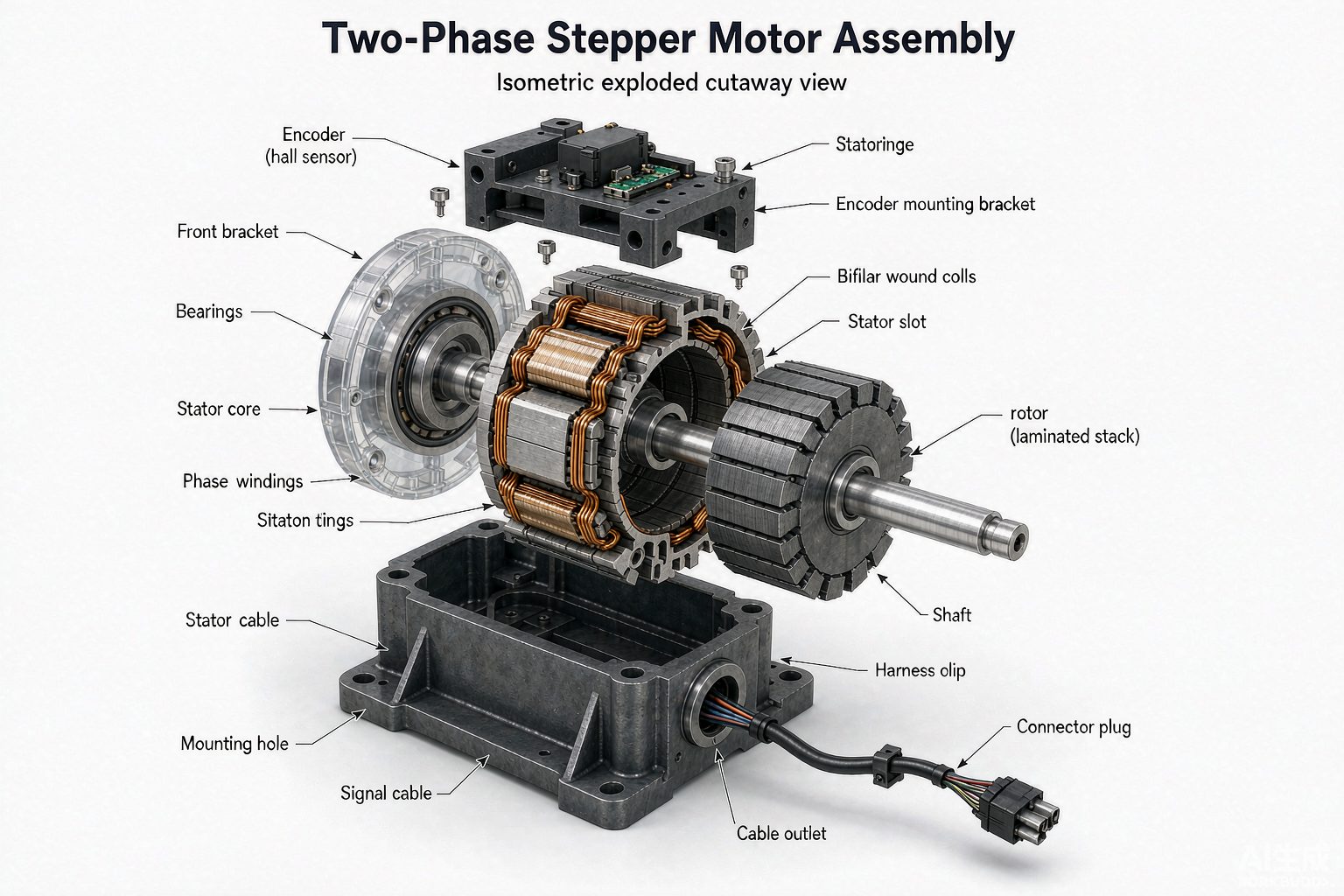
Our new closed-loop series bridges that gap by integrating high-resolution optical encoders and advanced onboard algorithms that continuously monitor rotor position and dynamically adjust current — all in real time. Unlike open-loop systems, these motors detect and correct errors before they propagate — delivering true step-and-hold fidelity across the full speed-torque envelope.
This isn’t just incremental improvement. It’s a paradigm shift in how stepper-based systems perform in mission-critical environments — from semiconductor handling to medical device assembly and beyond.
Key Technical Highlights & Performance Advantages
Built on HDB’s proven two-phase platform and rigorously validated against IEC 60034 standards, the new closed-loop motors deliver measurable gains across three core dimensions: accuracy, efficiency, and intelligence.
- Zero-Loss Positioning: Encoder feedback enables real-time correction of lost steps — eliminating positional uncertainty even during transient overloads or resonance events.
- Up to 40% Higher Effective Torque at Mid-to-High Speeds: Adaptive current control maintains optimal phase excitation, preserving torque where open-loop motors traditionally fall off — see How to Read a Stepper Motor Torque Curve (Holding vs Pull-out Torque).
- 25–35% Lower Power Consumption at Idle & Light Load: Current is automatically reduced when full holding torque isn’t required — reducing heat buildup and extending motor life.
- Integrated Thermal Protection & Stall Detection: Onboard temperature sensing and stall response logic prevent thermal runaway and enable autonomous fault recovery — critical for unattended operation.
- Plug-and-Play Compatibility: Designed to work seamlessly with our Stepper Drivers (companion) — including models supporting S-curve ramping, automatic resonance suppression, and CANopen/EtherCAT options.
Engineered for Real Applications — Not Just Datasheets
We didn’t design this motor in isolation. Every specification was validated against actual industrial use cases — where environmental stress, mechanical coupling variability, and uptime requirements shape engineering decisions.
Target Applications
- High-Precision Pick-and-Place Systems: Consistent placement accuracy (<±0.01°) across thousands of cycles — essential for electronics assembly, wafer handling, and micro-optics alignment.
- Automated Test Equipment (ATE): Repeatable indexing under dynamic load changes, with real-time verification of actuator position before signal acquisition.
- Lab Automation & Diagnostic Instruments: Quiet, low-vibration motion for pipetting, slide scanning, and fluidic control — where electromagnetic noise or positional jitter compromises assay integrity.
- Custom Rotary Tables & Gantry Modules: Paired with Hollow Shaft Stepper Motors or integrated gear reducers, these motors enable compact, high-inertia positioning stages with no external feedback wiring.
- Medical Device Actuation: FDA-aligned designs (IP54 standard; optional IP65 variants) for infusion pumps, surgical robotics, and imaging stage controls — where failure is not an option.
How It Fits Into HDB’s Broader Motion Ecosystem
This release doesn’t exist in a vacuum — it strengthens and completes HDB’s comprehensive stepper portfolio. Whether you're evaluating system architecture, optimizing total cost of ownership, or scaling production, our closed-loop motors sit at the intelligent center of a coordinated ecosystem:
- They complement our Two-Phase Open-Loop Stepper Motor line — offering a direct upgrade path for customers seeking higher reliability without redesigning mechanics or controllers.
- They extend the capabilities of our Integrated Pulse Stepper Motor family by adding encoder-grade feedback to pulse-driven architectures — ideal for legacy PLC integrations.
- They coexist with specialized variants like our Two-Phase Brake Stepper Motor and Two-Phase Waterproof Stepper Motor, enabling safety-critical or harsh-environment deployments with closed-loop assurance.
For engineers mapping their motion-control strategy, understanding the trade-offs between open- and closed-loop approaches is foundational. Our detailed comparison — Open-Loop vs Closed-Loop Stepper Motors: Which Should You Choose? — outlines selection criteria like cost sensitivity, motion profile complexity, and maintenance tolerance — helping teams align technology with business outcomes.
Getting Started: Design Support, Integration & Scalability
Launching a new motor platform means nothing without seamless adoption. That’s why every Two-Phase Closed-Loop Motors order includes:
- Free access to HDB’s Closed-Loop Tuning Assistant — a web-based tool that recommends driver settings based on your load inertia, acceleration profile, and target settling time.
- Pre-validated firmware profiles for leading PLC platforms (Siemens S7-1200/1500, Rockwell CompactLogix, Beckhoff CX series).
- Full mechanical interchangeability with existing NEMA 17, 23, and 34 frame sizes — minimizing redesign effort.
- Optional field-upgrade kits for select open-loop motors (subject to model eligibility and encoder mounting feasibility).
Need help selecting the right frame size, gear ratio, or driver pairing? Our application engineers provide free pre-sales support — including load simulation, thermal modeling, and motion profiling. Contact HDB Motor to schedule a technical consultation or request a custom evaluation kit.
Frequently Asked Questions (FAQ)
Do I need a new controller to use these closed-loop motors?
No — not necessarily. These motors are compatible with standard pulse/direction inputs and work with most modern stepper drivers. However, to unlock full closed-loop benefits (e.g., automatic current optimization, stall detection output, or real-time diagnostics), we recommend pairing them with our intelligent Stepper Drivers (companion) — especially models supporting encoder feedback loop closure.
Can I retrofit closed-loop capability onto my existing open-loop motors?
In most cases, no — closed-loop performance relies on precise mechanical integration of the encoder, optimized magnetic circuit design, and matched control algorithms. However, HDB offers select upgrade paths for specific open-loop models. Contact our team to explore feasibility for your application.
How does resolution compare to open-loop with microstepping?
While microstepping improves smoothness, it doesn’t guarantee positional accuracy — especially under load. Our closed-loop motors maintain true step fidelity regardless of microstep setting. For deeper insight, read our guide: Step Angle, Microstepping & Positioning Resolution Explained.
Conclusion
The launch of HDB’s Two-Phase Closed-Loop Stepper Motors marks more than a product update — it reflects our ongoing commitment to empowering automation engineers with smarter, more resilient, and truly deterministic motion solutions. By combining decades of stepper expertise with embedded intelligence and industrial-grade robustness, we’re enabling next-generation machines that operate with confidence — not compromise.
Explore the full range of motion-control technologies at all HDB motor products, or dive deeper into stepper fundamentals via our our Stepper Motors guide. Ready to specify? Visit the dedicated product page: Two-Phase Closed-Loop Motors.