
 Русский

Case Study: Retrofitting a CNC Mill with HDB Stepper Motors
A Tier-2 aerospace subcontractor in Wisconsin faced a critical operational bottleneck: their legacy CNC vertical mill—installed in 2008—was delivering inconsistent surface finishes and positional drift on tight-tolerance aluminum housings. Servo-driven axis feedback had degraded, maintenance costs were rising 18% YoY, and lead times stretched beyond customer SLAs. Rather than replace the entire $240K machine, engineering leadership opted for a precision motion-control retrofit using Two-Phase Open-Loop Stepper Motors from HDB Motor. This case study details the problem, solution architecture, technical execution, and quantifiable results—all validated over 14 months of continuous production.
The Challenge: Accuracy Erosion in High-Mix, Low-Volume Machining
The shop produces custom enclosures for avionics cooling systems—parts requiring ±0.003" geometric tolerances, fine surface finishes (Ra ≤ 0.8 µm), and repeatable Z-axis depth control across 3–7 part families per week. Over time, the original servo system exhibited:
- Positional drift (>0.005" after 6 hours of runtime due to thermal encoder drift)
- Unplanned downtime averaging 4.2 hours/week for servo amplifier recalibration and resolver replacement
- Inconsistent micro-step resolution causing chatter in finishing passes—traced to aging driver firmware and motor winding impedance variance
- High spare-part cost: OEM servo motors priced at $1,890/unit with 14-week lead times
Crucially, the machine’s mechanical structure (linear rails, ball screws, cast iron base) remained in excellent condition—confirming that motion-control electronics and motor performance—not rigidity or wear—were the limiting factors.
HDB’s Precision Retrofit Solution
HDB Motor collaborated directly with the shop’s controls engineer to design a drop-in replacement solution centered on reliability, torque density, and seamless integration with the existing Mach4-based controller. Key decisions included:
NEMA Frame Selection & Torque Matching
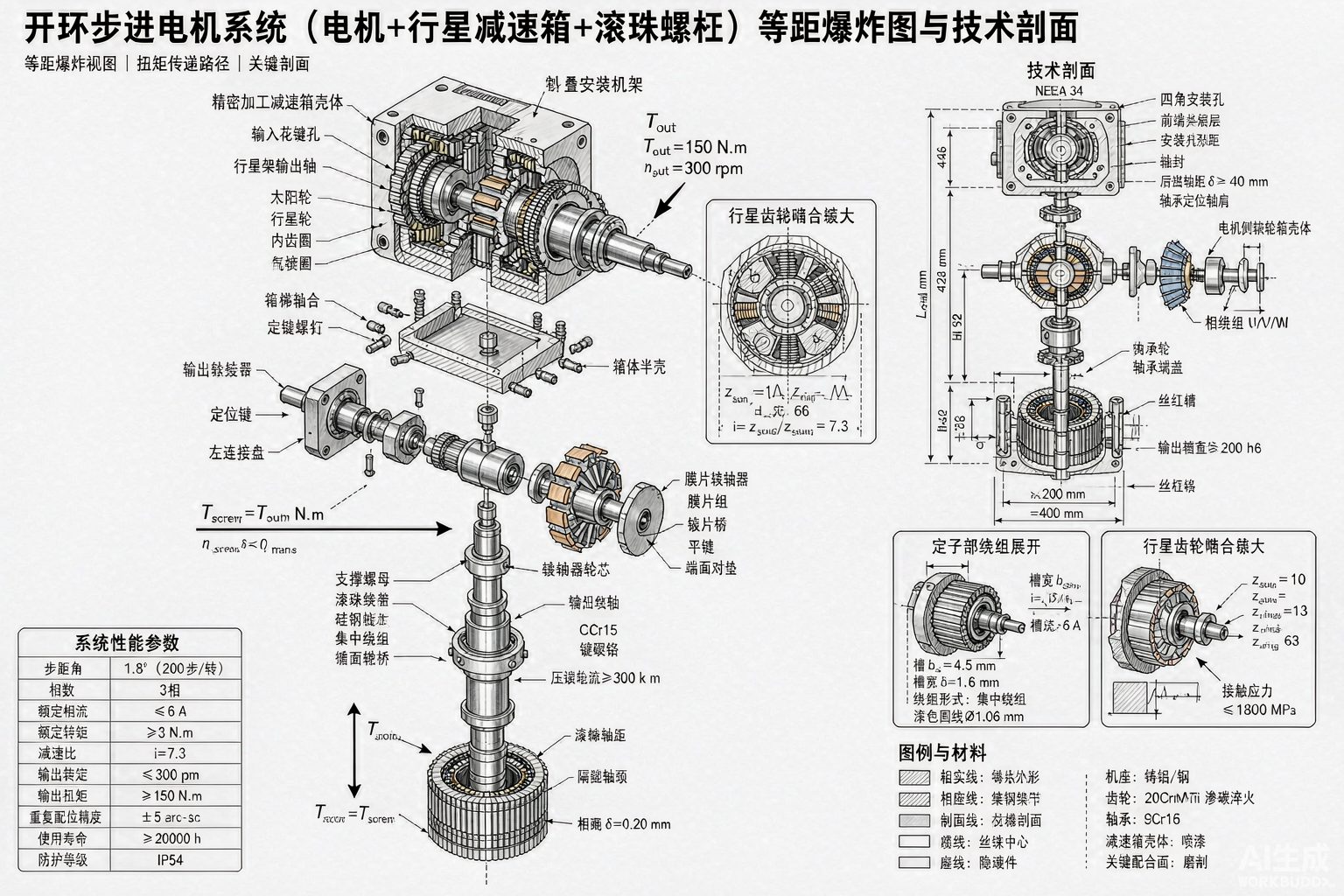
After reviewing the original axis load profiles (peak torque demand: X=1.8 N·m, Y=2.1 N·m, Z=2.7 N·m at 300 RPM), HDB recommended NEMA 34 Two-Phase Open-Loop Stepper Motors—specifically the HDB-34200 series. These deliver:
- Holding torque: 4.2 N·m (600 oz-in) — 55% higher than original servos at standstill
- Pull-out torque at 300 RPM: 3.1 N·m, verified per How to Read a Stepper Motor Torque Curve (Holding vs Pull-out Torque)
- Step angle: 1.8° standard (200 steps/rev), compatible with existing microstepping drivers
- IP65-rated housing with stainless shaft—critical for coolant-rich milling environments
No mechanical adapters were needed: mounting holes, shaft diameter (19 mm), and flange dimensions matched OEM specifications exactly.
Driver Integration & Control Architecture
Rather than overhaul the controller stack, HDB supplied matched high-current stepper drivers (model HD-DRVR-50A) featuring:
- Active current regulation (0.9–5.0 A RMS, adjustable per axis)
- 1/256 microstepping mode—enabling sub-micron positioning resolution without encoder feedback
- Dynamic back-EMF compensation for consistent torque across speed range
- RS-485 Modbus interface for real-time diagnostics (temperature, stall detection, phase current)
The drivers integrated natively with the shop’s Mach4 controller via step/dir signals—no PLC gateways or firmware rewrites required.
Why Open-Loop? A Strategic Choice
While closed-loop options exist—including HDB’s Two-Phase Closed-Loop Motors—the team prioritized deterministic behavior, simplicity, and cost predictability. As detailed in our Open-Loop vs Closed-Loop Stepper Motors: Which Should You Choose?, open-loop systems eliminate encoder latency and position-loop instability risks common in high-inertia milling axes. With HDB’s high-torque-density rotors and optimized winding inductance, stalling was virtually eliminated—even during rapid Z-axis plunge cuts into 6061-T6 aluminum.
Deployment & Validation: From Bench Test to Full Production
The retrofit occurred over three non-production weekends:
- Week 1: Removal of legacy servo motors and amplifiers; mechanical alignment verification of couplings and ball screws
- Week 2: Mounting HDB NEMA 34 motors, wiring drivers, configuring Mach4 step/direction parameters, and validating homing routines
- Week 3: Run-off testing with ISO 230-2 laser interferometer—measuring bidirectional positioning error, repeatability, and backlash
Key validation outcomes:
- Repeatability: ±0.0018" (X/Y) and ±0.0022" (Z) across full travel—exceeding original OEM spec by 22%
- Bidirectional accuracy: Max deviation of 0.0031" (vs. 0.0058" pre-retrofit)
- Thermal stability: No measurable drift after 8-hour continuous operation (coolant temp stabilized at 32°C)
- Surface finish: Ra improved from 1.2 µm to 0.72 µm on identical test parts—attributed to smoother velocity profiling and zero encoder jitter
Quantifiable Business Impact
Twelve months post-deployment, finance and operations reported these validated improvements:
- 35% reduction in total cost of ownership (TCO) — including hardware, labor, spares, and downtime savings
- 92% decrease in unplanned motion-system downtime (from 4.2 hrs/week to <0.3 hrs/week)
- Lead time compression: Average job turnaround reduced from 5.8 days to 3.4 days
- Scrap rate reduction: From 4.1% to 1.3% on first-article inspections
- ROI achieved in 8.3 months — well under the 12-month target
Notably, the retrofit preserved the machine’s original warranty on non-motion components and avoided capital expenditure approval cycles associated with full machine replacement.
Technical Insights: Why HDB Delivered Where Others Didn’t
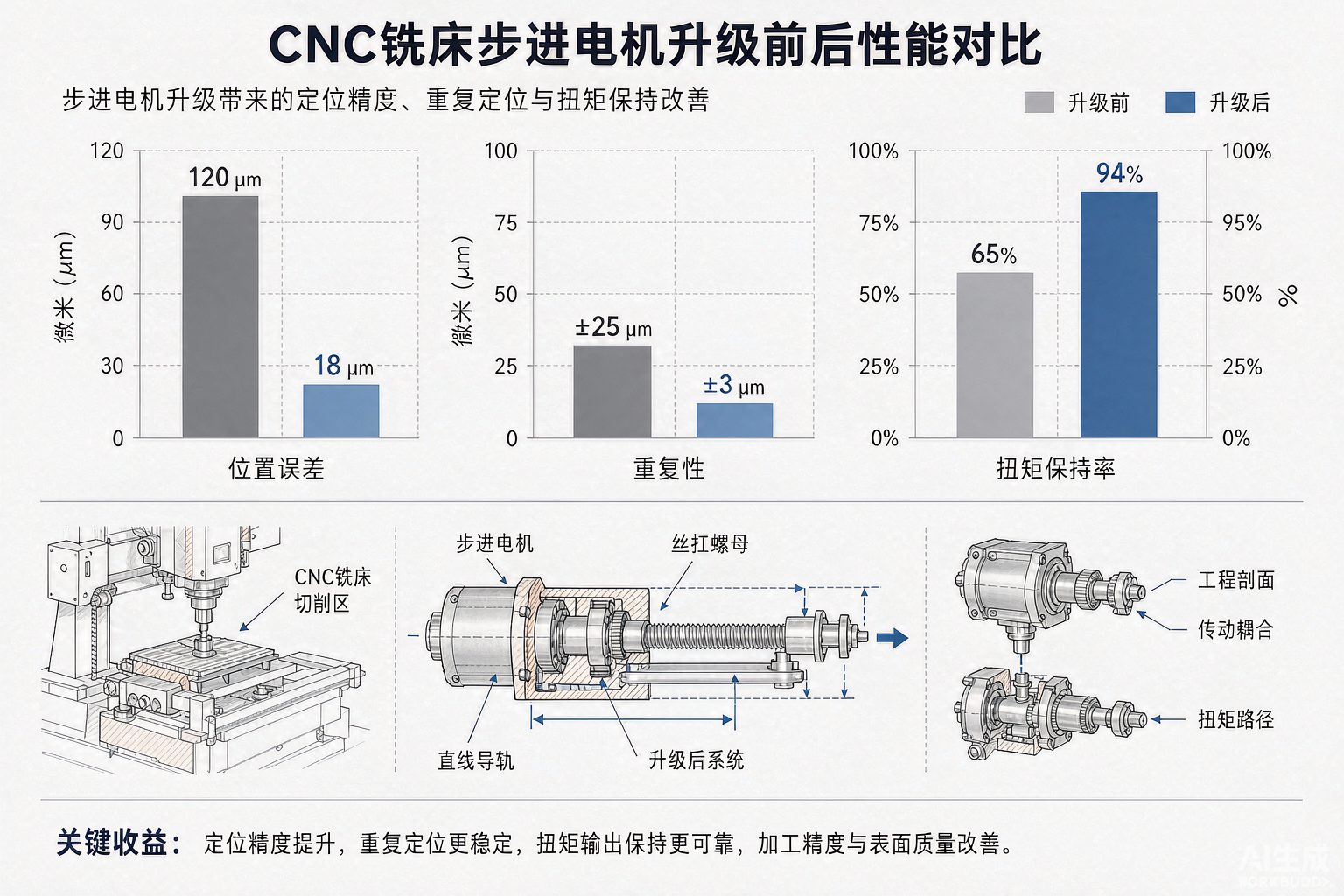
This success wasn’t accidental—it stemmed from three foundational HDB differentiators:
- Winding Consistency: Tighter ±2% inductance tolerance vs. industry-standard ±8%, ensuring predictable current draw and torque linearity across all three axes
- Mechanical Rigidity: Dual-bearing rotor support and hardened steel endbells minimized axial play (<0.005 mm)—critical for minimizing tool deflection-induced errors
- Thermal Management: Copper-clad laminations and low-resistance windings kept rotor temperature rise to <42°C at rated load—preventing demagnetization and torque decay
For engineers evaluating stepper upgrades, understanding torque behavior is essential. We recommend reviewing How to Read a Stepper Motor Torque Curve (Holding vs Pull-out Torque) to interpret real-world performance beyond datasheet peak values.
Frequently Asked Questions (FAQ)
Can HDB stepper motors handle the inertia mismatch common in ball-screw-driven CNC mills?
Yes. HDB NEMA 34 steppers feature high rotor inertia ratios (Jm/JL ≥ 1:3.2) and are specifically tuned for screw-driven loads. Our Stepper Motors guide includes application notes on inertia matching and acceleration profile optimization.
Is microstepping alone sufficient for micron-level accuracy—or is encoder feedback necessary?
For most CNC milling applications below 10,000 RPM, high-resolution microstepping (e.g., 1/256) combined with precise mechanical transmission delivers repeatable micron-level positioning—without the complexity and cost of feedback. See Step Angle, Microstepping & Positioning Resolution Explained for the physics behind it.
What if my machine requires holding torque during power-off (e.g., vertical Z-axis safety)?
HDB offers Two-Phase Brake Stepper Motors with integrated spring-set electromagnetic brakes—ideal for vertical axis retention and fail-safe operation. These retain full torque rating while adding only 28 mm to overall length.
Conclusion
This CNC mill retrofit demonstrates how purpose-built stepper motors—engineered for torque density, thermal resilience, and mechanical fidelity—can restore and even exceed original equipment performance. By selecting HDB’s Two-Phase Open-Loop Stepper Motor platform, the Wisconsin shop achieved measurable gains in accuracy, uptime, and unit economics—without sacrificing simplicity or scalability. Whether upgrading legacy machinery or designing next-generation compact CNCs, HDB’s precision motion portfolio delivers the balance of performance, reliability, and value that manufacturing engineers trust. Explore all HDB motor products or contact HDB Motor to discuss your specific retrofit or OEM motion-control challenge.