
 Deutsch
 한국어
한국어
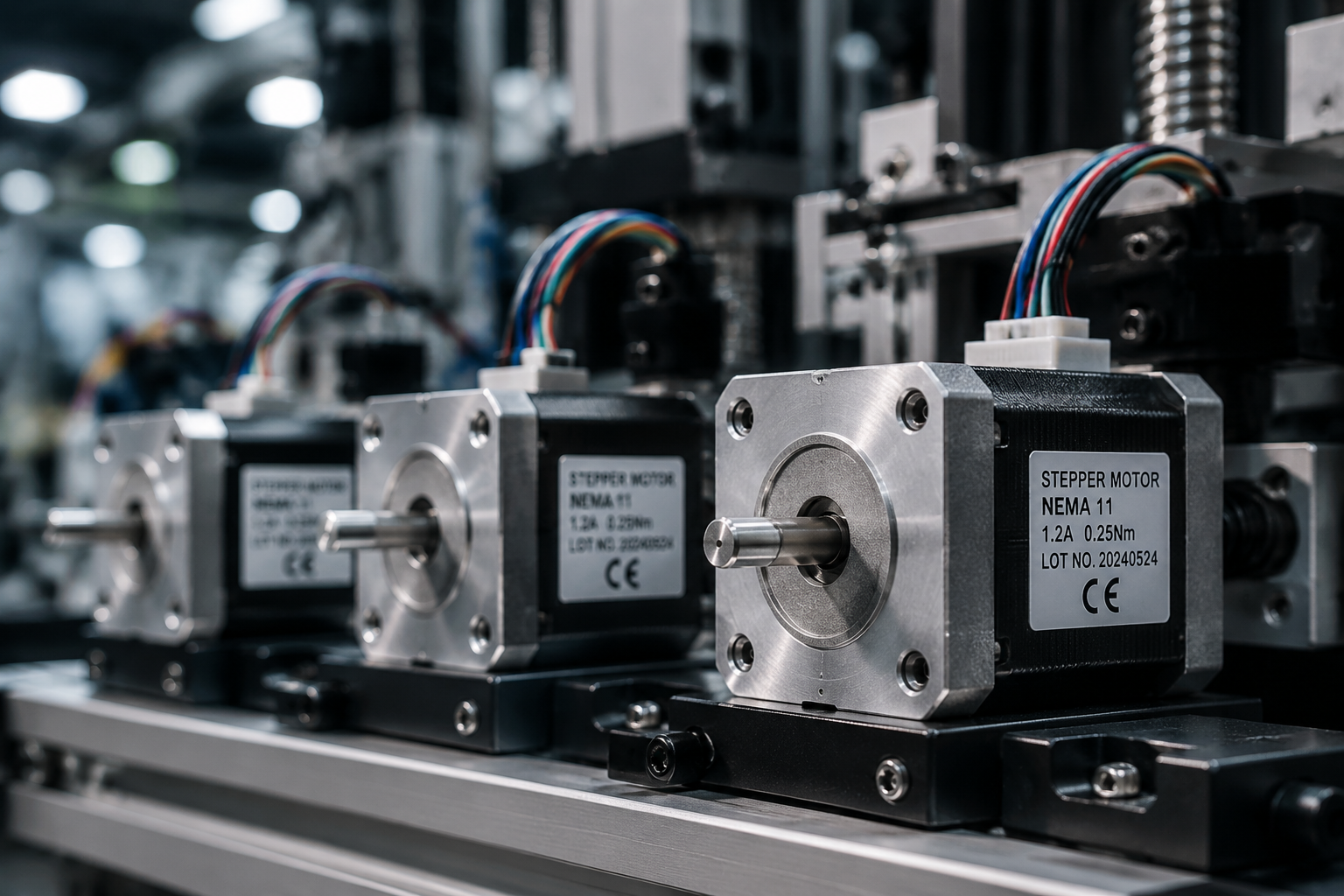
NEMA 11 stepper motors are widely used in compact precision motion systems where space efficiency, accurate positioning, and reliable control are critical. These motors typically feature a 1.1-inch faceplate dimension and are popular in medical equipment, optical devices, laboratory automation, semiconductor machinery, and compact robotics platforms.
For OEM buyers and engineers, selecting the right NEMA 11 stepper motor manufacturer involves much more than comparing prices. Manufacturing consistency, torque stability, thermal performance, driver compatibility, and customization capability all directly impact the final machine performance.
As industrial automation continues to move toward miniaturization, demand for high-performance compact motors is increasing rapidly. Manufacturers capable of delivering precision winding technology, stable rotor balancing, and long-term supply reliability are becoming strategic partners rather than simple component vendors.
This guide explains how to evaluate a NEMA 11 stepper motor manufacturer, what technical parameters matter most, and how buyers can reduce procurement risk while improving machine performance.
Why NEMA 11 Stepper Motors Are Popular in Precision Automation
NEMA 11 stepper motors are designed for applications requiring compact size combined with highly repeatable positioning accuracy. Unlike larger frame motors, these miniature systems fit into equipment where installation space is extremely limited.
Industries such as medical diagnostics, precision optics, and semiconductor inspection rely heavily on compact motion systems. In these applications, vibration control, thermal stability, and low noise are often more important than raw power output.
One major advantage of stepper technology is precise open-loop positioning capability. Many compact automation systems use open-loop stepper motor solutions because they eliminate the need for costly encoder feedback systems while maintaining excellent positioning repeatability.
NEMA 11 motors are also highly compatible with:
Lead screw systems
Belt-driven miniature actuators
Compact planetary reducers
Linear positioning assemblies
Compared with larger motors, they consume less power and generate lower inertia, making them ideal for portable and battery-powered industrial systems.
The increasing adoption of collaborative robotics and desktop automation equipment is also driving demand for miniature stepper motors worldwide.
Key Technical Specifications Buyers Must Evaluate
Selecting the correct NEMA 11 stepper motor requires understanding several critical engineering parameters. Many procurement issues occur because buyers focus only on holding torque while ignoring system-level integration factors.
Important specifications include:
| Parameter | Importance |
|---|---|
| Holding Torque | Determines load capacity |
| Step Angle | Affects positioning precision |
| Current Rating | Impacts thermal behavior |
| Phase Resistance | Influences driver compatibility |
| Rotor Inertia | Affects acceleration response |
| Motor Length | Determines torque density |
For a deeper understanding of motor sizing and engineering calculations, engineers should review this engineering parameter selection guide.
The step angle directly influences positioning resolution. Common NEMA 11 motors use 1.8° step angles, although finer resolutions are available for high-precision applications.
Thermal performance is another major factor. Small-frame motors can overheat if current control is poorly optimized. Manufacturers with advanced winding techniques and thermal management designs typically provide longer service life and more stable operation.
Buyers should also evaluate insulation quality, bearing lifespan, and shaft concentricity when sourcing motors for precision industrial systems.
How to Compare NEMA 11 Stepper Motor Manufacturers
Not all motor suppliers offer the same manufacturing capability. Many suppliers are trading companies rather than true manufacturers, which can create quality inconsistency and long-term supply chain risks.
A reliable NEMA 11 stepper motor manufacturer should provide:
Stable batch consistency
In-house winding production
Precision CNC shaft processing
Dynamic rotor balancing
Comprehensive testing procedures
OEM customization support
Manufacturing experience in motion control is especially important for miniature motors because small tolerances significantly affect final performance.
OEM buyers should request:
Torque curves
Thermal test reports
Noise test data
Lifetime validation
Driver compatibility reports
When evaluating global suppliers, it is also useful to compare broader industry capabilities through this motion control comparison resource.
An experienced manufacturer can also assist customers in optimizing:
Driver selection
Current settings
Acceleration profiles
Mechanical transmission integration
These engineering services often reduce development costs significantly.
The Importance of Driver Compatibility and Motion Control
Motor performance depends heavily on driver quality and current control algorithms. Even a high-quality NEMA 11 motor can experience vibration, noise, or missed steps if paired with an unsuitable driver.
Modern motion systems increasingly use:
Microstepping drivers
Sinusoidal current control
Smart pulse optimization
Dynamic current reduction
Advanced driver systems improve:
Positioning smoothness
Acoustic noise reduction
Energy efficiency
High-speed performance
For engineers developing compact automation systems, this guide on stepper motor control methods with Arduino provides useful insight into practical motion control implementation.
Some applications may also benefit from brushless DC motor technology when continuous high-speed operation is required.
Manufacturers that offer both motors and matched drivers usually provide better system compatibility and reduced commissioning problems.
Gearbox Integration for Higher Torque Applications
Although NEMA 11 motors are compact, some applications require higher output torque at lower speeds. In these cases, planetary gearbox integration becomes extremely important.
Gear reducers help:
Increase output torque
Improve low-speed smoothness
Reduce reflected inertia
Enhance positioning stability
Applications such as laboratory automation, dispensing systems, and precision feeders commonly use compact gearmotor assemblies.
Modern planetary gearbox integration solutions enable miniature motors to achieve significantly higher torque without increasing motor frame size.
When evaluating gearbox-equipped systems, buyers should consider:
Backlash performance
Gear wear resistance
Lubrication quality
Transmission efficiency
Noise characteristics
Manufacturers with integrated gearbox engineering capability generally provide better alignment precision and lower vibration levels than suppliers assembling outsourced components.
Common Quality Problems in Low-Cost NEMA 11 Motors
Low-cost miniature motors often suffer from inconsistent quality because of poor manufacturing control. These problems may not appear during initial testing but can cause severe reliability issues during long-term operation.
Typical problems include:
Excessive vibration
Shaft runout
High temperature rise
Bearing noise
Torque inconsistency
Missed steps under load
Improper current tuning can also cause overheating. Engineers troubleshooting thermal issues may benefit from this article about stepper motor overheating causes and solutions.
Noise is another major concern in medical and laboratory applications. Advanced current waveform optimization and precision rotor balancing are essential for reducing acoustic vibration.
Manufacturers focused purely on price competition often compromise on:
Copper winding quality
Bearing grade
Magnet consistency
Assembly precision
For mission-critical industrial systems, long-term reliability is usually far more important than minimal upfront cost savings.
OEM Customization Capabilities Matter More Than Price
For industrial automation companies, standard catalog motors are often insufficient. Many applications require customized:
Shaft dimensions
Connector types
Cable lengths
Winding configurations
Mounting modifications
A strong OEM manufacturer should support engineering collaboration during product development.
Customization capabilities can significantly shorten machine development cycles while improving system integration quality.
Buyers should also evaluate whether the supplier offers:
Small batch prototyping
Fast engineering response
Global logistics support
Long-term production continuity
Some applications may even require hybrid motion solutions combining compact steppers with advanced BLDC motor fundamentals for optimized speed and efficiency.
CTA Block
If your project requires compact high-precision motion systems, HDBMotor provides customized NEMA 11 stepper motor solutions for robotics, medical devices, semiconductor equipment, and industrial automation platforms.
Our engineering team supports:
OEM customization
Gearbox integration
Driver matching
Motion optimization
Global B2B supply
Comparison Table: What Defines a Reliable NEMA 11 Stepper Motor Manufacturer
| Evaluation Factor | Low-End Supplier | Professional Manufacturer |
|---|---|---|
| Torque Consistency | Unstable | High precision |
| Rotor Balancing | Basic | Dynamic balancing |
| OEM Support | Limited | Full customization |
| Driver Compatibility | Generic | Optimized matching |
| Quality Control | Random sampling | Full-process testing |
| Gearbox Integration | Outsourced | In-house engineering |
| Technical Support | Sales only | Engineering assistance |
Frequently Asked Questions
What applications use NEMA 11 stepper motors?
NEMA 11 motors are commonly used in medical devices, compact robotics, optical equipment, semiconductor systems, precision feeders, and laboratory automation equipment.
Are NEMA 11 motors suitable for high-speed applications?
They are suitable for moderate-speed positioning applications. For continuous high-speed motion, some systems may benefit from brushless DC motor alternatives.
Can NEMA 11 motors use planetary gearboxes?
Yes. Planetary gearboxes are commonly integrated to increase torque and improve low-speed positioning stability.
How important is driver selection?
Driver selection is extremely important because current control directly affects vibration, thermal behavior, and positioning smoothness.
What is the typical step angle of a NEMA 11 motor?
Most NEMA 11 motors use a 1.8° step angle, although higher-resolution options are available.
How can buyers evaluate manufacturer quality?
Buyers should review torque curves, thermal testing, noise data, OEM capability, and production consistency before selecting a supplier.
Conclusion
Choosing the right NEMA 11 stepper motor manufacturer requires careful evaluation of engineering capability, quality consistency, customization support, and motion control expertise.
For OEM buyers, long-term reliability and application-specific optimization are far more valuable than simply choosing the lowest-cost supplier. Manufacturers with integrated engineering support, precision production systems, and strong quality control processes can significantly improve machine performance and reduce operational risk.
As compact automation systems continue expanding across robotics, medical devices, and precision industrial equipment, high-quality NEMA 11 stepper motors will remain essential components in advanced motion control applications.