
 Русский

Why Precision Reducers Are the Unseen Engine of High-Performance Packaging Lines
Modern packaging automation demands more than speed — it requires repeatable, cycle-after-cycle accuracy under relentless operational loads. From blister-packing pharmaceuticals to high-speed carton erecting and label placement, every indexing motion must land within microns, thousands of times per shift. In this environment, the reducer is not just a torque-multiplying component — it’s the critical interface between motor command and physical output. When backlash drifts, inertia misaligns, or thermal creep accumulates, throughput drops, scrap rises, and maintenance interrupts production.
That’s why forward-thinking OEMs and system integrators are shifting from generic gearmotors to purpose-engineered precision reducers — especially in applications involving high-cycle indexing, tight-tolerance registration, and zero-downtime expectations. At HDB Motor, we see this trend daily: customers replacing legacy worm-gear or low-cost planetary units with engineered solutions that deliver measurable ROI through extended mean time between failures (MTBF), reduced calibration frequency, and tighter positional repeatability.
The Packaging Challenge: High-Cycle Indexing Under Real-World Stress
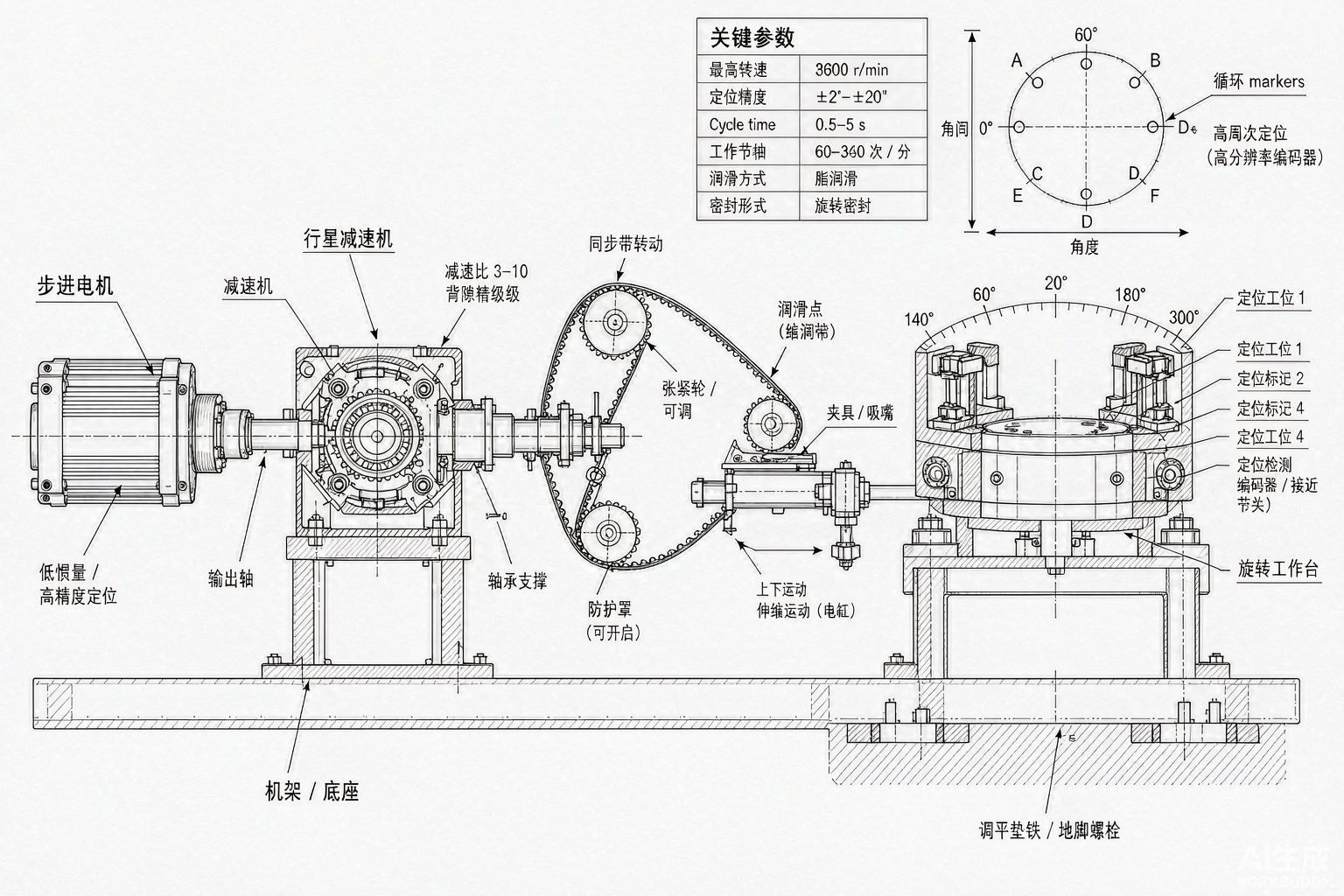
Consider a typical rotary packaging indexer handling 120–200 cycles per minute — 7,200–12,000 motions per hour. Over a 16-hour shift, that’s over 190,000 discrete positioning events. Each event subjects the reducer to:
- Dynamic load reversals — rapid acceleration/deceleration stresses gear mesh integrity;
- Thermal cycling — repeated heating/cooling causes material expansion and micro-clearance shifts;
- Vibration-induced micro-slip — especially during start/stop transitions in open-loop stepper systems;
- Contamination exposure — dust, lubricant mist, and cleaning agents challenge sealing and longevity.
In such conditions, even 5–10 arcminutes of backlash can translate into ±0.08 mm positional error at a 300 mm radius — enough to cause misaligned seals, missed vacuum pickups, or inconsistent fill volumes. That’s where precision-grade reducers move beyond spec sheets and into real-world value.
Case Insight: Pharma Blister-Packing Line Uptime Jumped 22% After Reducer Upgrade
A Tier-1 packaging machinery builder recently retrofitted an aging blister-packing line serving FDA-regulated facilities. The original cam indexer + servo combination suffered frequent positional drift after 4–6 hours of continuous operation, requiring manual recalibration every shift and generating 3.7% average scrap rate due to foil misregistration.
HDB Motor collaborated on a targeted upgrade: replacing the cam indexer with a Planetary Reduction Stepper Motor paired with a 10:1 high-rigidity planetary reducer featuring ≤1 arcminute backlash, preloaded tapered roller bearings, and IP65-rated sealed housing. The result?
- Uptime increased by 22% — no recalibration needed over 72+ hours of continuous run;
- Scrap rate dropped to 0.9% — consistent foil alignment across all 12 stations;
- Maintenance labor decreased by 65% — no grease relubrication or backlash adjustment required for 18 months;
- ROI achieved in 11 months — factoring reduced scrap, labor, and unplanned downtime costs.
This wasn’t just a hardware swap — it was a precision motion-system optimization rooted in understanding how backlash in gearboxes directly impacts positioning accuracy. For high-indexing packaging applications, backlash isn’t theoretical — it’s the difference between pass/fail lot acceptance.
Selecting the Right Reducer Family: Matching Technology to Packaging Function
Not all precision reducers serve packaging equally. The optimal choice depends on your motion profile, load type, accuracy envelope, and lifecycle expectations. Here’s how top-performing HDB reducer families align with key packaging functions:
• Planetary Reducers: The Workhorse for Balanced Performance
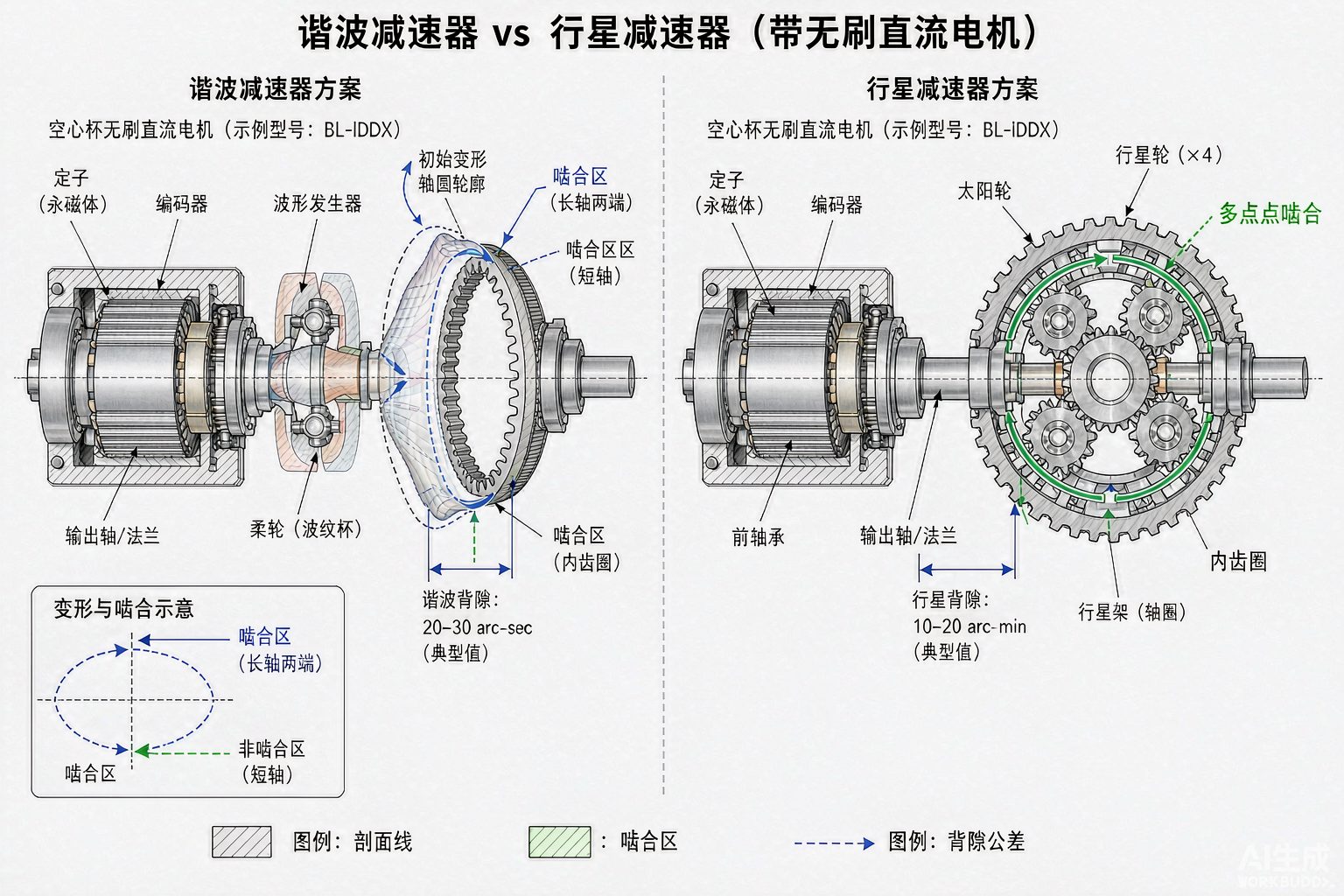
Ideal for medium-to-high torque indexing conveyors, rotary tables, and filling station actuators. Our Planetary Reduction Stepper Motor and Planetary Reduction BLDC Motor integrate high-efficiency gearing directly into the motor housing — eliminating coupling losses and minimizing reflected inertia. With standard backlash as low as 1 arcmin and torsional stiffness up to 1,200 N·m/rad, they offer exceptional responsiveness for fast-accelerating index moves.
• Harmonic Reducers: Where Zero-Backlash & Compactness Rule
When space is constrained and sub-arcsecond repeatability is non-negotiable — think label applicator arms or vision-guided pick-and-place end-effectors — harmonic drives deliver unmatched motion fidelity. Their flexspline design eliminates traditional gear backlash entirely. As explored in our deep-dive comparison, Planetary vs Harmonic Reducer: Trade-offs for Robotics & Automation, harmonic units excel in low-inertia, high-precision roles but require careful thermal management in sustained high-cycle use.
• RV & Cycloidal Reducers: Heavy-Duty Indexing Stability
For large-format carton erectors, palletizers, or rotary case packers carrying >50 kg payloads, RV and cycloidal reducers provide superior shock-load tolerance and moment rigidity. Their multi-point contact geometry distributes stress evenly — critical when stopping a 200 kg turret at full speed. Both families appear in All Products (reducer families: harmonic / RV / worm / cycloid / cam indexer), alongside application-specific variants optimized for food-grade lubricants and washdown environments.
• Cam Indexers: Predictable, High-Torque Motion for Fixed-Sequence Lines
Though less flexible than servo-driven alternatives, cam indexers remain the gold standard for ultra-reliable, fixed-motion sequences — e.g., 12-station bottle cappers running 24/7. Their mechanical simplicity delivers unmatched MTBF (>10 years in many installations) and zero electronic complexity. HDB offers custom-engineered cam modules integrated with stepper or BLDC motors for hybrid programmability and deterministic motion.
Designing for Reliability — and ROI — Beyond the Datasheet
Specifying a precision reducer isn’t just about ratio and torque. It’s about designing for the entire motion lifecycle:
- Reflected inertia matching — mismatched inertia ratios cause overshoot, settling delays, and resonance; our guide on How to Size a Gearbox for Your Stepper or BLDC Motor walks through dynamic calculations step-by-step;
- Sealing & environmental rating — IP65+ and NSF H1 food-grade lubricants prevent contamination-related wear;
- Bearing preload strategy — angular contact or tapered roller configurations minimize axial play and extend service life under reversing loads;
- Thermal derating awareness — high-cycle indexing elevates operating temperature; select reducers rated for continuous duty at ≥85°C ambient.
Many customers overlook how reducer selection cascades into motor sizing, driver tuning, and even PLC motion profiling. That’s why HDB supports integrators with full-system modeling — including thermal simulation and lifetime prediction tools — to validate ROI before build-out.
From Spec Sheet to Production Floor: Getting Started
If your packaging line faces recurring challenges with indexing accuracy, unplanned stops, or escalating maintenance — it may be time to re-evaluate your motion transmission layer. Start with these actionable steps:
- Map your highest-cycle motion axis: note cycle time, payload, radial/moment loads, and positional tolerance;
- Measure actual backlash using a dial indicator or laser interferometer — compare against OEM specs;
- Review thermal behavior: does positioning drift increase after 2+ hours of runtime?
- Consult our Gearboxes & Reducers guide for technology comparisons, failure mode analysis, and industry-specific best practices;
- Engage HDB’s application engineering team early — we co-develop solutions, not just ship components.
Whether you’re upgrading a single station or specifying for a new machine platform, our engineers help match the right reducer family, ratio, and integration approach — backed by test data, not assumptions. Explore the full range of motion-control enablers in all HDB motor products, or contact HDB Motor to request a free motion-system audit.
Frequently Asked Questions
What’s the minimum backlash needed for reliable high-cycle indexing in packaging?
For indexing repeatability ≤±0.02 mm at a 200 mm radius, target ≤1 arcminute backlash — ideally achieved with preloaded planetary or harmonic designs. Higher backlash (>3 arcmin) increases settling time and risk of cumulative error across multi-axis coordination.
Can I retrofit a precision reducer onto my existing stepper motor?
Yes — but only if shaft compatibility, flange mounting, and inertia matching are validated. Many HDB reducers offer modular mounting kits and custom shaft options. Always perform a full gearbox sizing analysis before retrofitting.
Do harmonic reducers require special maintenance in packaging environments?
Harmonic drives are sealed-for-life units with no routine lubrication — a major advantage in cleanroom or washdown settings. However, avoid exposure to abrasive dust or impact loading, which can accelerate flexspline fatigue. Thermal monitoring is recommended for >60% continuous duty cycles.
Conclusion
In packaging automation, precision reducers are far more than torque adapters — they’re strategic assets that define line reliability, product quality, and long-term operational cost. By selecting engineered solutions like HDB’s planetary, harmonic, RV, and cam-based reducers — and grounding decisions in real-world metrics like backlash behavior, thermal stability, and lifecycle ROI — OEMs and integrators transform motion control from a maintenance liability into a competitive differentiator. Whether optimizing an existing line or designing next-gen machinery, the right reducer doesn’t just move the load — it secures the output.