
 Русский

Reducer Supplier Selection Checklist for Procurement Teams
For procurement professionals sourcing gearboxes and reducers for industrial automation, robotics, or precision machinery, selecting the right supplier is as critical as choosing the right motor. A suboptimal reducer can undermine system accuracy, accelerate wear, delay production timelines, and inflate total cost of ownership—even when paired with a high-performance stepper or BLDC motor.
This checklist distills the five non-negotiable verification points procurement teams must confirm before finalizing a reducer supplier. It’s designed not for engineers alone—but for cross-functional buyers who need actionable, audit-ready criteria to evaluate proposals, compare quotes, and de-risk supply chain decisions.
1. Verify Ratio Tolerance: Don’t Assume ‘Nominal’ Means ‘Exact’
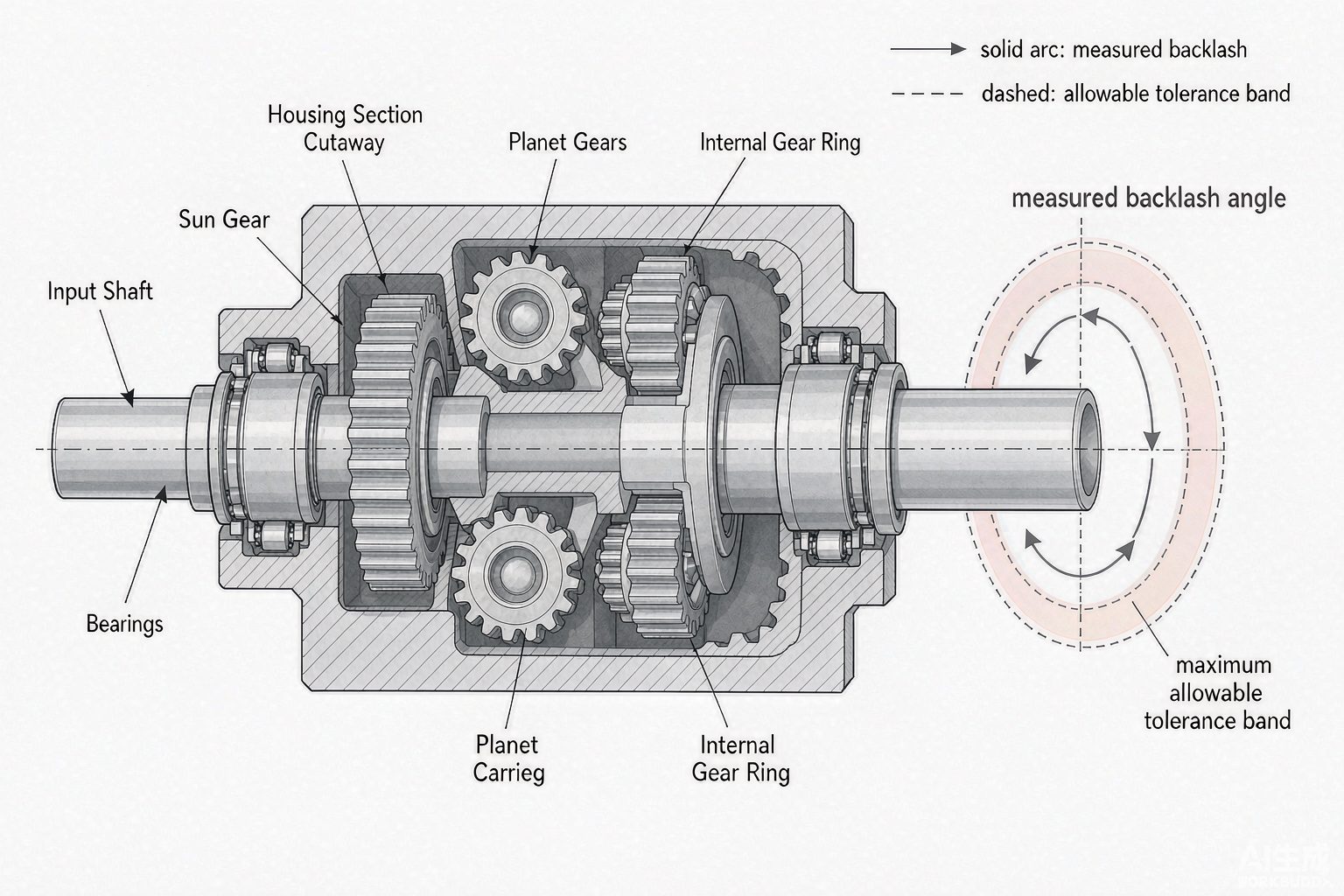
Reduction ratio defines how input speed and torque translate to output performance—and even minor deviations can cascade into positioning errors, servo tuning instability, or mismatched cycle times. Yet many suppliers list only nominal ratios (e.g., 10:1, 100:1) without specifying tolerance bands.
What to verify:
- Is the actual ratio guaranteed within ±0.5%, ±1%, or tighter? (Precision applications like semiconductor handling or optical alignment often require ≤±0.3%.)
- Is tolerance measured per unit—or averaged across a batch? Ask for test reports on your specific order lot.
- Does ratio drift under load or thermal cycling? Reputable suppliers provide dynamic ratio stability data—not just static bench measurements.
HDB Motor specifies ratio tolerance rigorously across its Planetary Reduction Stepper Motor series, with standard tolerances of ±0.5% (tighter options available on request), validated via laser interferometry and load-cycle testing.
2. Demand Backlash Certification—Not Just a Datasheet Claim
Backlash—the angular play between meshing gear teeth—is arguably the most consequential parameter for repeatability and closed-loop stability. Yet it’s also one of the most inconsistently reported specs. Some suppliers quote ‘typical’ values; others omit units entirely. Worse, some conflate ‘zero-backlash’ marketing language with true kinematic elimination.
What to verify:
- Is backlash measured per ISO 9409-1 or JIS B 1192—and is the test method documented (e.g., double-flank vs. single-flank, preload condition)?
- Do they provide a certificate of conformance per lot—or just a generic datasheet value?
- How does backlash behave after 5,000+ hours of operation? Request accelerated life-test summaries.
Understanding the implications of backlash goes beyond numbers. For context, read our deep-dive: Backlash in Gearboxes: What It Means for Positioning Accuracy. At HDB, all planetary and harmonic reducers undergo backlash certification at final assembly—with traceable reports included with every shipment.
3. Scrutinize Materials & Heat Treatment—Especially for High-Torque or Continuous Duty
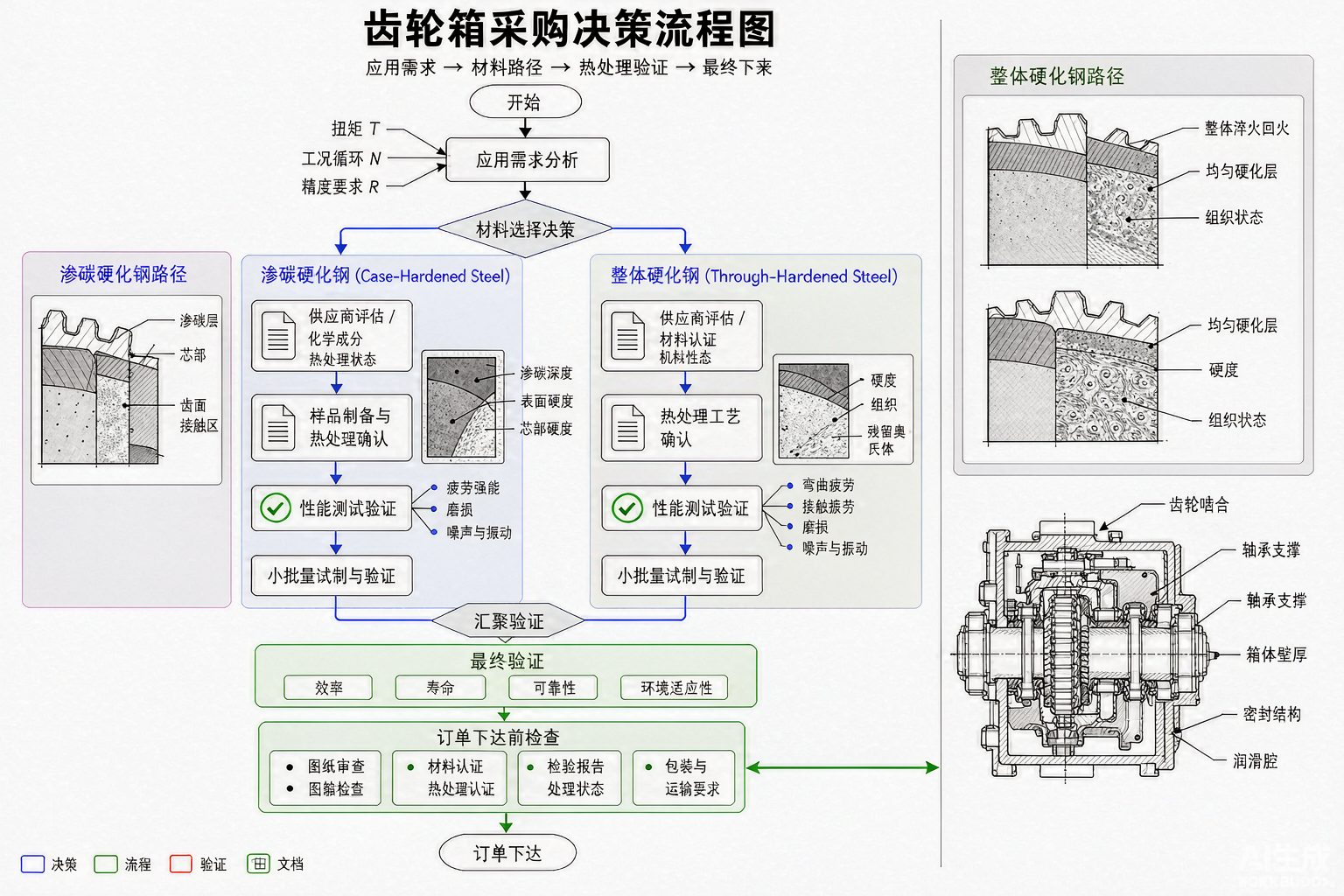
A reducer’s longevity isn’t defined by its housing color or brand logo—it’s defined by metallurgy. Gears subjected to shock loads, high duty cycles, or elevated ambient temperatures demand hardened alloy steels (e.g., SCM420, 17CrNiMo6), proper case depth, and controlled tempering. Inferior materials fatigue faster, increasing micro-pitting, noise, and eventual failure.
What to verify:
- Are gear materials specified by grade (e.g., “case-hardened 20MnCr5”)—not just vague terms like “high-strength steel”?
- Is surface hardness (HRC) and effective case depth provided? (e.g., 58–62 HRC, 0.5–0.8 mm depth)
- Are bearing races and shafts through-hardened or induction-hardened? How are corrosion-resistant finishes applied (e.g., black oxide, nickel plating)?
HDB’s RV and harmonic reducers use aerospace-grade bearing steels and proprietary heat-treatment protocols—validated through salt-spray and thermal-cycling validation per IEC 60068. This ensures consistent performance in demanding environments—from cleanroom robotics to outdoor solar tracking systems.
4. Confirm Realistic Lead Times—and Understand the ‘Why’ Behind Delays
In today’s volatile supply chain, lead time isn’t just a number on a quote—it’s a risk indicator. A ‘standard’ 8-week lead that slips to 16 weeks signals capacity constraints, raw material shortages, or quality bottlenecks. Procurement teams need transparency—not optimism.
What to verify:
- Is lead time quoted from PO confirmation—or from component availability? Ask whether gears, bearings, or custom housings are built-to-order or stocked.
- What’s the supplier’s on-time delivery (OTD) rate over the last 12 months? Request third-party logistics data if possible.
- Do they offer expedited build paths—and at what premium? (Note: true agility requires modular design and buffer inventory—not just overtime labor.)
HDB maintains strategic buffer stock for high-volume planetary reducer SKUs and offers guaranteed lead times on its Planetary Reduction BLDC Motor platform—backed by a dedicated production cell for rapid build-to-spec configurations. For urgent needs, contact HDB directly to explore priority scheduling options.
5. Evaluate Technical & After-Sales Support—Beyond the Sales Sheet
A supplier’s responsiveness during integration and troubleshooting often matters more than their catalog specs. Poor support leads to extended commissioning, undocumented workarounds, and untraceable field failures.
What to verify:
- Do application engineers co-sign sizing recommendations—or is support limited to quoting and shipping?
- Is there documented failure-mode analysis (FMEA) for common use cases (e.g., vertical lift, high-inertia loads)?
- What’s the warranty scope—and do they cover consequential damage (e.g., motor burnout due to reducer seizure)?
- Is local technical support available—or is escalation routed offshore with multi-day response windows?
HDB provides full lifecycle engineering support—from initial How to Size a Gearbox for Your Stepper or BLDC Motor guidance to on-site troubleshooting and custom redesign services. Our global team includes FA engineers fluent in motion-control protocols (CANopen, EtherCAT, Modbus RTU), ensuring seamless integration—not just part fulfillment.
Bonus: Cross-Reference Reducer Types Against Your Application
Not all reducers are interchangeable—even with identical ratios and torque ratings. Harmonic drives offer ultra-low backlash but lower torsional stiffness; worm gears deliver high reduction in compact envelopes but suffer efficiency losses; cycloidal reducers excel in shock load resistance but add rotational inertia.
Before shortlisting a supplier, align your core requirements with proven topologies. Compare trade-offs using our technical comparison: Planetary vs Harmonic Reducer: Trade-offs for Robotics & Automation. And explore HDB’s full portfolio—including harmonic, RV, worm, cycloid, and cam indexer families—on our all HDB motor products page.
Putting It All Together: A Procurement Action Plan
Use this checklist as a scoring matrix across three to five shortlisted suppliers:
- Score 1–3 per criterion (1 = undocumented/unverified, 3 = certified/tested/per-lot report)
- Weigh criteria by application criticality (e.g., backlash may be weighted 2× if used in vision-guided pick-and-place)
- Require written responses—not verbal assurances—for each verification point
- Request references from customers with similar volume, industry, and integration complexity
Finally, don’t overlook foundational credibility: Is the supplier ISO 9001-certified? Do they publish test standards and validation methods? Are they transparent about manufacturing location and process controls? These aren’t ‘nice-to-haves’—they’re early-warning signals for long-term reliability.
Frequently Asked Questions
How do I validate backlash claims if the supplier doesn’t provide test reports?
Ask for a sample unit under NDA for independent metrology lab testing—or request access to their internal test logs (including date, operator ID, equipment serial number). Reputable suppliers welcome such due diligence.
Can I get tighter ratio tolerance or lower backlash as a custom option—and how much does it cost?
Yes—most precision reducer manufacturers offer upgraded tolerances, but costs vary widely based on process changes (e.g., selective gear pairing, post-honing). Always request a formal deviation quote with revised lead time and MOQ.
Where can I find application-specific reducer guidance—not just product catalogs?
HDB’s comprehensive resource hub includes the our Gearboxes & Reducers guide, which covers selection frameworks, failure mode diagnostics, mounting best practices, and maintenance intervals—all grounded in real-world field data.
Conclusion
Selecting a reducer supplier is a strategic procurement decision—not a transactional one. By systematically verifying ratio tolerance, backlash certification, material integrity, lead time realism, and support capability, procurement teams gain leverage, reduce integration risk, and protect long-term system performance. At HDB Motor, we engineer every reducer with these five pillars in mind—and back them with documentation, responsiveness, and precision you can verify, not just trust. To discuss your specific application requirements or request a customized supplier evaluation package, contact HDB Motor today.