
 Русский

More Torque, Same Footprint: The Engineering Advantage of HDB’s Integrated Planetary Reduction Motors
When machine builders face mounting pressure to shrink system footprints without sacrificing performance, one question dominates design reviews: How do we get more torque—without adding space, complexity, or cost?
HDB Motor answers that challenge with its purpose-built Planetary Reduction Motor Series — a family of fully integrated, factory-coupled motor-and-gearbox solutions engineered for high-torque, high-precision applications where space, reliability, and repeatability are non-negotiable.
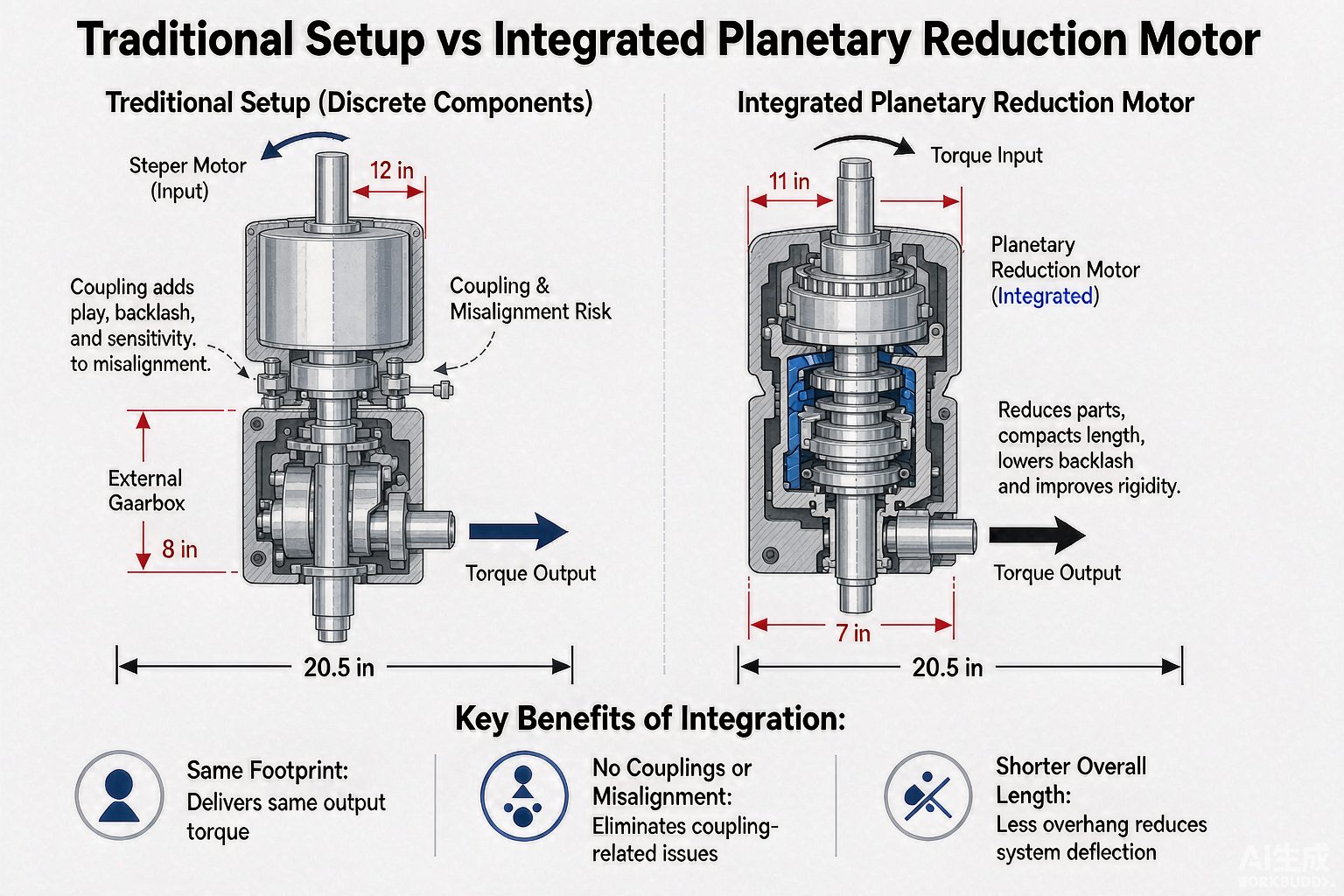
Unlike bolt-on gearmotor assemblies prone to misalignment, backlash drift, and mounting inconsistencies, HDB’s integrated planetary reduction motors deliver calibrated performance out of the box — with optimized thermal management, preloaded gearing, and unified mechanical and electrical interfaces.
What Is an Integrated Planetary Reduction Motor?
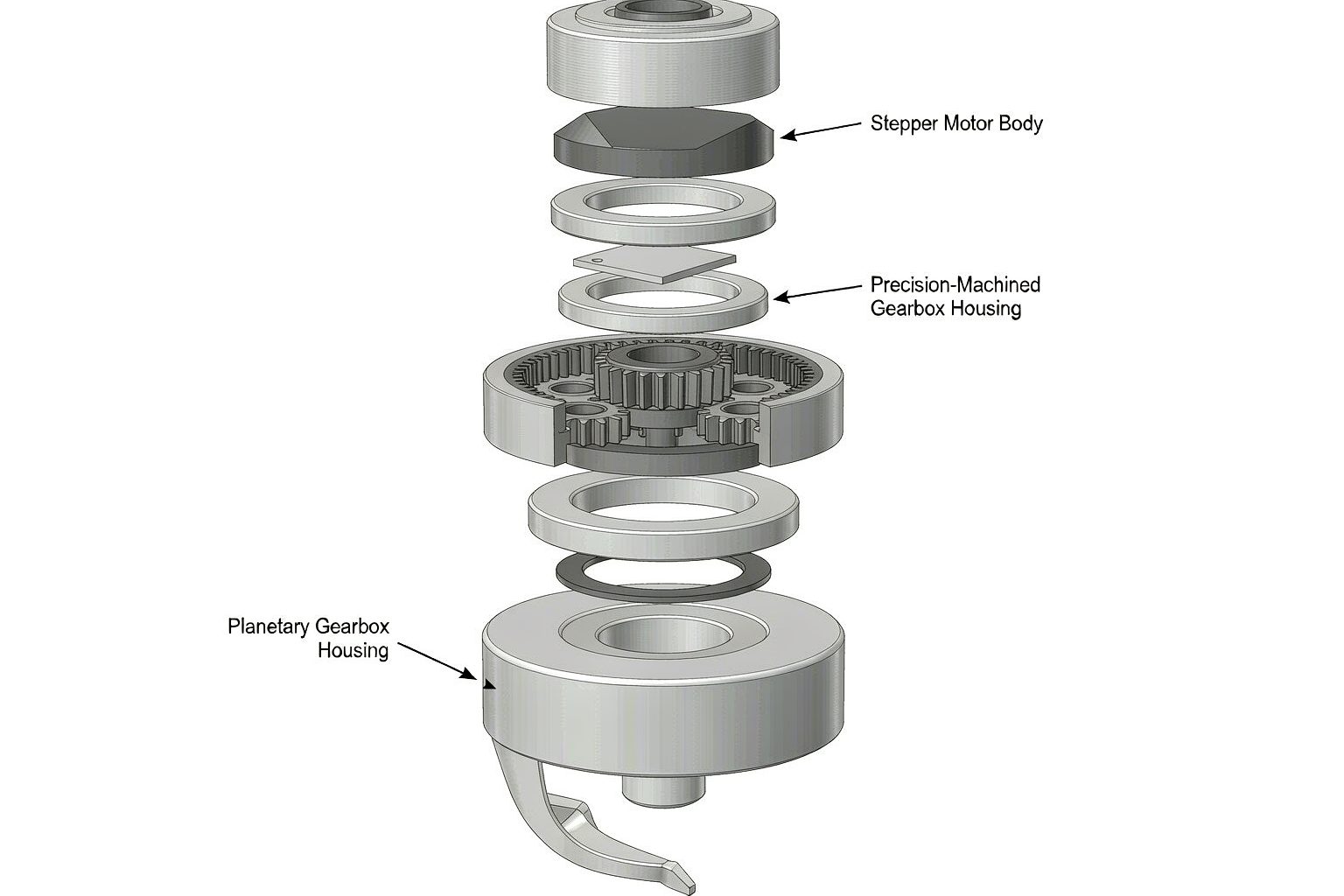
An integrated planetary reduction motor combines a high-performance motor (stepper or brushless DC) with a precision planetary gearbox — all in a single, coaxial, mechanically locked assembly. There’s no separate coupling, no alignment jigs, and no risk of relative shaft movement under dynamic load.
HDB offers two core variants:
- Planetary Reduction Stepper Motor: Ideal for open-loop positioning tasks requiring high holding torque, low-speed stability, and deterministic motion — from lab automation to medical dispensers.
- Planetary Reduction BLDC Motor: Engineered for closed-loop servo-like performance at higher speeds and continuous duty cycles — common in packaging machinery, collaborative robot joints, and semiconductor handling stages.
Both series use hardened steel planetary gear sets with ground-to-tolerance sun, planet, and ring gears — delivering typical backlash as low as ≤8 arc-min, efficiency up to 94%, and rated service life exceeding 20,000 hours under nominal load.
Why Integration Delivers Real-World Value
Integration isn’t just about convenience — it directly translates into measurable engineering advantages:
✅ Space & Weight Savings Without Compromise
By eliminating couplings, adapters, and external gearboxes, HDB’s integrated designs reduce overall length by up to 35% versus modular alternatives. A 57-mm frame stepper + planetary reducer delivers the output torque of a conventional 86-mm stepper — enabling redesigns of compact pick-and-place modules, portable diagnostic devices, and embedded rotary actuators.
✅ Precision You Can Rely On — Not Just Spec Sheet Promise
Backlash is the silent enemy of repeatable positioning. In bolted systems, even minor mounting flex or thermal expansion can increase effective backlash over time. HDB’s integrated units feature factory-preloaded gear trains and rigid housing structures that maintain tight backlash tolerances (<10 arc-min standard; <3 arc-min optional) across temperature swings and duty cycles. For context on how backlash impacts your application, see our deep-dive guide: Backlash in Gearboxes: What It Means for Positioning Accuracy.
✅ Faster Time-to-Prototype & Reduced Assembly Risk
Design teams report cutting mechanical integration time by 40–60% when switching to HDB’s integrated motors. No need to validate coupling stiffness, calculate torsional resonance, or retest shaft runout after assembly. Every unit ships with verified torque-speed curves, thermal derating data, and encoder-ready feedback options (incremental or absolute).
✅ Optimized Thermal & Electrical Behavior
Because motor windings and gearbox lubricants are thermally coupled within a shared housing, HDB engineers the entire thermal path — from stator heat transfer to gear oil convection — ensuring consistent performance at rated load. This eliminates hot-spot surprises common in mismatched motor+gearbox pairings.
Key Technical Specifications (Standard Configurations)
All models are available in NEMA 17, 23, 24, 34, and 42 frame sizes, with reduction ratios spanning 3:1 to 100:1. Common configurations include:
- Stepper variants: 2-phase, 1.8° step angle; up to 10 N·m output torque (NEMA 42); IP65-rated options available
- BLDC variants: Sinusoidal commutation; Hall or encoder feedback; up to 30 N·m continuous torque; built-in thermal protection
- Gearbox features: Single- and multi-stage planetary; stainless steel output shafts; synthetic long-life lubricant; optional zero-backlash versions
Customization is supported across voltage, winding, encoder resolution, brake integration, and environmental sealing — all validated as a complete system.
Where These Motors Deliver Competitive Advantage
HDB’s Planetary Reduction Motor Series is solving real challenges across demanding sectors:
Industrial Automation & Packaging
Tight cycle times demand rapid acceleration and high peak torque — especially in cam-indexed fillers and carton sealers. Integrated BLDC planetary motors eliminate coupling slippage during direction reversals, improving throughput consistency by up to 12% in field deployments.
Medical & Lab Equipment
From automated pipetting workstations to MRI-compatible robotic arms, space, quiet operation, and sub-micron repeatability are critical. The stepper-based series delivers ultra-smooth microstepping at low RPM with minimal vibration — thanks to precise gear meshing and balanced rotor dynamics.
Robotics & Collaborative Systems
In joint actuators for cobots and mobile manipulators, weight and torque density directly impact payload capacity and battery life. HDB’s NEMA 34 integrated BLDC + 20:1 planetary delivers 18 N·m in under 120 mm total length — outperforming many competitive servo+gearmotor stacks by 22% in torque-per-mm.
Choosing the Right Configuration: Sizing Made Predictable
Selecting the optimal reduction ratio and motor type requires balancing speed, torque, inertia matching, and thermal limits — not just peak numbers. That’s why HDB provides application-focused support, including free torque-speed curve modeling and mechanical interface validation.
For engineers new to gearbox integration, our practical resource How to Size a Gearbox for Your Stepper or BLDC Motor walks through inertia ratio targets, acceleration torque calculations, and thermal derating factors — with real-world examples drawn from packaging and optics positioning.
And because planetary isn’t always the best choice, we also help customers compare trade-offs: for instance, harmonic drives offer near-zero backlash but lower torsional stiffness and higher cost — ideal for precision robotics, less so for high-duty-cycle conveyance. See our side-by-side analysis: Planetary vs Harmonic Reducer: Trade-offs for Robotics & Automation.
Beyond Planetary: HDB’s Full Reducer Portfolio
While planetary reduction excels in torque density, efficiency, and cost-effectiveness for most mid-to-high-speed applications, HDB also manufactures and integrates other high-precision reducer families — including harmonic, RV, worm, cycloid, and cam indexers — all designed for seamless pairing with our motors.
Explore the full range in all HDB motor products, or dive deeper into selection criteria in our Gearboxes & Reducers guide.
Frequently Asked Questions
Can I replace my existing motor + gearbox setup with an HDB integrated unit without redesigning the mounting?
Yes — most standard-frame integrated models retain identical bolt patterns, shaft diameters, and flange dimensions as their non-reduced counterparts. We provide detailed mechanical drawings and STEP files for CAD integration prior to order.
Do these motors support feedback for closed-loop control?
Absolutely. Both stepper and BLDC variants are available with incremental encoders (500–5000 PPR), absolute magnetic encoders (17-bit), or resolver options — all factory-aligned and tested for phase accuracy and signal integrity.
What’s the lead time for custom ratios or environmental options?
Standard configurations ship in 2–3 weeks. Custom ratios (e.g., 13.7:1 or 47:1) and IP67/IP69K builds typically require 5–6 weeks — with expedited options available. Contact HDB Motor early in your design cycle for feasibility and timeline confirmation.
Conclusion
In today’s competitive automation landscape, squeezing more performance from less space isn’t a luxury — it’s table stakes. HDB’s Planetary Reduction Motor Series delivers exactly that: verified torque multiplication, factory-calibrated precision, and simplified integration — all in a drop-in-ready package. Whether you’re upgrading legacy equipment, designing next-gen robotics, or optimizing medical device ergonomics, these integrated solutions reduce risk, accelerate development, and raise the bar for what compact motion control can achieve. Ready to explore which configuration fits your application? Contact HDB Motor for personalized sizing support and technical consultation.