
 Русский

RV vs Cycloid Reducer: Choosing the Right Heavy-Duty Gearbox for Demanding Automation
When designing high-performance robotic arms, CNC rotary tables, packaging machinery, or material handling systems, selecting the right reducer is not just about gear ratio—it’s about structural integrity under shock loads, positional fidelity across millions of cycles, and long-term torsional rigidity. Two top-tier solutions dominate this tier: the RV reducer (developed by Sumitomo and widely adopted in industrial robotics) and the cycloid reducer (a time-tested planetary-epicyclic design with unique kinematic advantages). While both deliver high reduction ratios and exceptional torque density, their internal architectures produce distinct trade-offs in rigidity, backlash behavior, and dynamic response—especially under intermittent, high-inertia loads.
Core Design Differences: Kinematics Define Performance
Understanding how each reducer transmits motion reveals why they behave differently in real-world applications:
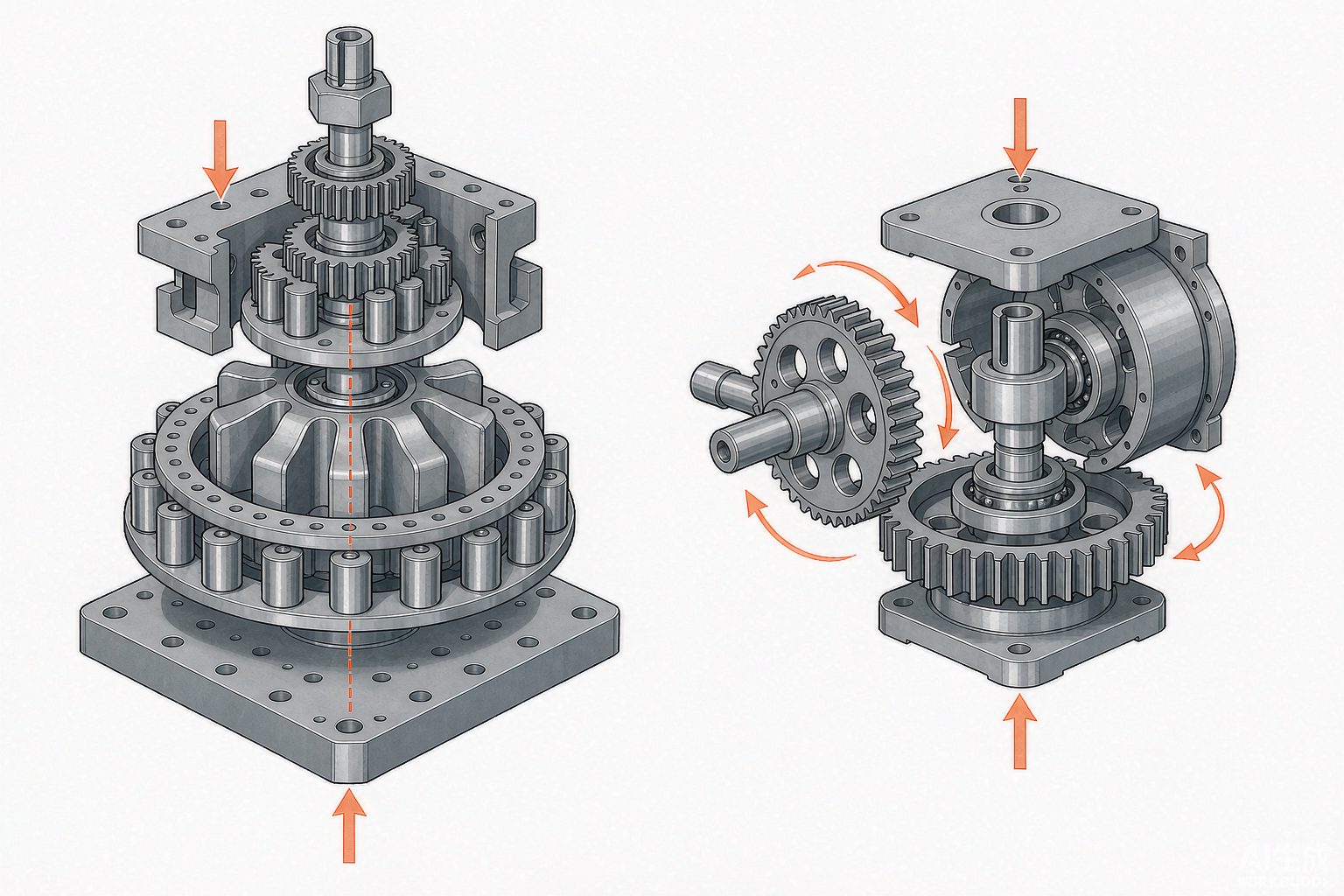
- RV Reducer: A hybrid architecture combining a planetary stage (for initial speed reduction and load distribution) and a cam-driven cycloidal stage (for final high-ratio reduction). Multiple needle rollers engage a cycloidal disc that rotates eccentrically around a stationary ring gear. This dual-stage design delivers ultra-low backlash (<0.5 arcmin typical), high torsional stiffness (>10,000 N·m/rad), and excellent moment-load capacity—making it the gold standard for 6-axis robot joints where repeatability and joint rigidity are non-negotiable.
- Cycloid Reducer: Based on the eccentric cam + cycloidal disc + output pins principle (often called “pinwheel” or “cycloidal drive”). Input rotation causes the eccentric bearing to oscillate the cycloidal disc, which then drives a set of output pins housed in a stationary ring. Because all contact points are distributed across dozens of simultaneous roller-pin engagements, cycloid designs achieve extremely high torque-to-volume ratios and inherent shock-load resilience. However, traditional cycloid units can exhibit slightly higher backlash (1–3 arcmin) and lower torsional stiffness than RV units—though modern precision variants (like those integrated into HDB’s [all HDB motor products](https://www.hdbmotors.com/products)) close this gap significantly through preloaded pin arrangements and hardened case-hardened components.
High-Ratio Capability: Where Both Excel—But Differ in Scalability
Both RV and cycloid reducers routinely achieve single-stage reductions from 30:1 up to 200:1—and multi-stage configurations extend beyond 5,000:1. Yet scalability differs:
- RV reducers maintain efficiency (≥85%) and low heat generation even at ratios >100:1 due to their balanced two-stage load sharing. Their compact envelope and axial symmetry simplify integration into space-constrained robotic joints.
- Cycloid reducers excel at ultra-high single-stage ratios (e.g., 119:1 or 171:1) without cascading stages—reducing part count and potential failure points. This makes them ideal for direct-drive replacement in rotary tables and indexing conveyors. However, efficiency dips slightly at extreme ratios (≈75–82%), requiring careful thermal analysis in continuous-duty applications.
Rigidity & Backlash: The Critical Axis for Precision Motion
In heavy automation, rigidity isn’t just about resisting deflection—it’s about preserving commanded position during acceleration, deceleration, and sudden direction reversals. Backlash compounds error in closed-loop systems, especially when paired with stepper or BLDC motors lacking inherent position feedback.
RV reducers lead in torsional rigidity thanks to their rigid planetary carrier and dual-bearing support of the cycloidal disc. This translates to minimal wind-up under rapid torque transients—critical in pick-and-place robots executing 100+ cycles/minute. In contrast, classic cycloid designs rely on pin-and-roller compliance; while modern versions use preloaded double-row pins and optimized clearances, they still typically measure 1.5–2× the angular deflection of equivalent RV units under identical torque.
That said, backlash is highly design-dependent. As explored in our deep-dive guide on Backlash in Gearboxes: What It Means for Positioning Accuracy, precision-ground cycloidal discs, zero-backlash pin carriers, and integrated preloading mechanisms allow high-end cycloid reducers (including select models in HDB’s [All Products (reducer families: harmonic / RV / worm / cycloid / cam indexer)](https://www.hdbmotors.com/products)) to achieve sub-1 arcmin backlash—matching entry-level RV performance at lower cost.
Shock-Load Tolerance: Real-World Resilience Under Impact
Shock loads—such as tool collisions, abrupt stops, or inertial jolts in palletizing cells—test a reducer’s structural limits. Here, cycloid technology has a distinct advantage:
- Cycloid reducers distribute impact energy across dozens of simultaneous roller-pin contacts, minimizing localized stress and preventing tooth chipping or pitting common in involute-gear systems.
- RV reducers handle shock well—but their planetary stage’s sun gear and planet bearings remain vulnerable to micro-pitting under repeated high-impact loading unless specifically hardened and lubricated for such duty.
For applications like automated forging feeders or robotic deburring stations—where tools frequently contact workpieces at unpredictable angles—the cycloid’s distributed contact pattern offers superior longevity. That said, RV units with enhanced needle roller cages and case-carburized cycloidal discs (as found in HDB’s premium industrial lines) narrow this margin considerably.
Integration Considerations: Motor Compatibility & Sizing
Neither RV nor cycloid reducers operate in isolation. Their performance depends heavily on seamless coupling with the motor—and correct sizing ensures optimal life, efficiency, and dynamics.
HDB offers integrated solutions across both technologies: our Planetary Reduction Stepper Motor line includes options with RV-compatible flanges and encoder-ready housings, while our Planetary Reduction BLDC Motor series supports high-inertia cycloid couplings with IP65-rated enclosures and thermal monitoring. Whether you’re pairing a 400W BLDC with a 100:1 cycloid stage or a 1.8° stepper with an RV-60 unit, proper sizing is essential.
Our practical guide How to Size a Gearbox for Your Stepper or BLDC Motor walks through inertia matching, torque derating for duty cycle, and thermal verification—key steps often overlooked when migrating from worm or planetary gearboxes to RV or cycloid platforms.
Where Do They Fit in the Broader Reducer Landscape?
RV and cycloid reducers occupy the upper echelon of the precision reducer hierarchy—above standard planetary and worm gearboxes, but alongside (and sometimes overlapping with) harmonic drives. Harmonic reducers offer even lower backlash (<0.1 arcmin) and compactness, but sacrifice torque density and shock tolerance. For context, compare these high-precision options in our foundational comparison: Planetary vs Harmonic Reducer: Trade-offs for Robotics & Automation.
Ultimately, the choice between RV and cycloid hinges on your application’s dominant stressor: rigidity-critical repeatability (favor RV) vs. impact-resilient torque transmission (favor cycloid). And for engineers evaluating multiple technologies side-by-side, our comprehensive resource our Gearboxes & Reducers guide maps performance envelopes, failure modes, and industry-specific best practices across all major reducer families—including worm, planetary, cam indexer, and harmonic—as featured in HDB’s full catalog.
Frequently Asked Questions
Can I replace a planetary gearbox with an RV or cycloid reducer without redesigning my motor mount?
Often yes—but only if you select a reducer with compatible ISO or NEMA mounting standards and matching shaft diameters. HDB offers drop-in RV and cycloid models with standardized flange patterns and hollow-shaft options. Always verify inertia match and encoder interface compatibility before integration.
Do cycloid reducers require special lubrication or maintenance compared to RV units?
Both require high-viscosity synthetic grease or oil, but cycloid units are more sensitive to contamination due to tight pin-clearances. RV reducers tolerate minor lubricant degradation better thanks to their planetary preload stability. Follow HDB’s recommended relubrication intervals per duty class—available in product datasheets.
Which reducer type better supports field-oriented control (FOC) with BLDC motors?
RV reducers edge out cycloid units in FOC applications demanding ultra-low torque ripple and instantaneous torque response—due to higher torsional stiffness and lower hysteresis. However, modern cycloid units with optimized pin geometry perform exceptionally well in servo-driven packaging machines and dispensing systems.
Conclusion
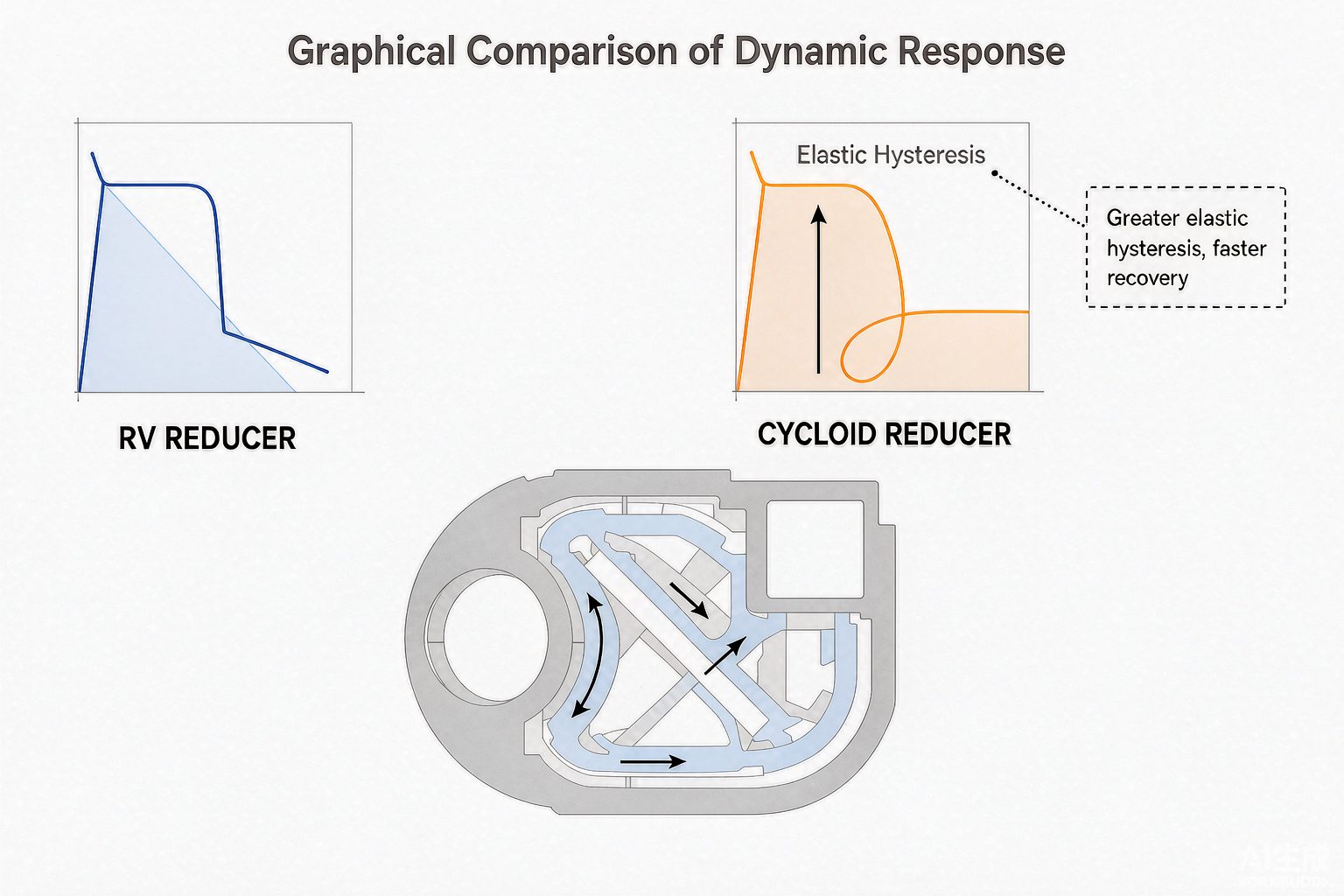
The RV vs cycloid reducer decision isn’t about declaring a winner—it’s about aligning mechanical philosophy with operational reality. RV reducers deliver unmatched rigidity and precision for repeatable, high-speed robotic motion. Cycloid reducers bring rugged, distributed-load resilience ideal for harsh, high-impact environments. At HDB Motor, both technologies are engineered to exacting ISO and JIS standards—and seamlessly integrate with our stepper, BLDC, and hybrid motion systems. To determine which solution best fits your next heavy-duty automation project, contact HDB Motor for application engineering support and custom sizing assistance.