
 Русский
HDBMOTOR Stepper Drive Control Modes: How to Choose the Best Option for Your Application
When searching for the right stepper drive, understanding HDBMOTOR stepper drive control modes is essential for optimizing your system’s performance. HDBMOTOR offers advanced stepper drive technology that supports multiple control modes including position, velocity, and torque control. This article explains these control modes in detail to help you select the perfect HDBMOTOR drive for your motion control needs.
What Are HDBMOTOR Stepper Drive Control Modes?
Control modes define how the drive commands the stepper motor to move. With HDBMOTOR, each stepper motor can be operated under various control modes such as pulse control, analog control, fieldbus communication, and standalone operation. These modes cover a wide range of industrial applications, ensuring flexibility and precision.
1. Pulse Control Mode: Traditional and Reliable
Pulse control is the most traditional and widely used method to command a stepper motor in both position and velocity control. The motor’s rotation length corresponds to the number of pulses received, while the speed depends on pulse frequency.
Common Pulse Control Types
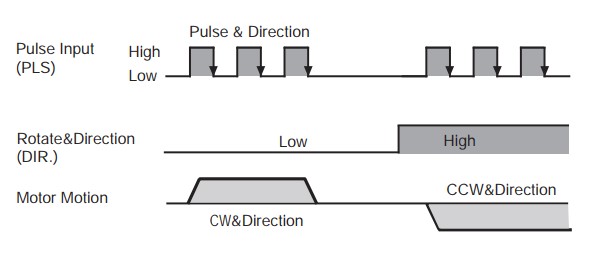
Pulse & Direction: The motor moves one step clockwise (CW) or counterclockwise (CCW) depending on the DIR input state when a pulse is received.
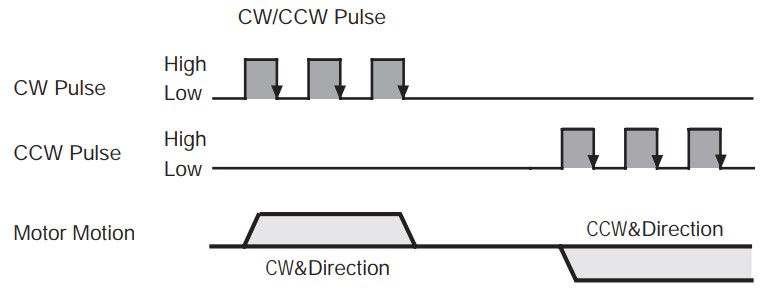
CW/CCW Pulse: Separate inputs (X1 and X2) command steps in clockwise or counterclockwise directions.
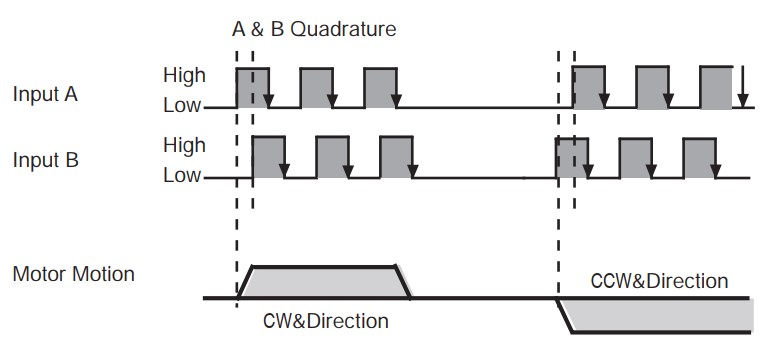
A/B Quadrature: Uses two-channel incremental encoder signals to control motor movement, with direction determined by which channel leads.
2. Analog Control Mode: Smooth and Precise
HDBMOTOR stepper drives accept analog signals to control position, velocity, or torque. Analog control provides an intuitive way to regulate motor speed or torque by varying voltage or current inputs.
3. Fieldbus Control: Seamless Industrial Communication
HDBMOTOR supports all popular industrial network protocols such as RS-485, Modbus, CAN, Ethernet, and EtherCAT. Fieldbus control enables integration into complex automation systems with real-time data exchange and command execution.
4. Standalone Operation Mode: Intelligent and Flexible
HDBMOTOR’s built-in Q drive controller allows standalone single-axis operation through stored sophisticated programs. It supports up to 744 lines of Q programs stored in non-volatile memory. Programs are created via Q Programmer software, enabling multitasking, analog/digital parameter calculations, conditional logic, and data register manipulation using an easy text-based language.
This mode is ideal when you want to minimize reliance on external controllers and simplify wiring.
Why Choose HDBMOTOR Stepper Drive Control Modes?
Versatility: Multiple control modes cover diverse industrial needs.
Flexibility: Support for all major industrial networks.
Precision: Accurate position, velocity, and torque control.
User-Friendly: Easy programming and configuration with dedicated software.
Reliability: Robust hardware with advanced drive algorithms.
How to Select the Right HDBMOTOR Stepper Drive Control Mode?
Define Your Application Needs: Positioning accuracy, speed, torque requirements.
Consider Communication Requirements: Do you need fieldbus integration or standalone control?
Evaluate Control Signal Availability: Pulse, analog signal, or network command.
Check Software Support: Ease of programming and parameter configuration.
For detailed product specifications and to explore the full HDBMOTOR stepper drive portfolio, visit HDBMOTOR official website or learn more about related products in our Stepper Motor Series.
Summary
Understanding HDBMOTOR stepper drive control modes helps you optimize your motion control system for better performance and efficiency. Whether you need traditional pulse control, smooth analog control, robust fieldbus communication, or standalone operation, HDBMOTOR offers a solution tailored to your needs.
Feel free to contact our sales team for personalized recommendations and quotation requests to accelerate your project success.
Recommended Articles:
What Is a Stepper Motor & How Does It Work?
Stepper Motor Continuous Jitter When Returning to Origin
Top 8 Features of Hybrid Stepper Motors You Should Know
How to Select a Better Extruder Stepper Motor