
 Русский
Differences Between Hall Sensors and Incremental Encoders
Hall sensors and incremental encoders are both motion-detection components used for measuring position and speed. However, their working principles, accuracy, application scenarios, and cost structure differ significantly. Understanding these differences is essential when selecting feedback devices for motors and motion-control systems.
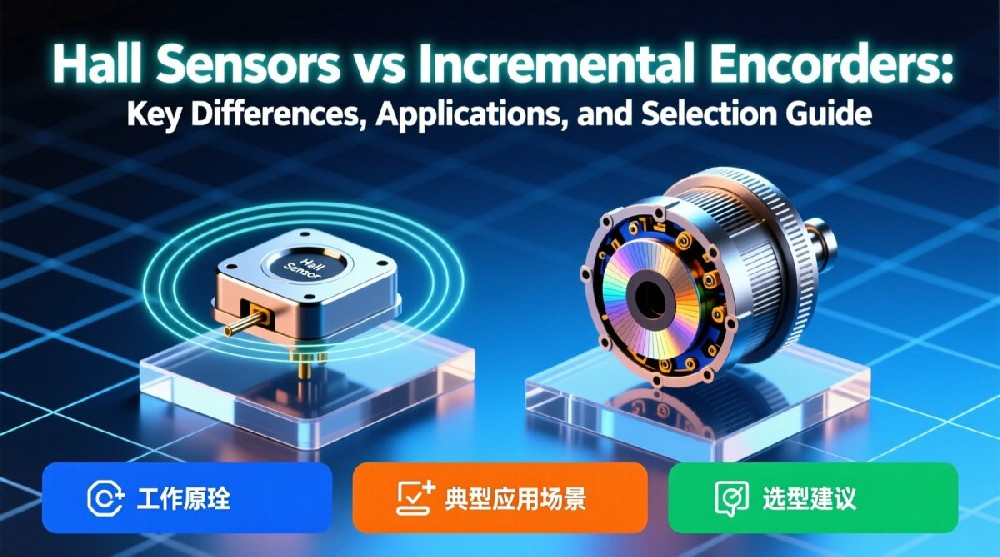
Hall Sensors
A Hall sensor is a magnetic sensor based on the Hall effect. When a magnetic field approaches the sensor, it outputs a digital electrical signal. In motor control applications, two or three Hall sensors are typically embedded inside the stator. As the permanent-magnet rotor rotates, the magnetic field triggers the sensors in sequence, generating three square-wave signals with 120° electrical phase shift.
Hall sensors offer advantages such as low cost, simple circuitry, high reliability, and insensitivity to dust or oil contamination. However, their limitations are also clear:
Very low position accuracy. Hall sensors can only detect the rotor’s magnetic pole sector. A motor with 4 pole pairs has only 24 discrete positions per revolution.
Low-speed measurement error because speed depends on timing of digital transitions.
No absolute initial position; a startup alignment procedure is required.
In simple terms, a Hall sensor divides rotation into large sectors. It can detect which sector the rotor is in, but not the exact angle inside that sector.
Incremental Encoders
An incremental encoder uses an internal optical or magnetic code disk to convert rotation into electronic pulse signals. The disk contains finely spaced patterns. During rotation, the sensor outputs two pulse channels, A and B, with a 90° phase shift, enabling direction detection.
Position is obtained by counting pulses, and speed is derived from pulse frequency. A Z-index pulse is generated once per revolution to serve as a reference point.
Incremental encoders offer:
High precision and resolution, from hundreds to tens of thousands of PPR.
Fast dynamic response, ideal for real-time closed-loop control.
But they also have drawbacks:
Higher cost
Possible accumulated error if pulses are lost
Require re-homing after power-off
Conceptually, an incremental encoder is like a precision ruler without an absolute zero mark—it measures changes accurately but needs a reference point.
Comparison Between Hall Sensors and Incremental Encoders
| Feature | Hall Sensor | Incremental Encoder |
|---|---|---|
| Working Principle | Detects magnetic field polarity changes (Hall effect) | Detects optical or magnetic grid pulses with 90° phase shift |
| Output Signal | Three digital signals 120° apart | A/B quadrature pulses + Z-index |
| Accuracy / Resolution | Very low | High to extremely high |
| Function | Commutation and rough speed control | Precise speed and position feedback |
| Power-On Initial Position | Requires alignment | Requires Z-pulse reference |
| Cost | Low | Medium to high |
| Typical Applications | BLDC fans, UAV propellers, tools, pumps | Robotics, CNC, servo motors, precision conveyors |
| System Complexity | Simple | Higher due to pulse processing |
Sensor Selection Strategy for Motion Control
When to Choose Hall Sensors
Low-accuracy applications such as BLDC commutation for fans, drones, and home appliances.
Cost-sensitive mass production where simple circuitry and durability are priorities.
When to Choose Incremental Encoders
High-precision closed-loop systems like servo motors, CNC machinery, and industrial robots.
High-resolution, real-time feedback for dynamic motor control.