
 Русский
Troubleshooting Closed-Loop Stepper Motor Position Error Exceeded
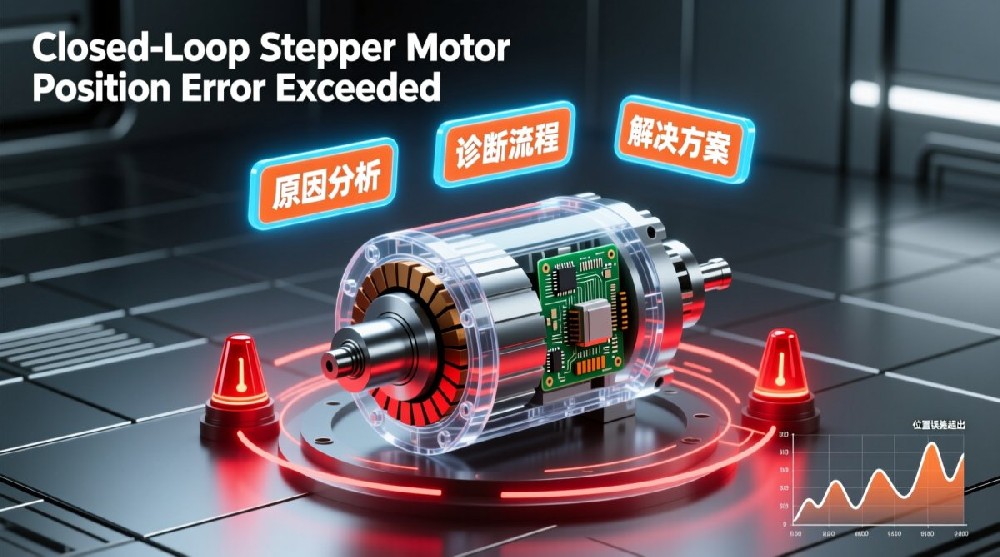
When a closed-loop stepper motor shows a position error exceeded alarm, it is usually caused by mechanical issues, electrical problems, encoder faults, or improper parameter settings. The following guide provides a complete troubleshooting process and explains the most common root causes.
1. Mechanical System Issues
Excessive Load or Mechanical Jamming
If the motor torque is insufficient to overcome mechanical resistance—such as tight guide rails, worn gears, over-tightened belts, or sliding friction—the motor may lose steps and trigger a position error.
Mechanical Resonance
At specific speeds, mechanical resonance can cause vibration, instability, or step loss.
Loose Transmission Components
Loose couplings, belts, or lead screws may cause slipping, resulting in a mismatch between the actual position and encoder feedback.
2. Motor and Driver-Related Problems
Insufficient Motor Torque
Incorrect motor selection or low driver current settings may prevent the motor from properly driving the load.
Incorrect Driver Parameters
Overly high microstepping: Excessive microsteps decrease high-speed torque and may cause dynamic step loss.
Improper current or speed-loop settings: Unoptimized PID parameters may cause slow response or overshoot.
Driver Hardware Failure
Damaged driver circuits can cause abnormal output and unstable operation.
3. Encoder or Feedback System Issues
Encoder Signal Interference
Poor wiring, damaged shielding, or electromagnetic noise may distort feedback signals.
Encoder Damage or Misalignment
Faulty sensors or poor concentricity can cause inaccurate feedback.
Encoder Resolution Mismatch
If the resolution settings between the driver/controller and encoder do not match, position deviation errors occur.
4. Control Signal Problems
Pulse Frequency Too High
Exceeding the motor’s maximum response frequency may lead to lost pulse commands.
Control Signal Interference
Unshielded long-distance pulse/dir lines are vulnerable to EMI, causing incorrect command input.
Controller Output Errors
PLC or motion controller programming mistakes may output incorrect pulse signals.
5. Improper Motion Parameter Settings
Acceleration/Deceleration Too Aggressive
If the acceleration exceeds the motor’s load capability, dynamic step loss occurs.
Position Error Threshold Too Small
Over-sensitive error tolerance may cause frequent alarms during normal fluctuations.
Unoptimized Closed-Loop Parameters
PID parameters in the position loop may not match the load characteristics.
6. Power Supply and Environmental Factors
Unstable Voltage
Power fluctuations or insufficient supply capacity can reduce motor torque.
Temperature Issues
Overheating in the motor or driver can degrade performance.
External Vibration or Shock
Strong vibration may cause mechanical shifts or encoder misjudgment.
7. Software or Firmware Problems
Control Algorithm Flaws
Issues such as integral wind-up or insufficient delay compensation may cause instability.
Outdated Firmware
Driver or controller firmware may have compatibility issues and require updates.
Step-by-Step Troubleshooting Procedure
Mechanical Inspection
Ensure the load rotates smoothly by hand; check the tightness of couplings, belts, and screws.Electrical Testing
Measure driver output current; use an oscilloscope to verify encoder signal stability.Parameter Verification
Check motor current, microstepping, acceleration/deceleration times, and test with reduced speed.Interference Check
Use shielded cables, ensure proper grounding, and avoid interference from high-power equipment.Component Replacement Test
Swap the motor, driver, or encoder to confirm whether hardware is faulty.
Solutions for Closed-Loop Stepper Motor Position Error Exceeded
Optimize Mechanical Structure
Reduce friction, reinforce transmission components, and install dampers to suppress resonance.
Adjust Driver Parameters
Increase current, reduce microstepping, and optimize closed-loop PID settings.
Strengthen Anti-Interference Measures
Use twisted-pair shielded cables and magnetic rings to improve noise immunity.
Reconfigure Motion Parameters
Extend acceleration time and appropriately increase the position error threshold.
If the closed-loop stepper motor continues to show “position error exceeded,” it is recommended to contact the equipment manufacturer or use professional diagnostic tools for further analysis.