
 Русский

Brushed vs Brushless DC Motors: What Really Drives Long-Term Value?
In precision motion-control applications — from automated lab equipment to packaging machinery and robotic joints — the choice between brushed and brushless DC (BLDC) motors impacts more than just initial cost. It shapes system reliability, energy consumption, electromagnetic compatibility (EMI), service intervals, and total cost of ownership over years of operation. For engineers specifying motors at the design stage, understanding the trade-offs around brush wear, EMI generation, maintenance frequency, efficiency curves, and lifecycle cost is essential — not theoretical.
The Core Difference: Commutation Method Defines Everything
At its heart, the distinction lies in how current is delivered to the motor’s rotor windings:
- Brushed DC motors use physical carbon or graphite brushes sliding against a commutator to switch current direction as the rotor spins. This mechanical switching creates inherent friction, arcing, and wear.
- Brushless DC motors eliminate brushes entirely. Instead, electronic controllers (drivers) precisely time current delivery to stationary stator windings using rotor position feedback — typically from Hall-effect sensors or sensorless algorithms. This enables smoother, more efficient, and far more controllable rotation.
This fundamental difference cascades into measurable performance and operational consequences — especially in demanding, continuous-duty environments.
Brush Wear: The Silent Failure Mode of Brushed Motors
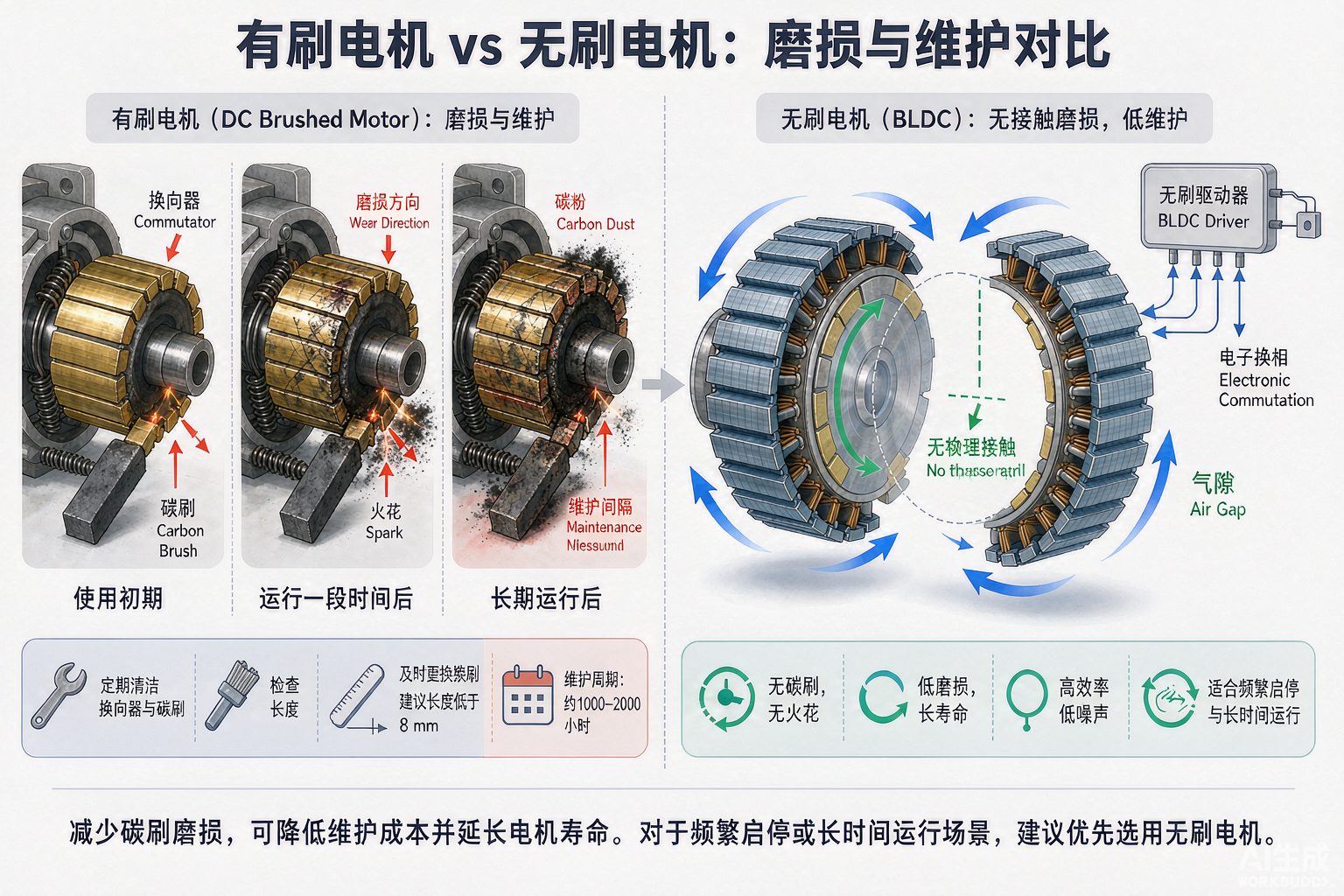
Brush wear is the single most predictable failure mechanism in brushed DC motors. As brushes slide across the copper commutator, they erode gradually — generating conductive dust, heat, and voltage spikes. Over time, this leads to:
- Increased electrical resistance and inconsistent torque delivery
- Commutator pitting and grooving, requiring resurfacing or replacement
- Intermittent contact causing speed fluctuations or stall conditions
- Eventual open-circuit failure when brush material depletes
Typical brushed motor life spans range from 1,000 to 5,000 operating hours — heavily dependent on load, speed, ambient temperature, and duty cycle. In contrast, brushless DC motors have no wearing commutation components. Their rated life is often defined by bearing wear (typically 10,000–20,000+ hours) and thermal degradation of magnets or windings — both far more gradual and predictable. When paired with high-precision planetary gearboxes — like our Planetary Reduction BLDC Motor — the entire assembly maintains consistent output torque and positioning accuracy over thousands of cycles without scheduled brush replacement.
Efficiency: Where BLDC Gains Compound Over Time
Brushed motors suffer multiple efficiency losses:
- Brush contact resistance (0.5–2 V drop under load)
- Frictional losses from brush-commutator interaction
- Commutation losses due to arcing during switching
As a result, typical peak efficiency for brushed DC motors sits between 70% and 80%. BLDC motors avoid all three losses. With optimized winding layouts, low-resistance MOSFET drivers, and precise field-oriented control, modern BLDC designs achieve peak efficiencies of 85%–92% — and maintain high efficiency across a broader speed-torque range.
That 10–15 percentage point gain isn’t trivial. In a continuously operating conveyor drive drawing 200 W, upgrading from 75% to 90% efficiency saves ~30 W per hour — over 260 kWh annually. Multiply that across dozens of axes in a production line, and energy savings quickly offset the higher upfront cost of BLDC systems. To explore how these gains translate across applications, see our our Brushless DC Motors guide.
EMI: A Critical Consideration for Sensitive Electronics
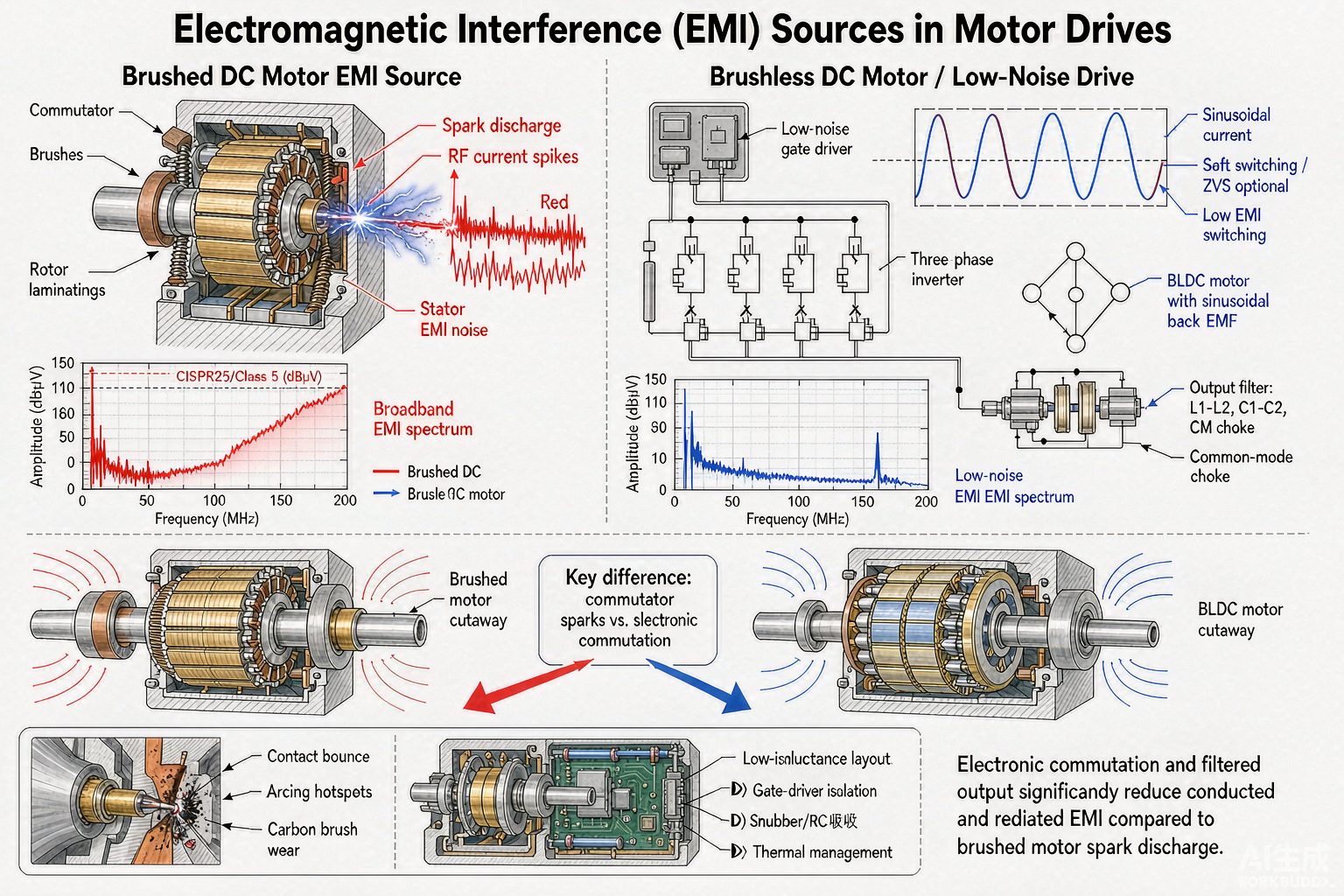
Brushed motors are notorious sources of electromagnetic interference (EMI). Each time a brush breaks contact with a commutator segment, it generates micro-arcs — broadband radio-frequency noise spanning kHz to MHz. This noise couples into nearby sensors, PLCs, vision systems, and communication buses, causing signal corruption, false triggers, or data loss.
While external filtering (capacitors, ferrites, shielded cables) can mitigate EMI, it adds cost, complexity, and space requirements — and rarely eliminates it fully. BLDC motors, by contrast, produce significantly lower EMI because commutation is controlled electronically with minimal arcing. Noise is largely confined to the driver’s switching frequency (typically 10–100 kHz) and harmonics — making it easier to filter and contain. This makes BLDC ideal for medical devices, semiconductor handling, and collaborative robotics where electromagnetic cleanliness is non-negotiable.
Maintenance: Downtime vs Predictability
Brushed motors demand regular, hands-on maintenance:
- Brush inspection and replacement every 500–2,000 hours
- Commutator cleaning and occasional turning
- Re-lubrication of bearings (if not sealed)
- Periodic alignment checks to prevent uneven brush wear
Each intervention requires machine shutdown, trained personnel, spare parts inventory, and documentation — all contributing to unplanned downtime and labor cost. BLDC motors shift maintenance from reactive to predictive. With no brushes to replace, routine tasks reduce to verifying mounting integrity, checking thermal performance, and validating encoder or Hall-sensor signals. Many HDB BLDC systems integrate diagnostics — such as overtemperature alerts or current anomaly detection — enabling condition-based servicing. For deeper insight into how control strategy affects longevity and serviceability, read our Sensorless vs Hall-Sensor BLDC Commutation: Pros and Cons.
Lifecycle Cost: Looking Beyond the Price Tag
A common misconception is that brushed motors are “cheaper.” While their unit cost may be lower, lifecycle cost tells a different story:
- Energy cost: Higher inefficiency → greater electricity spend over time
- Maintenance labor & parts: Frequent brush changes, commutator servicing, and associated downtime
- Failure risk: Unplanned stoppages disrupt production schedules and impact SLA compliance
- Design overhead: EMI mitigation, cooling provisions, and mechanical accommodations for brush access
When modeled over 5–10 years, BLDC systems — particularly integrated solutions like our Brushless DC Motors — consistently deliver lower TCO in medium-to-high duty-cycle applications. That’s why leading OEMs increasingly standardize on BLDC for new platform designs — even where brushed alternatives remain technically viable.
When Might Brushed Still Make Sense?
Brushed DC motors retain niche advantages:
- Ultra-low-cost, low-duty applications (e.g., toy actuators, simple fans)
- Situations requiring simple, direct-drive analog control (no controller needed)
- Extremely compact form factors where integrated electronics would compromise size
However, for any application requiring repeatability, long service life, quiet operation, or integration with digital control networks, BLDC is now the default engineering recommendation. And if your application demands high torque at low speed, consider pairing a BLDC motor with a precision gearbox — our Planetary Reduction BLDC Motor delivers up to 100:1 reduction ratios with sub-arcminute backlash and >90% transmission efficiency.
Choosing the Right Motor Technology for Your Application
Selecting between brushed and brushless isn’t just about motor specs — it’s about aligning with your system architecture, maintenance infrastructure, and long-term product roadmap. Engineers also frequently weigh BLDC against stepper motors, especially in open-loop positioning tasks. Our BLDC vs Stepper Motor: When to Use Each in Automation article breaks down torque profiles, control complexity, resonance behavior, and thermal management trade-offs to help you decide confidently.
For those just beginning to implement BLDC technology, our BLDC Speed & Torque Control Basics for Beginners walks through key concepts like PWM frequency selection, current limiting, and closed-loop feedback options — all grounded in real-world HDB motor performance data.
Frequently Asked Questions
Do brushless DC motors require a controller?
Yes — absolutely. Unlike brushed motors, which run directly from a DC voltage source, BLDC motors need an electronic controller (driver) to sequence current through the stator windings based on rotor position. This is non-negotiable for operation and enables precise speed, torque, and position control.
Can I replace a brushed motor with a BLDC motor in an existing design?
Often yes — but it requires careful re-engineering of the power stage, control interface, and possibly mechanical mounting. HDB offers scalable BLDC solutions with standardized footprints and configurable feedback options to ease retrofitting. Contact our application engineers early in the process to evaluate compatibility and optimize the transition.
How does thermal management differ between brushed and brushless motors?
Brushed motors concentrate heat at the commutator-brush interface — a localized hot spot that’s hard to cool effectively. BLDC motors distribute heat more evenly across the stator laminations and housing, allowing better conduction and convection paths. Many HDB BLDC models include thermal sensors and derating curves to support intelligent thermal management in embedded systems.
Conclusion
Brushed DC motors served industry well for decades — but their mechanical commutation imposes unavoidable limits on efficiency, reliability, and electromagnetic compatibility. Brushless DC motors represent a mature, high-performance alternative that delivers measurable improvements across brush wear, EMI, maintenance burden, and total lifecycle cost. Whether you’re designing next-generation automation equipment or upgrading legacy systems, evaluating BLDC — especially integrated, precision-engineered solutions like those in our all HDB motor products portfolio — is a strategic investment in performance, uptime, and sustainability. Contact HDB Motor today to discuss your specific motion-control challenge with our technical team.