
 Русский
Motor Torque Calculation Formula: Complete Guide with Practical Example
The Motor Torque Calculation Formula is essential for engineers working with servo motors, stepper motors, and general electric motors. Whether you are designing automation equipment, CNC machinery, robotics, or motion control systems, understanding torque requirements ensures the selected motor can achieve the target acceleration, speed, and load performance.
This article explains the Motor Torque Calculation Formula in clear steps, using a real calculation example. It also covers related formulas, such as the servo motor torque calculation formula, the electric motor torque calculation formula, and the general formula for calculating torque of a motor. These principles apply when evaluating NEMA stepper motors, servo drives, industrial DC motors, or any motor-driven mechanism.
1. Why the Motor Torque Calculation Formula Matters
Every motor must produce enough torque to:
accelerate a rotating mass
overcome friction
maintain its rated speed
reach the target speed of a motor within a required time
support mechanical loads safely
If torque is insufficient, the motor may stall, fail to reach speed, or operate inefficiently. This is why engineers rely on the Motor Torque Calculation Formula before selecting a suitable motor.
2. Standard Formula for Calculating Torque of a Motor
The universal formula for calculating torque of a motor during acceleration is:
Torque = Moment of inertia × Angular acceleration
This same method applies to:
servo motor torque calculation formula
electric motor torque calculation formula
stepper and brushless motor torque estimation
To demonstrate how this works, we use a real calculation problem below.
3. Real Calculation Example
Problem:
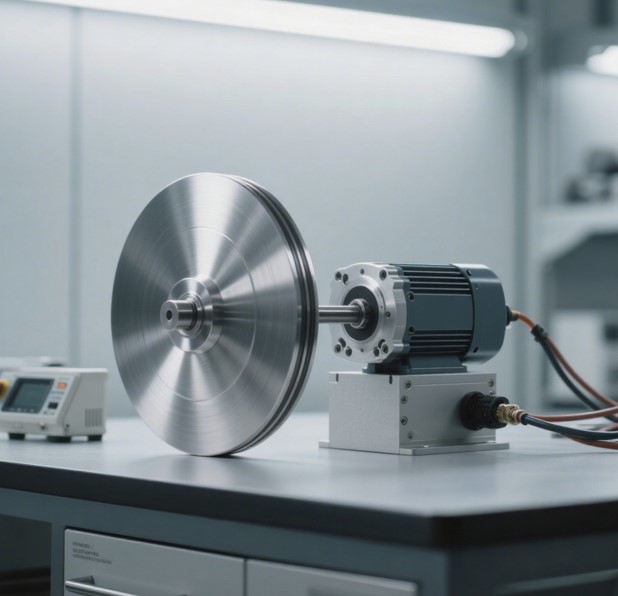
What torque is required to accelerate a flywheel (50 g, radius 4 cm) from 0 to 3000 rpm in 1 second?
This is a typical engineering motor torque calculation formula problem used when sizing motors for rotating loads.
Step 1: Unit Conversion
Mass: 50 g → 0.05 kg
Radius: 4 cm → 0.04 m
Final speed: 3000 rpm → approx. 314.159 rad/s
Initial speed: 0 rad/s
Time: 1 second
Step 2: Moment of Inertia
Assume the flywheel is a uniform solid disk.
Moment of inertia = 1/2 × mass × radius²
radius² = 0.04 × 0.04 = 0.0016
mass × radius² = 0.05 × 0.0016 = 0.00008
moment of inertia = 0.5 × 0.00008 = 0.00004 kg·m²
Step 3: Angular Acceleration
Angular acceleration = change in angular speed ÷ time
Angular acceleration ≈ 314.159 rad/s²
Step 4: Torque Calculation
Torque = 0.00004 × 314.159
Torque ≈ 0.0126 N·m
Also:
0.0126 N·m = 12.6 mN·m
This means the motor must deliver at least 12.6 mN·m to meet the required acceleration.
4. Engineering Interpretation
In real applications, additional torque is needed for:
friction
air resistance
mechanical coupling
safety factors
peak-load startup conditions
Therefore, engineers typically add 20–50% torque margin depending on system requirements.
This principle is used in:
servo motor torque calculation formula for high-speed positioning
electric motor torque calculation formula for industrial drives
stepper motor load estimation
inertia matching for servo drive systems
5. Where the Motor Torque Calculation Formula Is Commonly Used
This formula is widely used in industries involving:
CNC routers and laser machines
3D printers and automation lines
robotics joints
conveyor systems
precision motion control equipment
Engineers rely on these torque calculations to ensure the chosen motor can reach both the acceleration rate and the final rated speed safely.
6. Summary
The Motor Torque Calculation Formula provides a universal way to determine the torque needed for accelerating any rotating load. Understanding this formula helps you choose the right motor, ensure reliable operation, and optimize performance across servo motors, stepper motors, and electric motors.