
 Deutsch
 한국어
한국어
NEMA 17 vs NEMA 23 vs NEMA 34 Stepper Motors
Stepper motors play a vital role in precision motion control across industries such as 3D printing, CNC machining, and automation equipment. Selecting the proper stepper motor model is essential to achieve the desired performance and efficiency. Among the commonly used motors, NEMA 17, NEMA 23, and NEMA 34 sizes dominate due to their versatility and range of torque outputs. This article explains the 7 key differences and typical applications of these motors to guide your selection process.
What is the NEMA Standard?
The National Electrical Manufacturers Association (NEMA) is a U.S.-based organization that defines standards primarily for motor mounting dimensions. The numbers in NEMA stepper motors, like 17, 23, and 34, indicate the motor’s flange size in inches — the front face of the motor that mounts onto your equipment.
Size Differences of NEMA 17, NEMA 23, and NEMA 34
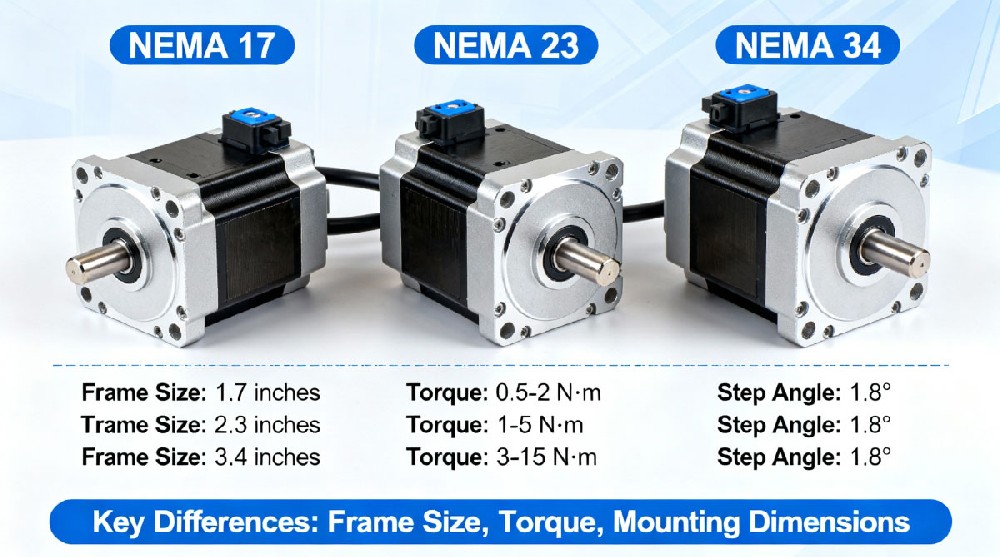
NEMA 17: Flange size of 1.7 inches (approximately 43.2 mm)
NEMA 23: Flange size of 2.3 inches (approximately 58.4 mm)
NEMA 34: Flange size of 3.4 inches (approximately 86.4 mm)
Typically, as the flange size increases, so do the motor’s physical volume, weight, torque, and power output.
Torque and Performance Comparison
NEMA 17: Offers relatively low torque, generally between 0.2 to 0.5 Nm, suitable for light loads demanding high precision, such as 3D printers and desktop automation.
NEMA 23: Provides medium torque, usually 0.5 to 2.0 Nm, ideal for moderate loads including laser cutters, CNC mills, and industrial automation equipment.
NEMA 34: Delivers high torque, typically above 2.0 Nm, designed for heavy-duty industrial applications like large CNC machines and industrial robots.
Typical Applications
NEMA 17
Due to its compact size and precise control, NEMA 17 motors are widely used in 3D printers, photolithography equipment, small robots, and medical devices that require light load handling.
NEMA 23
These motors fit medium-load machines such as laser engravers, CNC routers, and automated assembly lines, making them prevalent in industrial automation.
NEMA 34
NEMA 34 motors are best suited for applications requiring high torque and sustained power, including large CNC machines, industrial robots, and heavy machinery capable of handling substantial loads.
Other Technical Parameters to Consider
Besides flange size and torque, other important factors include step angle, rated current, shaft diameter, and overall weight. These parameters influence the motor’s performance and compatibility with your system. Always review detailed datasheets and consider your specific application requirements before finalizing your choice.
NEMA 17 vs NEMA 23 vs NEMA 34: Quick Comparison
| Motor Size | Flange Size | Typical Torque | Typical Weight | Typical Speed Range | Typical Applications | Recommended Scenarios |
|---|---|---|---|---|---|---|
| NEMA 17 | 1.7 in (42/43 mm) | 0.2–0.5 Nm | Light | Suitable for light-load, moderate-speed motion | 3D printers, medical devices, small robots, desktop automation | Choose when compact size and precise positioning matter more than high torque |
| NEMA 23 | 2.3 in (57/58 mm) | 0.5–2.0 Nm | Medium | Balanced for torque and speed in general industrial use | CNC routers, laser machines, packaging equipment, assembly systems | Choose when you need a versatile motor for medium-load automation tasks |
| NEMA 34 | 3.4 in (86 mm) | Above 2.0 Nm | Heavy | Designed for heavy-load, high-torque applications | Large CNC machines, industrial robots, heavy-duty automation equipment | Choose when load capacity, holding torque, and continuous output are the priorities |
Note: Actual torque, speed, and weight vary by motor length, current, winding design, and driver matching.
How to Choose the Right Stepper Motor?
Load Requirements: Torque and continuous operating capacity needed for your application.
Space Constraints: Available mounting space and weight limitations.
Precision Needs: Required step angle and motion control accuracy.
Electrical Parameters: Rated voltage, current, and driver compatibility.
Budget: Cost differences among motor sizes and models.
Frequently Asked Questions
Can I replace a NEMA 17 motor with a NEMA 23 or NEMA 34 motor?
Not directly in most cases. Although a larger motor may provide higher torque, you must also check mounting dimensions, shaft size, driver current, power supply, and available installation space before replacing one motor size with another.
How do I match the right driver with a stepper motor?
The driver should be selected based on the motor’s rated current, voltage range, phase configuration, and required motion performance. In practical applications, proper driver matching is essential to achieve stable running, avoid overheating, and maintain torque at the target speed.
Can stepper motors be customized for OEM projects?
Yes. Many OEM and industrial projects require customization such as shaft length, shaft type, cable and connector, encoder integration, brake, gearbox, or waterproof protection. Customization helps ensure the motor fits both the mechanical structure and the electrical control system of the machine.
Can you provide samples and technical support?
For project evaluation and qualification, sample support, datasheets, and basic technical consultation can help customers confirm motor suitability before mass purchase. This is especially useful for CNC, robotics, and automation equipment development.
Conclusion
Need help choosing between NEMA 17, NEMA 23, and NEMA 34? Send us your load, speed, voltage, and installation space, and we will recommend the right stepper motor with datasheet and quotation support.We support custom shaft length, cable length, encoder, brake, and mounting options for OEM projects.
Need Help Selecting the Right Motor?
If you are comparing NEMA 17, NEMA 23, and NEMA 34 for your machine, we can help you choose the right model based on torque, speed, mounting size, and application requirements.
Request Datasheet Get a Quote Ask for Custom Motor
Recommended Articles:
Electric Stepper Motor Terminolog
Stepper Motor Selection Parameters: 7 Key Factors You Must Know