Русский
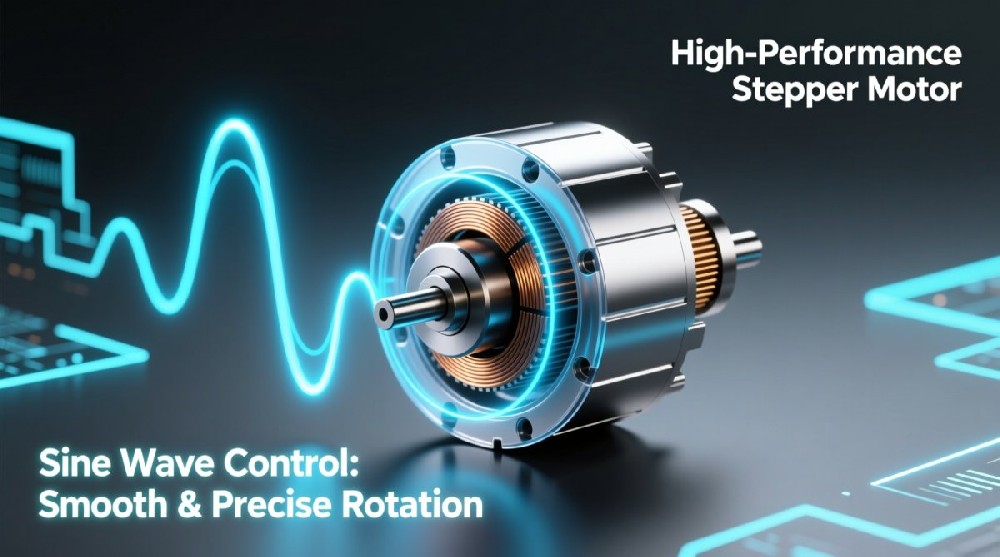
Stepper Motor Sinusoidal Control: Achieving Smooth Rotational Motion
Stepper motors are widely used in various applications due to their precise control and reliability. One interesting application is making a stepper motor rotate according to a sine wave pattern. This technique not only enhances the smoothness of motion but also allows for more complex movement profiles. This article will outline the core principles and implementation methods for sinusoidal control of stepper motors, ensuring compliance with Google SEO best practices.
Core Principle of Stepper Motor Sinusoidal Rotation
1. Generation of a Sinusoidal Speed Curve
The first step in achieving sinusoidal rotation is to generate a sinusoidal speed curve. This curve can be mathematically modeled using the sine function:
v(t) = Vmax · sin(2πft)
Where:
Vmax is the maximum motor speed (in steps per second).
f is the frequency of the sine wave (in Hertz).
By discretizing time into small intervals Δt, we can calculate the speed at each time step:
tn = n · Δt
2. Synchronous Direction Control
The direction of the motor's rotation is dictated by the sine wave's positive and negative halves:
During the positive half-cycle (where
v(t) > 0), the motor rotates forward.During the negative half-cycle (where
v(t) < 0), the motor rotates in reverse.
3. Improving Motion Smoothness
To enhance motion smoothness, consider using microstepping. This technique allows smaller steps for the motor, reducing the jerky sensation typically associated with stepping motors. Increasing the step pulse frequency also aids in achieving smoother motion that closely follows the desired sinusoidal trajectory.
Steps to Realize Sinusoidal Rotation
Step 1: Generate a Sinusoidal Speed Curve
Develop a sinusoidal speed function and compute the values at small intervals. The discretized speed values can be converted into step pulse frequency output (PPS) as follows:
PPS(tn) = v(tn) · stepsper_rev
Where:
stepsper_rev is the motor’s step angle resolution.
Step 2: Stepper Motor Control
Speed Command Mapping: Calculate the PPS based on the computed speed values.
Rotation Direction Control: Adjust the motor's direction in real-time based on the sign of
v(tn).
Step 3: Real-Time Control with Microcontroller
Using an Arduino, the code will dynamically calculate speed and adjust the step interval using the delayMicroseconds() function for smooth acceleration and deceleration. Below is a simplified code example:
#include <Stepper.h>


const int steps_per_rev = 200; // Steps per revolution

const float Vmax = 5.0; // Max speed in rps

const float frequency = 0.5; // Frequency in Hz

Stepper myStepper(steps_per_rev);

float delta_t = 0.01; // Time increment


void setup() {

    myStepper.setSpeed(100); // Set initial speed

}


void loop() {

    for (float t = 0; t < 1; t += delta_t) {

        float speed = Vmax * sin(2 * PI * frequency * t);

        int pps = speed * steps_per_rev; // Convert to PPS

        myStepper.step(pps);

        delayMicroseconds(1000000 * delta_t);

    }

}
Step 4: Optimization and Precautions
Microstepping: Enable microstepping mode on the stepper driver (1/16 recommended).
Timer Interrupts: Use hardware timers for high-speed motions to avoid blocking delays.
Limiting Speed: Ensure
Vmaxdoes not exceed the motor’s maximum PPS.Constrain Acceleration: If the motor does not start or stop smoothly, apply an acceleration constraint like an S-curve.
Hardware Connection for Sinusoidal Rotation
To implement sinusoidal rotation, connect the stepper motor driver to the microcontroller. The driver’s DIR pin receives direction signals, while the STEP pin receives pulse signals. Ensure the driver is powered correctly to match the motor’s voltage specifications.
Additional Enhancements
Precomputed Sine Tables: Precompute and store arrays of sinusoidal speed curve values to reduce real-time computational load.
Closed-Loop Feedback Control: Install a rotary encoder for real-time position feedback and apply a PID control algorithm to adjust the motor’s movement, ensuring the actual motion trajectory closely follows the theoretical sine curve.
Conclusion
By following the methods outlined above, you can successfully control a stepper motor to track a sinusoidal velocity curve, allowing for smooth and precise rotational motion. Implementing these techniques not only enhances motor performance but also opens up new possibilities for dynamic applications in automation and robotics.